Follow Me on Twitter!

Find me on twitter @TroyComets
Showing posts with label identity. Show all posts

Tuesday, March 29, 2016

The Fosters and Faith

Have you watched The Fosters?

It is a family oriented show for modern families which debuted on what was ABCFamily in 2013.  It’s now one of the flagship series for Freeform, the latest incarnation of what started as the Family Channel back in cable’s hayday.

I remember the buzz about it.  I hadn’t looked into it too much.  But because I knew a lot of people connected with the foster system I thought I would check it out.  So, picture it:  The premiere episode.  We meet a lesbian couple—a white cop and a biracial educator from a charter school—Brandon, the biological son of the cop, who, by the way, is still working with her ex-husband, the father of her child, on the police force, and the couple’s two adopted Latino children. Jesus and Mariana.  Then we meet Callie, a child they literally rescue from the absurdity of a foster system that has grown so large and so underfunded.  Eventually we meet Callie’s brother, Jude, who falls in love with one of his athletic classmates at the charter school and begins to identify as gay. 

Like I said:  A family oriented show for modern families. 

It was a dynamic premise for a forty something minute TV series.  There was always something going on relationship-wise with the kids, parenting-wise for Steff and Lena (the couple who have taken responsibility for this brood), and identity-wise for everyone.  The show has dealt with topics such as racism, addiction, sexuality, faithfulness, healthy boundaries, mental health, cancer, and…religion.

This poor family has dealt with more in three years than many families deal with in eighteen. 

And that’s where I’ve kind of settled on the show this season.  It just seemed that everything the writing team was throwing at the family was just too much.  Not unbelievable because everyone watching could identify with the struggles and challenges.  It was just becoming overwhelming.  I began to be afraid that either the writers had committed characters to storylines that were becoming weights around the neck of the show or…worse, they were trying to be too many things to too many people and failing everyone in the process.  This is why TV shows have “bibles” that set boundaries on characters and possibilities. 

To me, this season has felt less like a family oriented show for modern families and more like a telenovela of the Mexican variety:  Entertaining but way over the top in storyline and dramatic presentation.   

But then they aired the season finale last night and I remembered why I was first drawn to this show.

So after a season of melodramatic storylines, a painful episode featuring the culmination of a story arc about a Romeo and Juliet musical written by writers who had apparently never read Romeo and Juliet, and a few plotlines that seemed to go on and on like this current election cycle, driving us to a point where we really don’t care about Callie and Brandon and their poor boundaries….we’re punched in the gut with the reality of the foster care system:  Kids being placed in homes that are unqualified to take care of kids and in which the kids end up dead. 

This affects Jude profoundly because right before we learn that Jack, the foster kid who we’ve gotten to know this season, was murdered by the same foster father who had abused Callie and Jude, we see Jack kissing Jude.  Jack later confides in Callie that he felt it was a mistake because he’s not attracted to Jude because he, Jack, is straight.  Jack never has the chance to confess this to Jude. 

So the episode opens with a funeral/prayer service/informal gathering on the beach where Jude is delivering a sermon/eulogy.  This caught my interest right away because it was actually thoughtfully done and the words Jude was using to commend Jack to God’s care were words I’ve heard too many times in real funeral services.  This polished eulogy was coming from someone who has never really struggled with religion in the show’s run.  Jude has never explored it, questioned it, struggled with it.  But his sermon was spot on theologically.  In real life, if Jude was an actual person, one could clearly see that he was taking this seriously and had committed a great deal of thought and research to his reflection. 

So, as a student of religion and theology as well as psychology, I’m turning this scene over and over in my head for the rest of the episode.  I’m wondering where it came from and where it could be going because it was so unpredictable in a show that has become too predictable this season.

Fast forward to the last ten minutes of the show or so.  So, yeah, if you haven’t seen the episode and don’t want to know anymore, maybe you should stop reading now.  This is your warning.

Through the episode we see Jude talking with one of his female classmates and friends.  At one point we hear Jude expressing that maybe he’s not into guys.  Which, of course, the friend picks up on right away since she’s been crushing on Jude for about two seasons now.  But toward the end of the show we see Callie confronting Jude on his interest in the female friend.  Callie is confused because Jude has identified as gay pretty much since they came to this foster home which ended up adopting them.  Jude’s response?

“Maybe I’m not supposed to be gay.  I’ve loved two guys and God has taken them both away.”

I don’t know how other people heard that line but this is how I heard that line.  “I loved a guy named Connor and he moved away and our relationship ended.  I was falling in love with a guy named Jack and he was murdered.  I’m going to interpret this as a sign.  Maybe God is trying to tell me I need to get back on the straight path.”

I write about this a lot.  We story the events in our lives in an attempt to make sense of the things that we can’t explain.  When it comes to tragedy, as a rule, people will cite providential intervention as the reason things happen.  They will interpret that intervention as meaning this or that.  It’s how the individual copes.  I know that.

But here’s what I also know.  My theology informs me that God does not cause horrible things to happen.  God doesn’t need to.  Human beings do that well enough on our own.  God didn’t kill Jack in The Fosters.  The broken system operated by human beings killed Jack.  God certainly doesn’t punish people; that’s superstitious bullshit that should have died out with witch trials.  And God does not take people away from us or tear people away tragically to give us a message.   (I'm mentioning this in the middle of this review of The Fosters because I can't seem to stop reminding people of these important truths--especially a community and a subset of a community who tend to be victimized by such backward Christian nonsense.)

All of a sudden my interest in The Fosters has returned.  What sucks is that it’s from one of the most realistic characters that we don’t get to see too much of because of all the “kids” on the show the actor who portrays Jude is a kid and child labor laws impact his storylines.  But this is what The Fosters needed, I think.  A step away from the over-the-top-never-going-to-end drama of Callie and Brandon, or Jesus and his search for identity which, with a new actor, focused in a direction the character has never looked before (namely his birth father), or Mariana and all her teenage girl drama. 

Once again the show comes back to Jude. 

I don’t know where the writers are going to go with this but it’s pretty clear that in the time that passed between the horrible episode featuring Romeo and Juliet: The Musical and Jack’s tragic death and the season finale with the appearance of Preacher Jude, someone has obviously influenced Jude’s thinking on sexuality and God.  I really hope this is explored more next season because these are very real issues younger folks in the LGBTQ community struggle with.  I think that’s where they’re going considering the kiss Jude shares with his female classmate and the weird smile he has on his face afterwards. 

What do you think? 


Share it forward!

Follow me on Twitter @TroyComets

Monday, March 28, 2016

Boy George, Troye Sivan, and Me

I spend a lot of time puttering around on the internet.  Every morning I get up and start googling random crap and cruising through YouTube subscriptions and trendings.  It inevitably happens.  At some point a search for one specific thing will lead me to something completely different and it will be that something completely different that will unexpectedly educate and inspire me.


Today I ended up on this video on YouTube.  It’s an interview from 1984 between Johnny Carson and Boy George. 

History lesson time.  Before James Corden rode around in a car singing with superstars and Stephen Colbert lampooned newsmakers with mock earnestness, there was an old white guy who sat behind a desk and did some interviews and cracked some jokes.  In the interest of full disclosure I wasn’t a fan.  But a lot of folks tuned in because, really, he was the only game in town until folks like Joan Rivers and Arsenio Hall brought life and variety to the late night talk show arena.  But Carson was kind of the godfather of it all. 

So, picture it.  1984.  The AIDS crisis is evolving.  Ronald Reagan is president and neither he nor his First Lady, Nancy, will acknowledge the crisis because they don’t even want to be associated with the dirty word “homosexual.”  That doesn’t stop religious leaders and conservative politicians from making hay on the suffering of others by demonizing the victims of the disease while declaring “God’s judgment” on “sinful and deviant lifestyles.”

In the midst of this ignorant morass of silence and blame and fear comes…Boy George.


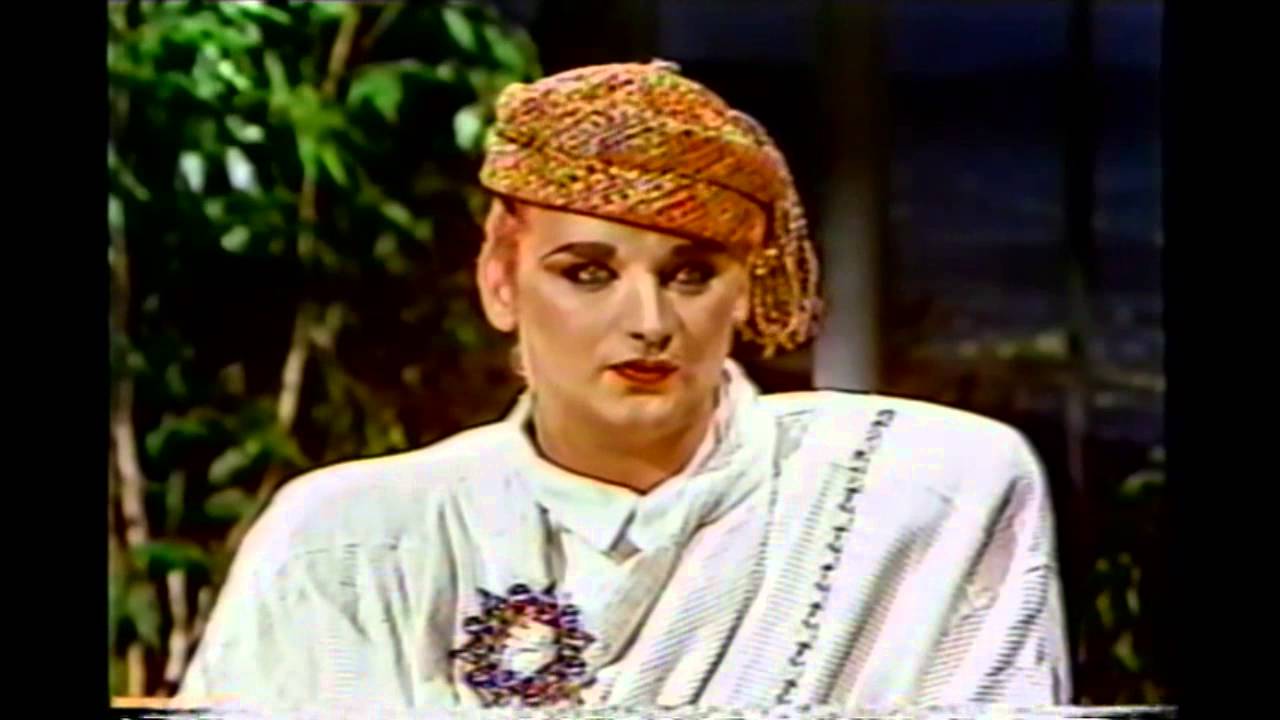
That picture is a screen capture of Boy George from the Johnny Carson interview.  It was the second time he had appeared on Carson’s show but the first time with Carson.  The first time he had appeared the iconic Joan Rivers was hosting.  This is a fact that Boy George jokes about in the interview with Carson by commenting, “The last time I was here you were in drag.”  Carson quickly distanced himself from the joke, clarifying that it had been Joan Rivers and not Carson with whom he had appeared.  If I’m right, this is a picture of Boy George and Joan Rivers from that first appearance. 


So, back to the video of Carson, the old White guy with his sense of humor that seems to ignore other people’s senses of humor, and Boy George sitting on the opposite side of the desk in all of his Boy George glory.  In 1984.  Amidst fear and ignorance.  And remembering that the culture of the UK is usually about 20 years ahead of culture in the US.  So, for Boy George, the smallest things he said or did at home were met with raised brows and anxiety here in the United States. 

Carson introduced Boy George, who comes in and makes the joke about Carson being in drag that Carson finds so repugnant, and then the interview begins.  It’s clear where Carson wants to go with the interview. 

Not long before this appearance Boy George attended the Grammies and made a joke about wondering when they music industry would see a real queen dressed as a drag queen.  Carson brings up the controversy his comment caused and Boy George brushes it aside, pointing out that in the UK you can say things like that and people laugh but in the US it’s basically a big scandal.  This brings up a conversation about “all of the stupid questions” Boy George had been answering since his arrival in LA from LA radio personalities. 

“What are some of the dumb questions they ask so I know which ones to avoid.  I mean, the first one has got to be,” and Johnny Carson makes sweeping gestures with his hands.  “Why do you dress like that?”

You can hear Boy George’s eyes rolling in his answer.  “I’ve answered that one so many times I’m going to avoid that one.”

“Okay, so what are the other questions?”

“Well, basic things like ‘How long does it take to do my makeup?’ you know and just boring things about my childhood.  Which was just the same as anybody else’s really.  Pretty dull.  Pretty boring.  So, Father Christmas, you know, and grazed knees, that kind of stuff.” 

“Yeah, but you can’t blame them, can you, Boy George, for asking those kinds of questions.  Because you are rather controversial.  It is something new that—“

“But after like three years of seeing me you would think people would be a bit used to me by now, you know.  I mean, in a country that has Liberace, I am hardly revolutionary, am I?

And the audience cheers.  But see the difference between Boy George and Liberace is that Liberace’s glam was still masculine.  He still wore tuxes and suits while performing.  So what if they were covered it glitter and sequence?

Johnny Carson continues.  “I’m trying not to be square you see.  I come from the middle of the United States.  State called Nebraska, which is right out in the middle of the country.  Rather conservative.  Now if I was your dad and you came home one day and I didn’t know it and I walked in and saw you as a young man—I guess you were about fifteen or sixteen when you started actually….wearing the make up and the costumes—I wouldn’t know how to react myself.  I think I would be adult enough myself to try to handle it but—“

“What do you got to handle?”

“Well, the effect that you walk in and you see your son dressing with makeup on.  The average person….”

“Okay, well, you’re going to have Halloween in a couple of weeks, you know.  What’s the difference between somebody dressing up for Halloween?  It’s only because people think it’s serious that they get frightened.  They look at me and they say, ‘Well, it’s not a Halloween party.’  So you have to have a reason to dress up.  There is nothing wrong with being different.  Why do you have to have an excuse to enjoy yourself?  You know there are people out there taking drugs, killing each other, fighting.  And like I just don’t see that you have to wait once a year, Christmas or Halloween, to enjoy yourself.  I think it’s a load of rubbish.  I think there is nothing wrong with dressing up and enjoying yourself if you want.”

“I think you’re right.  I think what you said before though…people are probably uncomfortable though with some things they don’t quite understand or something that’s different from them and they get uptight about it.”

I’ll leave the transcript there because it speaks to the points I want to make. [Go and watch the video, though.  It’s fascinating. ]

In 1984, when Boy George was being interviewed by Johnny Carson, I was in the sixth grade.  I remember my class’s Halloween party.  We still dressed up “back in the day” and spent the afternoon munching candy and watching movies.  One of my classmates dressed up as Boy George.  I knew it was a Boy George costume because she had obviously done the makeup and hair thing but she had written “Boy George” on her t-shirt.  My teacher, who was about the age of Johnny Carson, had a conniption.  He ranted about the costume being inappropriate and offensive.  And it was a female classmate dressed up as Boy George.

Of course this was the same teacher who demanded a male student remove his earring.

This was the mentality of the time.  It’s gotten better, to be sure, but we still have such a long way to go.  Someone I follow on social media just tweeted today that if people fought as hard for the poor as they fight against equal rights and protections, poverty would be history. 

But Johnny Carson, in this interview, actually makes a point.  He pointed out that people are uncomfortable with things they don’t understand or things that are different from them.  And make no mistake about it—Johnny Carson and Boy George and a significant segment of the audience knew that this conversation had nothing to do with make-up and clothes.  This was about identifying as something other than straight (on Boy George’s side) and the fear of validating something that not even the president would even speak about (on Johnny Carson’s side). 

I don’t know what the conversation was like in the UK or other parts of the world, but in the United States, at this time, coming out wasn’t an option for many artists and actors.  For example, George Michael at this same time was making it big with Wham!.  And speculation was just as bad.  If I had a dime for every time I heard a story about the members of New Kids on the Block having their stomach pumped to find gallons of bodily fluids, I could have retired at age 20.  I even remember watching some awards show with my folks one time and hearing my mother comment about how masculine Grace Slick from Jefferson Starship was trying to be while performing “We Built This City.” 

More and more I find myself stopping in my tracks to take stock of how far we’ve come, not just in the LGBTQ community but as a society.  Sharing our stories, when we can and how much we can and in whatever overt or veiled language we can, changes things.  It started somewhere.  It didn’t begin with Boy George on Johnny Carson and it’s certainly not going to end with marriage equality or the overturning of North Carolina’s disgusting law.  We all play our parts, when we can, how we can.  We show our faces with courage.  We move in small circles for our own safety.  We speak from behind the curtain of the internet to protect the people who love us. 

I’ve written before about Troye Sivan.  Last week Troye Sivan tweeted, “I am forever indebted and so so so grateful for the LGBTQ+ people who have come before me.”   This hit me for a variety of reasons but the truth of it is so poignant.  Troye Sivan, global recording superstar, gay, out at 20, changing the world.  But not just him.  Jordan Gray (@TallDarkFriend), trans contestant on The Voice UK, sharing her powerful story.  Noah Galvin on TV—a gay man playing a gay teen on The Real O’Neals.  YouTuber stars from all over the world, out and proud and sharing their stories, continuing the fight for equality so that the next generation of LGBTQ people won’t have to struggle so hard.

Just as Troye Sivan, still fighting with his beautiful spirit and his powerful words (“Without losing a piece of me, how do I get to heaven?”), doesn’t have to fight as hard as Boy George did. 


But here’s the flip side of Troye Sivan’s grateful statement.  My response:  “The ones who came before are grateful to the ones who come after; you’re still changing the world & us.”

You see, this is the reality in which I live.  The world has yet to open for me.  The light of peace and acceptance (of the world toward me and me toward the world, for that matter) hasn’t reached the dark recesses of my “closet.”  But I celebrate these rewards that have been hard won and the ability of those who can live in that light.  I am thrilled when I see Troye Sivan changing the world with his music.  I am thrilled when I read about Cole Ledford’s “Fifty States of Gay” project.  I am thrilled when I see someone like Jordan Gray on a national/international platform like The Voice, not only sharing her gift and her story, but doing it with Boy George himself watching and tearing up for each of her performances.

And all of these and more give me hope that maybe the world will change enough for me and this light will break open my prison door.  You see, in a place where teachers flipped out over girls dressing like Boy George and students assaulting other students just because they might be gay all with the blessing and support of a Church that loves Jesus but not enough to actually listen to the things Jesus says—for people who lived in these places, people like me, then and now, people like Boy George and Troye Sivan mean nothing.  They could be from a completely different world, somewhere over the rainbow (if you’ll pardon the expression). 

But from within my closet, I hear their words coming to me from that magical place of hope.  They inspire me, the one who came before who, from the shadows, fought and still fights,   It’s a cycle, I suppose.  An enormous wheel.  Where does what one generation give to the next begin and end? 

I hear their words and they tell me of a time I will be able to be me without causing the people I love and who love me a pain they don’t deserve for something not in their control anymore than the pain I’ve suffered for things outside of my control.  I’ve lived as a victim of the world’s ignorance for this long.  With these glimpses of hope, I can wait.  I will not victimize others to escape my lot. 

So I keep watch.  I listen.  I write and I speak what I can, when I can, how I can.  And I hope I make a difference.  Probably not as big of a difference as Boy George, Troye Sivan, or Jordan Gray.  But hopefully a difference, if only to one person.  Because that one person still has the potential to change the world.

Addendum:  About 30 minutes after posting this entry I found the interview of Boy George with Joan Rivers.  An astounding difference.  Night and day.  Whereas Carson backs away from Boy George, Joan Rivers sings his praises, calling him "cute and sexy."  


Share it forward!

Follow me on Twitter @TroyComets

Thursday, March 24, 2016

Lightworkers and Making It Through

I need to tell you about my cousin, Joanna. 

So I’m really good with people.  It’s equal parts education and intuition, I think.  I spend a lot of time watching people and I’ve spent a lot of time working with people.  It doesn’t take me long to figure a person out.  It comes with my background and training.  People talk to me or I listen to people and things just click into place, giving me an insight into the person’s goals, interests, fears, and challenges. 

For example.  If you tell me that you have a difficult time having a relationship because you exhaust yourself and neglect yourself for the energy you invest in the relationship, I can tell you that you haven’t had people to connect with in the past and you’re so desperate not to repeat a pattern of broken connections that you put everything into your relationships.  You are driven to connection but by the time you’ve poured all you have to pour into a relationship in order to secure that relationship you’ve burned yourself out.  (This is just an example from a conversation I recently had.  It’s not a universal truth.)

It’s easy for me, given some time, to figure people out. 

My cousin, Joanna?  It takes her absolutely no time to figure a person out.  She is so good at intuiting people, their motivations, their fears, their emotions, that it makes a lot of people uneasy.  She’s so good at this she’s developed this shtick in which she “reads palms.”  She’ll hold your hand, point at the different lines, tell you the names of the lines and what they all mean, and then she’ll completely ignore your hand and tell you everything about yourself.  I’ve seen her do it hundreds of times and it’s fascinating. 

It’s not always received well.  Once people know she does “this palm reading thing” they’ll race up to her, holding out their hands.  Once people see how accurate she is in her observations, people’s hands start disappearing into their pockets.  I have family members who actually stay on the opposite side of any room Joanna’s in for fear that she’ll see their secrets and truths in their eyes.

My cousin Joanna is unconventional.  She’s a free spirit.  She’s a seeker.  She’s deeply spiritual but challenges a lot of ideas about traditional religion.  I’ve learned a lot from her—about people, about myself, about faith and spirituality. 

I’ve held onto something Joanna taught me a few years ago.  It was such a brilliant way of explaining and describing something I see in certain people and how these people affect the world around them.  She taught me the concept of a lightworker.

One of the reasons I held onto this information the way I have is that nearly every approach I take to explaining how people react to and interact with the world around them is based in traditional Christianity.  I use Christian terminology to explain, in Christian terms, how God works through people to improve the word, specifically in providing care for the least and the lowest.  This works great if it’s Christian people of faith I’m speaking with, but as regular readers of my blog may have figured out by now, I have a particular interest in reaching out to the people the Church has hurt in some way.  Who wants to hear about how God works through people when the people who should be God’s hands and voice in the world are the very people who have rejected you, called you names, and stripped you of your humanity for simply not conforming to their expectations?

So I’ve held onto this idea of lightworkers.  I’ve used the term before with people.  The trick of it, for me, is that I’m abandoning Christian terminology and concepts for the language and metaphor of another religion…and that doesn’t make me feel comfortable either.  My discomfort isn’t that I think Christianity is right and the other religion is wrong.  My discomfort comes from the fact that I’m not a part of the faith tradition that speaks of lightworkers.  I don’t want to be one of those people who picks over other religions, philosophies, and cultures for “the good stuff” and then, in my arrogance and ignorance, misrepresent the thing I’ve stolen.  I also never want to speak for a group or culture to which I don’t belong.

But I find myself using this term more and more because I think it accurately represents a phenomenon that can be seen in people regardless of faith tradition.  So as I talk about lightworkers, I hope that I do so respectfully and accurately.

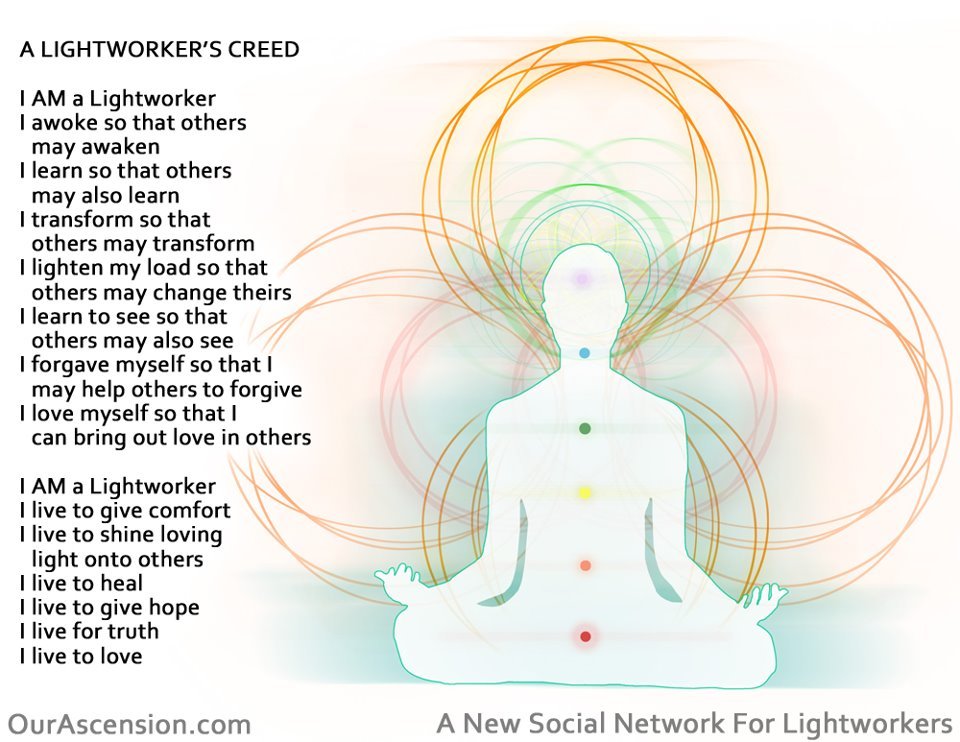
What exactly is a lightworker?  One resource suggests the following:

Lightworkers are souls who carry the strong inner desire to spread Light – knowledge, freedom and self-love – on earth. They sense this as their mission. They are often attracted to spirituality and to therapeutic work of some kind.

Because of their deeply felt mission, lightworkers often feel different from other people. By experiencing different kinds of obstacles on their way, life provokes them to find their own unique path. Lightworkers are nearly always solitary individuals, not fitting into fixed societal structures.

I think this description might be a bit conservative compared to others I’ve seen in that the individual actually may not realize how spiritual they are or recognize how their work (light) actually affects the people around them.  I do think it’s universal that these individuals are “helpers” in some way.  It may not be some sort of therapeutic or healing job in which they work but somewhere along the way they engage in healing activities to help people around them.  Healing in this case is more than just physical healing.  They are motivated to see healing in the world—healing within communities and healing within individuals. 

That’s kind of the “ground floor” explanation of lightworkers.  From there the definition and identification of traits becomes more and more spiritual.  I don’t want to go any deeper into the spiritual conversation for our purposes here mainly because I’m not qualified to speak to the deeper spirituality.  What I want to focus on is the fact that these are people who, consciously or subconsciously, reach out to the hurting people around them to ease their pain and make the world a better place.

Think about everything you know about the imagery of light.  Light is used to connote healing, knowledge, wisdom, life, and good.  It can convey grace or blessing from divine forces.  The disappearing of light can reflect fear, anxiety, cold, illness, and death.  The coming of light can convey understanding, growth, healing, and salvation from difficulty.  Light metaphors permeate our literature (“…what light through yonder window breaks?”) our music, our movies, and our religious expressions.  It’s universally known imagery within the whole of human experience even apart from a religious context—and that’s why I’m drawn to the term.

To me a lightworker is an individual who has a knack for understanding things differently, through compassionate eyes that see deeper into the humanity of struggles most politicians and religious leaders choose to over-simplify.  With that unique understanding comes the ability to connect with people to pass the light which is within them along to others. 

I believe lightworkers are able to make these connections through common struggles and pains.  I think that’s why, within the context of the LGBTQ community and relationships/friendships, it’s through the recognition of common struggles, themes, and pains that create the bridge for the light to pass between the lightworker to the person in need of healing.  Why do you think the “It Gets Better” campaign is so successful?  People who watch these videos and hear these stories are able to see themselves in the “expert’s” story. 

Why am I even bringing this up?  Over the past couple of weeks my blog has focused on taking control of your own story along with some serious discussions about homophobia, bullying, and suicide.  I’ve spent time taking my faith tradition to task for continuing to hold onto ignorant and superstitious interpretations and institutionalized prejudices.  Why am I suddenly talking about this concept of lightworkers?

Like all of you I’ve been watching the news.  Brussels was just attacked; another city of innocents drawn into a war of ideology and politics that the Western world created but refuses to take responsibility for.  North Carolina has legalized bigotry by passing a law that does not protect LGBTQ people from discrimination.  The state of Georgia is on the verge of signing into law a bill that would give religious officials in the state the option to refuse to perform same-sex marriage ceremonies and for tax-funded groups to deny services to gay people.  Donald Trump’s rise to power continues.  The Senate GOP refuses to do its job by calling for hearings to confirm Judge Merrick Garland to the Supreme Court.  Iran sanctions, Obama in Cuba….it all just gets to be too much.  The news is so incredibly discouraging and that just the news.  The talking heads on the 24/7 news networks have no idea of the struggles of my life or yours, the pain that doesn’t hit close to home but lives in our homes.  It’s easy to feel like the darkness is about to swallow us whole.

But one of the things I’ve noticed more and more is this:  The darker things seem to get, the more people I would consider lightworkers I seem to notice.  I guess it’s true: You can’t appreciate the power of a candle until all of the lights have gone out. 

I see a lot of candles in the darkness.

They’re all around us.  They come to us from a variety of places, usually unexpected places as the world continues to change.  They reach out to us, to reassure us and bring us healing and hope, to remind us that we matter and have value.  The tell us it will get better. 

I think the old saying still holds true.  “The world is going to hell in a handbasket.”  But that’s nothing new.  Humanity has been visiting pain and suffering onto itself since we learned to walk on two legs and make fire.  But more than that and much more importantly than that:  We are able to do so much more good.  Sometimes I wonder how our public mood would change if 24/7 news networks would start reporting light-related stories rather than the headlines that have traditionally made them money—headlines of murder, terror, and fear.


So, look around you.  I guarantee that no matter how dark it seems right now in your life and how overwhelmed you are by the horrible stuff that is going on in the world and in your life, there are lightworkers right there with you, ready to share their light.  I also guarantee that everyone who is reading this right now has enough light inside of themselves to reach out to the broken world around them to make life a little better for the people around them as well.  You are both worthy of the gift of hope that people will offer you and able to share that gift with others.  I promise you.


Wednesday, March 23, 2016

A Real Look at "The Real O'Neals"

Lent is coming to a close so that means I should get all my repenting done. 

I need to repent something on my blog.  On March 2 I posted my thoughts on the premiere episodes of ABC (American Broadcasting Company)’s The Real O’Neals.  In my reflection I moved through stages of concern over how the show would be received and what good the show will ultimately do to a “Okay, well, it’s here so let’s give it a try” mentality. 

I got it all wrong.  Mea culpa.  Mea maxima culpa.

The show is brilliant and let me explain why and what was wrong with my original views.

The biggest issue I had with the show was that I didn’t believe the target audience was going to be there.  That is, I didn’t believe that the LGBT youth who would be able to identify with the main character would actually be sitting on the sofa next to their parents and watching the show.  I still don’t know if they are or aren’t but what I’ve discovered is that it simply doesn’t matter.  Why?  Because social media has made the living room sofa HUGE. 

For the past few weeks I’ve gotten to know clueless yet well intentioned Jimmy, sneaky, underhanded, duplicitous Shannon, terrifying and judgmental Eileen, Pat who may or may not have figured out how the drier turns off by now, Aunt Jodi who’s always got her emergency child pageant kit in her car, and, of course, dear, sweet, gay Kenny.  And as I’ve gotten to know this caricature of an American family I’ve sat on the virtual couch via Twitter and watched other people get to know them, too.  What’s more I’ve watched as Martha Plimpton, Jay Ferguson, Matt Shively, Mary Hollis Inboden and the rest of the cast join in the conversation.  This is the gift of social media:  Stars were unapproachable in previous generations but are literally right there watching with you now…from a different time zone, sometimes, but laughing and joking and enjoying the show right along with you in real time.

Social media has changed how we approach television. 

But THIS is what I’ve witnessed that has made me completely change my mind about this show.  I now believe it is one of the most important programs on TV for the LGBT community. 

Last night I watched episode 105.  In a nutshell, Shannon tells her brothers that their mother is internet dating but the truth of the matter is that she’s actually looking for a job.  This leads to his siblings encouraging Kenny to do some internet dating of his own.  I won’t spoil it for you but I will say that porn and limencello lead to A LOT of great lines.  And amidst the killer one liners and the word plays come the truly touching lines that mean the world to the LGBT audience.  In a brief exchange between characters the LGBT audience can identify themselves in the conversation for similar conversations they’ve actually had in their own lives or they see the kind of healthy and functional family that they can’t seem to find in their own lives.

In last night’s episode, as Kenny sat next to his father in the car, and lamented that he was going to die alone because the relationship thing was too complicated and that there’s a lot of homework to being gay, his father, Pat, responds with nothing but support and encouragement, saying, “It’s not complicated.  Just think about your ideal person.  What’s he like?”  Kenny says, “Right now I just want someone cute to smile at me.”

How many of us can identify with Kenny’s situation?  How many of us long for the support of Kenny’s father?  I had to stop myself midtweet from commenting that I wish Jay Ferguson would adopt me because too many of us ache for that kind of support. 

And that’s when I saw it.  People were getting that kind of support.  Not only was the show validating their own feelings, seeing themselves in Kenny’s situation, but as they tweeted about Kenny’s father’s response, so many of the cast of The Real O’Neals were right there giving people that support.  Matt Shively became Jimmy, the older brother who wants to help but just doesn’t have a clue and tweeted support.  Mary Hollis Inboden became Aunt Jodi, with her whimsy and solid support and encouragement and tweeted hugs and a willingness to be everyone’s Aunt Jodi.  And during his live tweeting Noah Galvin became a mirror for so many people at that moment you could just feel the looming clouds of many LGBT people’s lives breaking up to allow a glimpse of that rainbow—of hope and promise. 

I was right in my first reflection on one thing, though.  This show isn’t about simple entertainment.  We’ve become so accustomed to the current sitcom formula in which we’re entertained by jokes and slapstick that we forget there was a time in which sitcoms carried a bit of a “punch” to them—a glimpse into real life and suggestions on how to make it through.  Because The Real O’Neals’ premise lies in the midst of a culture that has struggled for recognition and equality for so many decades, I knew that it had to be on target and address the realities of the LGBT community within the framework of comedy.  I wrote at the time that I was worried that the show would simply be known as “that show with the gay kid.”  I don’t think there’s any danger of that anymore.  I think The Real O’Neals is the show about the gay kid we either were, are, or wish we could be and the family who, along with him, is trying to figure out what it all means.  The gift is that not only does the show take the audience along this journey of discovery but the cast have gone out of their way to join the audience on the audience’s journey of discovery.

So, I have definitely transitioned from tentative support to fierce fan and advocate.  The LGBT community and the world need this show.  It’s doing something—something I didn’t expect and something I can’t quite get my head around.  All I know is how it’s affected me and how I’ve seen, through social media, the show affecting others.

So, ABC decision makers, if you’re reading this, you really need to make sure season two happens.  You won’t regret it.

#TheRealONeals
#RenewTheRealONeals
#LetsGetReal

#YouGayBro

Sunday, March 20, 2016

The View from Here

I was a strange child.

Well, okay.  Maybe “strange” is a bit over the topic.  Let me try a few other words. 

Unique?  Peculiar?  Unusual? 

Getting closer.  But I think all of those words still miss the reality.  Not to mention they carry with them a bit of a stigma that needs to be unpacked.

How about…creative?  Pensive?  Imaginative? 

Hrm.  Those are good adjectives that described me as a child but they still aren’t quite capturing the reality I’m trying to describe. 

Maybe because there is no easy, clean-cut way to describe people.  Or, in this case, the result of what people become because of the coping mechanisms they end up using.

Let me explain.

Today I’m having one of those “stuck on the outside, looking in” sort of days.  It’s a phrase that basically means there’s something separating you from all of the activity you want to be a part of.  Think of it like walking down a city street and passing a huge window through which you see a party going on.  Fun looking people eating great food while laughing and dancing and celebrating life in one another’s presence. 

The reality, though, is that when I say this, like many other people, I mean, “I’m trapped on the inside, looking out.”  In other words, I’m stuck inside myself and the reality I experience, longing to be a part of the world I see around me.  This isn’t a new phenomenon for me.  A lot of LGBTQ people feel this way, especially when they are literally trapped inside of themselves for fear of revealing who they truly are. 

Some of you might recognize this experience.  Growing up, particularly in my teenage years, school was not a pleasant experience.  It wasn’t that the academic work was difficult; I would have had straight A’s if I would have decided that was what I wanted.  What made it difficult was watching the people around me and, in many cases, wanting to be involved in what they were doing but never daring to step up and be involved.  I was awkward and inept, like all teenagers, I suppose.  But the big thing that kept me from coming out of my shell was fear of simply coming out.  How would I dare try to hang out with one of the guys that simply radiated cool when it wasn’t his charisma that attracted me to him but how incredibly attractive he was?  Sandy brown hair, bright green eyes flecked with gold, not a zit in sight, and (don’t you dare laugh) a permed mullet that was so damn sexy back in the day.  Not to mention his sense of humor, his quick wit, his athletic body….

….you get the idea.

Like I said, some of you will recognize the experience.  And you’ll also recognize the fear that grips you in these situations because you’re so worried about being “too interested” in something he or she does or says.  What if I laugh too hard?  What if I ask the wrong question?  What if I just say the wrong thing and he figures out who I actually am and what I actually see when I look at him?

When those are your fears, when you live with the anxiety of being discovered and outed, it just becomes easier to withdraw and live inside yourself.  If you don’t interact you don’t risk interacting too much.   Sure, that means watching the world move on around you—people laughing, having fun, falling in love, having relationships—but it’s worth the occasional twinge of pain at being left behind if you can protect yourself.

Isn’t it?

I mean, look at it this way.  If the story I’m about to share would have happened today, it would have ended quite differently.  When I was in ninth grade I was the victim of what today would have been considered an assault.  Or worse.

It was in an art class.  “Back in the day” we were required to take a certain number of art classes, music classes, writing classes…the artsy classes that are only occasionally offered now as electives because there’s not enough time in the day to indoctrinate students on taking standardized tests.  These classes were mandatory in my school.  It was a large room that seemed to ramble on in every direction.  The main part of the classroom was near the door.  Large, wooden worktables with worn tabletops which had been nicked and painted and stained by generations of pubescent Picassos were our desks.  I don’t remember what the teacher was lecturing on that day or what we were actually working on but I do remember the sense of panic I experienced when one of my classmates took a wire used for slicing chunks of clay off of the larger blocks and, from behind me, wrapped it around my neck and pulled it tight.  I’m not sure how long he held the wire around my neck but I remember the laughter of his friends and the pain when he finally released the wire.  I don’t know where the teacher was when this happened; he never did find out about it.  Plenty of students on my side of the room saw what happened but no one ever said anything.  Probably because I never said anything.  I forced myself to laugh, as if I was in on the planning of the morning’s entertainment.  I knew that if I made an issue about it my complaint would just draw more attention and more attention was not what I wanted.

If this was the kind of thing my peers did when they only suspected I was gay, what would they do if they actually knew I was gay?  If I said the wrong thing, did the wrong thing, walked the wrong way, talked the wrong way, gave someone too much attention….It was just easier (and safer) to withdraw as much as possible within myself.

I think this is how my imagination and creativity blossomed. 

I began to write in junior high school, which for me began in seventh grade.  Puberty had arrived, bringing with it a number of realizations that couldn’t be unrealized.  This is when I started pulling back within myself.  But once there, apart from the world outside, I would create worlds and scenarios.  Sometimes I would even bring the people around me from the “real world” into my imagination; if I couldn’t hang out with them in the “real world,” I could hang out with them in my fictional world where I could be the cool one that they wanted to hang around and emulate. 

So I wrote stories starring mythical versions of myself and the people who were either too cool for me to talk to or the guys I was too attracted to that I avoided lest they look into my eyes and see my soul.  Looking back at the thought of writing those stories I have to admit I’m embarrassed—but not for reasons you would think.  I’m not embarrassed because of what I turned my fear and anxiety into and how I attempted to capture the personalities and characteristics of my classmates.  It was the writing that was cringe worthy. 

I think some of the best writing, some of the best fiction, has to come from something relatable and something real.  Learning to take my struggle and turn it into a narrative in which I learned to expose my thoughts and feelings to even fictional versions of the people around me was an important lesson for me to learn.  I still do it.  In These are the Days, I’ve inserted pieces of myself and people I know into the characters.  In the new story I’m working on I’ve taken it a step further and am actually using people I knew as the rough outline of the characters in the story—and it’s working really well.

Where am I going with all this?  Well, I have two points I need to make.

The first point goes back to where I began:  I’m having a “trapped on the outside, looking in” sort of day.  It’s been….an undisclosed number of years since my high school days but old habits die hard.  There are a many people whose own paths mine has connected with in some way, whose light I find refreshing and inspiring.  Being a connection oriented person I find myself aching to learn more about these people.  This is why I hate doing “meet and greets” at concerts; the twenty minutes or so I have with the artist or artists isn’t nearly enough for me to develop that connection—especially when I have to share the artist with other people with meet and greet tickets.  So, for example, when I try to interact with people through social media and my attempts fall flat, I feel like I’m looking in through that large window at fun people having a fun time and I have no idea how to get involved. 

Still happens. 

I think it will always happen. 

So I think it’s important to remember that I’m in control of how I respond to this feeling.  If I let myself be consumed by the sights that are holding my attention through that window, I’ll become rooted to the spot.  I’ll never find a way in and I’ll just make myself feel worse and worse.  But if I choose to change my perspective, to leave that spot and turn away from those tantalizing sights, I might someday find my way “into the party.”  Or…better yet….I might find something even better to be a part of.

Remember, though, that the grass is never greener on the other side. 

The second point is this:  You aren’t alone.  I know there are people reading this who can identify with my story.  I know there are people out there who are victims not only of the ignorance and prejudice of the people around them but who are also victims of their own coping strategies, the things they do to make it through life.  Things like disengaging from the world around you because you’re too afraid that the world around you won’t accept you.  It gets better.  It really does.  And the experiences you had or are having, experiences like mine, will give you something.  They’ll give you lessons to help you be a better person.  They’ll give you motivation to become a better person.  And they may stimulate your imagination and creativity to help you help others to stimulate their imaginations while telling them that there is absolutely nothing wrong with who they are. 


Wednesday, March 16, 2016

Discussions of Equality in High School

It’s easy to forget but sometimes the words we use and how we use them can be incredibly painful and even deadly. 

Imagine for a moment that you have a secret.  Absolutely nobody knows about your secret.  You have tried very hard to keep this secret hidden from everyone, including your family.  It’s not that this secret makes you ashamed or that you don’t want to share this secret.  The reverse is actually true:  You are aching to share this secret, to be honest with the people around you, especially the people you love.  You keep this secret because you have learned by watching the world around you that honesty isn’t always met with reason.  People who have shared this same secret have been met with judgment and ignorance and intolerance.  Some have had their lives taken from them.  Some have taken their own lives because of how they were treated after confessing their secret, after revealing their truth. 

This secret doesn’t make you feel alone.  It makes you alone.  You are isolated.  No one to confide in.  No one to support you.  No one to comfort you when hateful words are thrown around without a care as to who could hear them and how they will be heard.

This is what it’s like for many LGBTQ people. 

Today a friend of mine casually dropped a comment on social media about a conversation that took place in his history class.  The assignment had been given:  Prepare a one page discussion on your opinion as to the state of equality in American society and provide an example of how society could be made more equal.  During the course of the review discussion of the assignment, the teacher asked if there was anything else the class wanted to discuss.  One student blurted out, “Yeah.  Fag marriage.”

And apparently it all went downhill from there.

My immediate question was:  What did the teacher do in response to the offensive language?  The answer:  Apparently nothing.  Students referred to LGBTQ people as “diseased.”  One student said that if he had a child “who had a mental disorder or was gay or trans” he would lock “it” up.  It.  He called his theoretically child an “it” because he needed to distance himself from the humanity of a theoretical child that failed to suit his inherited, preconceived notions of what was acceptable.

And the teacher said nothing.

Another student took this a step further and said that he “would probably shoot it.”   

And the teacher said nothing.

And my friend, the student, was trapped, listening to this ignorance that science abandoned over forty years ago and even contemporary religion has begun walking away from.  Yet, here was my friend, stricken by the lack of compassion, lack of human recognition, his fellow students were parroting.  I stress parroting because kids don’t develop this kind of hate on their own; it’s nurtured into them by parents who were spoon-fed the same nonsense when they were children.

And the teacher said nothing.

I want to stress again that my friend was trapped.  He wasn’t able to leave the class lest it bring more attention to him and his situation.  He couldn’t speak to the point without tipping his hand.  He was forced to sit in his high school history class and listen to people liken sexuality to mental disorders that are deserving of death while the teacher, who was either woefully unprepared to address the topic or woefully uneducated to address the topic sensibly, finally managed to say, “"I don't have a huge problem with it....but do two people really have to get married to proclaim their love?”  Never mind the fact that apparently this teacher did get married to his wife to proclaim his love. 

In case people have missed it, we are in the year 2016.  Applied to this situation, this means a few things:
1.      If you are a teacher who invites discussion about controversial topics over an assignment about equality you had better have the education and the wherewithal to ensure that the participants in that discussion are respectful of the equal standing of all human beings regardless of age, gender, sexual identity, religion, ethnicity, and so on.  If you can’t maintain a modicum of decorum in your class when it comes to these conversations then you had better not invite these conversations.  Today this teacher failed his students.  He failed to model the spirit of a lesson on society’s call to provide equality by allowing students to cross a very serious line in their rhetoric and demeanor.
2.     Absolutely everyone in this country (and even the world) is free to develop and speak their own opinions.  You are not, however, free to treat that opinion as fact.  What makes you, a high school student, more intelligent and more informed than an entire scientific community who rejected your theories decades before you were even born?  What makes you, a high school student, more versed in law and legal issues than the nine men and women who sit on the highest court in the United States and declared that opinions like yours are not valid opinions in a court of law and are therefore out of step with the spirit of the constitution of the United States? 
3.     Parents, if this is the kind of thing that you are teaching your children at home or are subjecting your children to in the life of your religious or faith communities, you better think again about the damage you are potentially doing to your children.  It used to be said that three of every ten people were LGBTQ.  A recent survey reported that nearly half of today’s teenagers identify as something other than straight.  And, yes, that includes young people in the Bible belt and conservative pockets of the United States.  Pushing your uninformed, medieval notions of homosexuality is not only perpetuating ignorance; you are also probably causing stress and anxiety in, statistically, half of the children in your home. 

I’m not going to name names.  I’m not going to identify the school.  I don’t want this to come back and cause problems for my friend.  That being said I have absolutely no doubt that a copy of this essay is going to find its way into the hands of the school’s administration and I hope to God that this issue is addressed.  I’m not suggesting suspensions or detentions.  I’m suggesting that students and teachers would benefit from a little education with regard to the history of the LGBTQ movement and how stupid, ignorant, throw away comments can undo a person’s sense of self-worth. 


Monday, March 14, 2016

Homosexuality and the Bible

Recently I wrote about growing up in the Church and how ignorance and superstition have dictated ecclesiastical social stances for far too long.  The things that the Church has supported either overtly in its misguided proclamation or covertly by its silence and turning of a blind eye have damaged too many groups of people including the LGBTQ community.

I had no idea how what I was writing in that post would flow into what caught my attention today.

Tom Goss (on Twitter @TomGossMusic) released a music video today on YouTube.  It’s a contemporary take on a classic song:  “Son of a Preacher Man.”  The video depicts a romance between two boys, one of them apparently being the son of the fundamentalist preacher who begins the video by preaching an anti-gay sermon based on 1 Corinthians 6.9-10. 

I want to make one thing clear.  I’m not using the term “fundamentalist preacher” in a throwaway sense or as a derogatory reference.  I’m actually using the term appropriately.  How do I know this character is a fundamentalist preacher?  Because of how he treats this passage of Scripture. 

To demonstrate, I want to share how the video’s preacher-character recites 1 Corinthians 6.9-10.

1 Corinthians, chapter 6, verses 9 and 10.  It talks about the things that prevent people from entering the kingdom of God.  It talks about all kinds of immoral behavior.  But right in the midst of that passage, right in the middle of that verse, it says “and those who are homosexual.”  That’s not ambiguous.  Let me be perfectly clear, you cannot abide the gospel and be OK with homosexuality.  You cannot have faith in God and be OK with homosexuality.  You cannot call yourself a Christian, and be OK with homosexuality.  But this is about love.  It would be unloving not to tell someone when salvation is at stake.  We must tell the homosexuals the very same thing that I would say to you and you would say to me, “it is possible to change.  With God, all things are possible.” 

Okay, so I’m going to jump into this and I hope that I won’t lose you because I’m going to do more “academic writing” than story telling in this post.  Why?  Because what the video’s preacher does here is so far off base from what the passage of Scripture actually says that I need to give you that academic background.  This way when you bump into this kind of ignorance in your life you will hopefully have the necessary words to combat this nonsense.  This video’s preacher is obviously a fictional character…but he is representative of far too many leaders of the Church who influence far too many people in devastating ways. 

When you read the Bible the first thing you need to understand is what it is you are actually reading.  In this case, 1 Corinthians, you are reading what’s called “an occasional document.”  It’s a document written for a specific occasion.  It’s a letter.  All letters capture events and topics of specific moments in time.   Letters in the Bible are no different.  What makes letters in the Bible more complicated, however, is the fact that, for English language speakers, we need to remember that the Bible wasn’t written in English.  What we read when we open our English Bibles is the best guesses of translations of languages that aren’t even spoken anymore.  A lot of work goes into figuring out what the words mean but in the end the Bible’s translators’ agenda will peak through. 

So what does 1 Corinthians 6.9-10 actually say?  Let me give you a couple of translations.  Like I did with the quote from the video’s preacher, I’ll bold the word that we’re concerning ourselves with. 

First up, the New International Version (NIV):

Or do you not know that wrongdoers will not inherit the kingdom of God? Do not be deceived: Neither the sexually immoral nor idolaters nor adulterers nor men who have sex with men[a] 10 nor thieves nor the greedy nor drunkards nor slanderers nor swindlers will inherit the kingdom of God.

The NIV, to its credit, includes a footnote following “…sex with men” which reads:  The words men who have sex with men translate two Greek words that refer to the passive and active participants in homosexual acts.

Second, the New Revised Standard Version (NRSV):

Do you not know that wrongdoers will not inherit the kingdom of God? Do not be deceived! Fornicators, idolaters, adulterers, male prostitutes, sodomites10 thieves, the greedy, drunkards, revilers, robbers—none of these will inherit the kingdom of God.

Third, the King James Version (KJV):

Know ye not that the unrighteous shall not inherit the kingdom of God? Be not deceived: neither fornicators, nor idolaters, nor adulterers, nor effeminate, nor abusers of themselves with mankind,10 Nor thieves, nor covetous, nor drunkards, nor revilers, nor extortioners, shall inherit the kingdom of God.

So what are the words we’re actually looking at here?  The oldest words (notice I’m not calling them “original” because we no longer have the original manuscripts) that we’re working with are malakos and arsenokoitÄ“s.  The online resource Blue Letter Bible gives the following information on these two words (in summary):

malakos:  A catamite (that is a boy who is kept for sexual relations with an adult man).  (This, of course, was a very Roman custom.) 

arsenokoites:  Strongs states that this is a blending of two other Greek words, namely the word for “male” and “couch.”  In other words a male who lies on a couch.  This isn’t just an ordinary couch but a reference to prostitution.  Blue Letter Bible indicates that this word is translated, in the King James Version, as “sodomite” or “a male who lies with another male as with a female.”

So the word that our video’s preacher interprets as “homosexual” is actually two words which are rendered in a variety of ways in different translations but, in the end, have absolutely nothing to do with our modern understanding of homosexuality or LGBTQ people.  Let me explain.

The author of First Corinthians is addressing behaviors that are surfacing in the church in Corinth and is trying to highlight how members of that church shouldn’t be falling back into old patterns.  The whole reference to baptismal language just before the verses we’re looking at is an attempt to remind members of the Corinthian church that they’re supposed to be starting over and not engaging in these questionable and heinous practices—namely keeping catamites and engaging in prostitution INCLUDING male-male prostitution.  Why?  Because the entire underpinning of the Gospel of Jesus Christ is a recognition of humanity and self-worth as the faithful live into the promise of the Kingdom of God.  You can’t recognize another’s humanity if you hold power over them.  You can’t validate another’s worth if you demean them. 

This has absolutely nothing to do with being gay. 

As LGBTQ people have fought their way out of the shadows by sharing their stories and helping non-LGBTQ people understand what it means to be “something other than straight,” we have struggled to help others understand what it is we have wanted for so long:  We just want healthy relationships that validate our worth and our humanity.  In other words, we’re striving toward the kind of intimate relationships that the author of First Corinthians is trying to encourage.

This is exactly the kind of ignorance and superstition that I’ve talked about in previous posts to my blog.  People who parrot back whatever their preacher/pastor/priest has told them or who simply open their Bibles and point to the page and say, “It’s right there in black and white.”  And in order to justify this narrowness and lack of biblical criticism, they will invoke a superstitious understanding by saying, “If that’s not what God wanted you to know then he never would have allowed it to be written like that.” 

Believe me, there’s been more politics behind the creation and translation of the Bible than the average person in the pew on Sunday morning realizes. 

So I hope this makes sense to you.  Again, I’m sharing this in the hopes that it helps you when you bump into people like the attendees of this video’s Sunday services or the people who would tell you that “being gay is a sin.”  It’s not.  It absolutely is not.  Our modern understanding of what it means to be LGBTQ has absolutely no equivalent in the ancient Hebrew culture (Old Testament) or the Greco-Roman culture (New Testament).  Hopefully you can use this information—not to pick fights but to continue the conversation because it’s through conversation that we’ve made the difference we’ve made.  It’s through conversation that we’ll continue to change the world.

I want to thank Tom Goss for sharing this song in such a powerful way and giving us the opportunity to talk about these issues that we continue to struggle with. 

I also want to apologize to those of my readers who aren’t Christian people of faith or who have been too hurt by the Church to hear my words without it bringing up painful memories or causing you anger and consternation.  It never should have been that way for you.