Follow Me on Twitter!

Find me on twitter @TroyComets
Showing posts with label role models. Show all posts

Monday, March 28, 2016

Boy George, Troye Sivan, and Me

I spend a lot of time puttering around on the internet.  Every morning I get up and start googling random crap and cruising through YouTube subscriptions and trendings.  It inevitably happens.  At some point a search for one specific thing will lead me to something completely different and it will be that something completely different that will unexpectedly educate and inspire me.


Today I ended up on this video on YouTube.  It’s an interview from 1984 between Johnny Carson and Boy George. 

History lesson time.  Before James Corden rode around in a car singing with superstars and Stephen Colbert lampooned newsmakers with mock earnestness, there was an old white guy who sat behind a desk and did some interviews and cracked some jokes.  In the interest of full disclosure I wasn’t a fan.  But a lot of folks tuned in because, really, he was the only game in town until folks like Joan Rivers and Arsenio Hall brought life and variety to the late night talk show arena.  But Carson was kind of the godfather of it all. 

So, picture it.  1984.  The AIDS crisis is evolving.  Ronald Reagan is president and neither he nor his First Lady, Nancy, will acknowledge the crisis because they don’t even want to be associated with the dirty word “homosexual.”  That doesn’t stop religious leaders and conservative politicians from making hay on the suffering of others by demonizing the victims of the disease while declaring “God’s judgment” on “sinful and deviant lifestyles.”

In the midst of this ignorant morass of silence and blame and fear comes…Boy George.
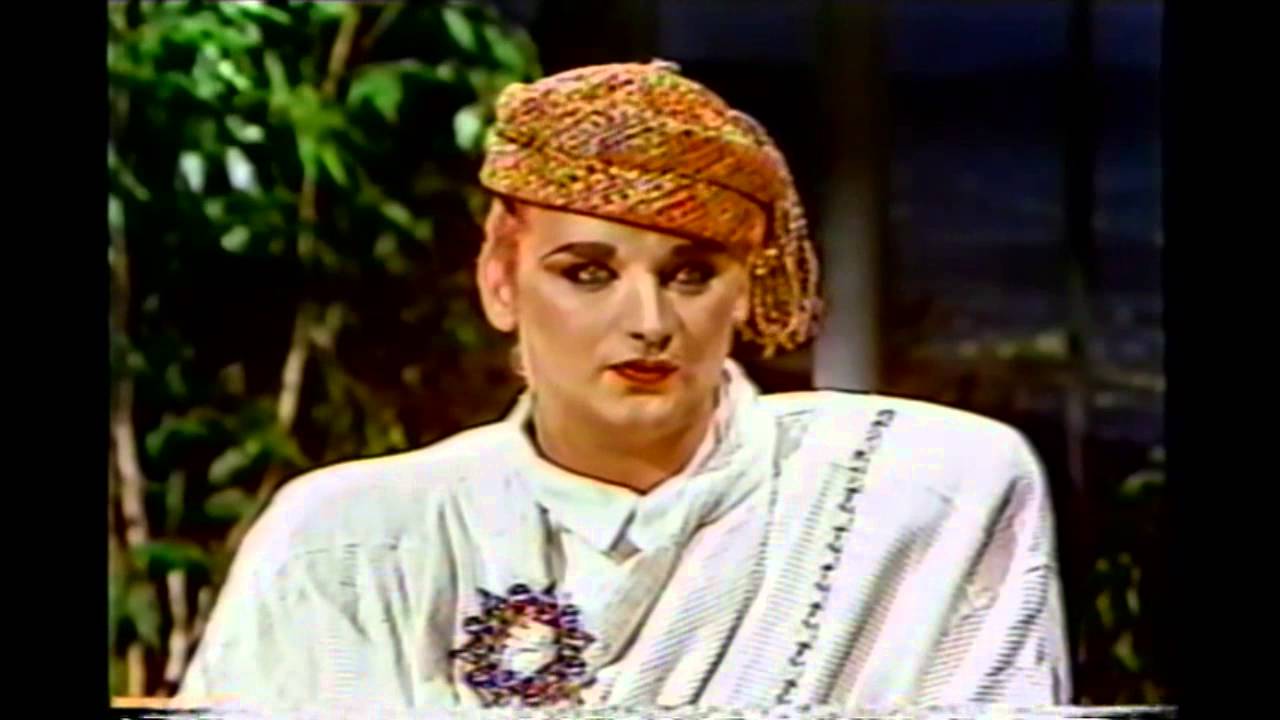

That picture is a screen capture of Boy George from the Johnny Carson interview.  It was the second time he had appeared on Carson’s show but the first time with Carson.  The first time he had appeared the iconic Joan Rivers was hosting.  This is a fact that Boy George jokes about in the interview with Carson by commenting, “The last time I was here you were in drag.”  Carson quickly distanced himself from the joke, clarifying that it had been Joan Rivers and not Carson with whom he had appeared.  If I’m right, this is a picture of Boy George and Joan Rivers from that first appearance. 


So, back to the video of Carson, the old White guy with his sense of humor that seems to ignore other people’s senses of humor, and Boy George sitting on the opposite side of the desk in all of his Boy George glory.  In 1984.  Amidst fear and ignorance.  And remembering that the culture of the UK is usually about 20 years ahead of culture in the US.  So, for Boy George, the smallest things he said or did at home were met with raised brows and anxiety here in the United States. 

Carson introduced Boy George, who comes in and makes the joke about Carson being in drag that Carson finds so repugnant, and then the interview begins.  It’s clear where Carson wants to go with the interview. 

Not long before this appearance Boy George attended the Grammies and made a joke about wondering when they music industry would see a real queen dressed as a drag queen.  Carson brings up the controversy his comment caused and Boy George brushes it aside, pointing out that in the UK you can say things like that and people laugh but in the US it’s basically a big scandal.  This brings up a conversation about “all of the stupid questions” Boy George had been answering since his arrival in LA from LA radio personalities. 

“What are some of the dumb questions they ask so I know which ones to avoid.  I mean, the first one has got to be,” and Johnny Carson makes sweeping gestures with his hands.  “Why do you dress like that?”

You can hear Boy George’s eyes rolling in his answer.  “I’ve answered that one so many times I’m going to avoid that one.”

“Okay, so what are the other questions?”

“Well, basic things like ‘How long does it take to do my makeup?’ you know and just boring things about my childhood.  Which was just the same as anybody else’s really.  Pretty dull.  Pretty boring.  So, Father Christmas, you know, and grazed knees, that kind of stuff.” 

“Yeah, but you can’t blame them, can you, Boy George, for asking those kinds of questions.  Because you are rather controversial.  It is something new that—“

“But after like three years of seeing me you would think people would be a bit used to me by now, you know.  I mean, in a country that has Liberace, I am hardly revolutionary, am I?

And the audience cheers.  But see the difference between Boy George and Liberace is that Liberace’s glam was still masculine.  He still wore tuxes and suits while performing.  So what if they were covered it glitter and sequence?

Johnny Carson continues.  “I’m trying not to be square you see.  I come from the middle of the United States.  State called Nebraska, which is right out in the middle of the country.  Rather conservative.  Now if I was your dad and you came home one day and I didn’t know it and I walked in and saw you as a young man—I guess you were about fifteen or sixteen when you started actually….wearing the make up and the costumes—I wouldn’t know how to react myself.  I think I would be adult enough myself to try to handle it but—“

“What do you got to handle?”

“Well, the effect that you walk in and you see your son dressing with makeup on.  The average person….”

“Okay, well, you’re going to have Halloween in a couple of weeks, you know.  What’s the difference between somebody dressing up for Halloween?  It’s only because people think it’s serious that they get frightened.  They look at me and they say, ‘Well, it’s not a Halloween party.’  So you have to have a reason to dress up.  There is nothing wrong with being different.  Why do you have to have an excuse to enjoy yourself?  You know there are people out there taking drugs, killing each other, fighting.  And like I just don’t see that you have to wait once a year, Christmas or Halloween, to enjoy yourself.  I think it’s a load of rubbish.  I think there is nothing wrong with dressing up and enjoying yourself if you want.”

“I think you’re right.  I think what you said before though…people are probably uncomfortable though with some things they don’t quite understand or something that’s different from them and they get uptight about it.”

I’ll leave the transcript there because it speaks to the points I want to make. [Go and watch the video, though.  It’s fascinating. ]

In 1984, when Boy George was being interviewed by Johnny Carson, I was in the sixth grade.  I remember my class’s Halloween party.  We still dressed up “back in the day” and spent the afternoon munching candy and watching movies.  One of my classmates dressed up as Boy George.  I knew it was a Boy George costume because she had obviously done the makeup and hair thing but she had written “Boy George” on her t-shirt.  My teacher, who was about the age of Johnny Carson, had a conniption.  He ranted about the costume being inappropriate and offensive.  And it was a female classmate dressed up as Boy George.

Of course this was the same teacher who demanded a male student remove his earring.

This was the mentality of the time.  It’s gotten better, to be sure, but we still have such a long way to go.  Someone I follow on social media just tweeted today that if people fought as hard for the poor as they fight against equal rights and protections, poverty would be history. 

But Johnny Carson, in this interview, actually makes a point.  He pointed out that people are uncomfortable with things they don’t understand or things that are different from them.  And make no mistake about it—Johnny Carson and Boy George and a significant segment of the audience knew that this conversation had nothing to do with make-up and clothes.  This was about identifying as something other than straight (on Boy George’s side) and the fear of validating something that not even the president would even speak about (on Johnny Carson’s side). 

I don’t know what the conversation was like in the UK or other parts of the world, but in the United States, at this time, coming out wasn’t an option for many artists and actors.  For example, George Michael at this same time was making it big with Wham!.  And speculation was just as bad.  If I had a dime for every time I heard a story about the members of New Kids on the Block having their stomach pumped to find gallons of bodily fluids, I could have retired at age 20.  I even remember watching some awards show with my folks one time and hearing my mother comment about how masculine Grace Slick from Jefferson Starship was trying to be while performing “We Built This City.” 

More and more I find myself stopping in my tracks to take stock of how far we’ve come, not just in the LGBTQ community but as a society.  Sharing our stories, when we can and how much we can and in whatever overt or veiled language we can, changes things.  It started somewhere.  It didn’t begin with Boy George on Johnny Carson and it’s certainly not going to end with marriage equality or the overturning of North Carolina’s disgusting law.  We all play our parts, when we can, how we can.  We show our faces with courage.  We move in small circles for our own safety.  We speak from behind the curtain of the internet to protect the people who love us. 

I’ve written before about Troye Sivan.  Last week Troye Sivan tweeted, “I am forever indebted and so so so grateful for the LGBTQ+ people who have come before me.”   This hit me for a variety of reasons but the truth of it is so poignant.  Troye Sivan, global recording superstar, gay, out at 20, changing the world.  But not just him.  Jordan Gray (@TallDarkFriend), trans contestant on The Voice UK, sharing her powerful story.  Noah Galvin on TV—a gay man playing a gay teen on The Real O’Neals.  YouTuber stars from all over the world, out and proud and sharing their stories, continuing the fight for equality so that the next generation of LGBTQ people won’t have to struggle so hard.

Just as Troye Sivan, still fighting with his beautiful spirit and his powerful words (“Without losing a piece of me, how do I get to heaven?”), doesn’t have to fight as hard as Boy George did. 


But here’s the flip side of Troye Sivan’s grateful statement.  My response:  “The ones who came before are grateful to the ones who come after; you’re still changing the world & us.”

You see, this is the reality in which I live.  The world has yet to open for me.  The light of peace and acceptance (of the world toward me and me toward the world, for that matter) hasn’t reached the dark recesses of my “closet.”  But I celebrate these rewards that have been hard won and the ability of those who can live in that light.  I am thrilled when I see Troye Sivan changing the world with his music.  I am thrilled when I read about Cole Ledford’s “Fifty States of Gay” project.  I am thrilled when I see someone like Jordan Gray on a national/international platform like The Voice, not only sharing her gift and her story, but doing it with Boy George himself watching and tearing up for each of her performances.

And all of these and more give me hope that maybe the world will change enough for me and this light will break open my prison door.  You see, in a place where teachers flipped out over girls dressing like Boy George and students assaulting other students just because they might be gay all with the blessing and support of a Church that loves Jesus but not enough to actually listen to the things Jesus says—for people who lived in these places, people like me, then and now, people like Boy George and Troye Sivan mean nothing.  They could be from a completely different world, somewhere over the rainbow (if you’ll pardon the expression). 

But from within my closet, I hear their words coming to me from that magical place of hope.  They inspire me, the one who came before who, from the shadows, fought and still fights,   It’s a cycle, I suppose.  An enormous wheel.  Where does what one generation give to the next begin and end? 

I hear their words and they tell me of a time I will be able to be me without causing the people I love and who love me a pain they don’t deserve for something not in their control anymore than the pain I’ve suffered for things outside of my control.  I’ve lived as a victim of the world’s ignorance for this long.  With these glimpses of hope, I can wait.  I will not victimize others to escape my lot. 

So I keep watch.  I listen.  I write and I speak what I can, when I can, how I can.  And I hope I make a difference.  Probably not as big of a difference as Boy George, Troye Sivan, or Jordan Gray.  But hopefully a difference, if only to one person.  Because that one person still has the potential to change the world.

Addendum:  About 30 minutes after posting this entry I found the interview of Boy George with Joan Rivers.  An astounding difference.  Night and day.  Whereas Carson backs away from Boy George, Joan Rivers sings his praises, calling him "cute and sexy."  


Share it forward!

Follow me on Twitter @TroyComets

The Hidden Truth Behind Me, Queen Elizabeth, Barack Obama, and the Aliens

We’re going to have some fun today.

So, I’ve been doing this blogging thing for about three months.  I started my Twitter account the same day I launched my blog.  I did these things because I wanted a way I could connect with readers and build an audience for my book.  But I’ve ended up being surprised at how the blog has really become a creature of in its own right. 

I’ve been kind of bummed lately, however, because my numbers on both my blog and my Twitter account seemed to have leveled off.  Last night I realized why.  Because Troy Comets isn’t a real person and I write pseudonymously, I don’t bring a natural audience and network to my blog and social media.  I don’t have friends and family and colleagues signing up, right out of the gate, to read my stuff or to share it.  What I’ve built on my blog and through Twitter was built in a vacuum.  Those of you who read my blog are people who found me on your own.  I think that means something.  My family would be….well, they would be shocked to read the stuff I share with you….but they would be obligated to read and share my stuff.  You guys aren’t.  But yet you do.  That means something to me.

As part of learning to do this blogging thing, I follow some different experts on social media.  One of those experts is Yann Girard (@girard_yann).  I won’t get into all of the reasons why I follow Yann, but recently I read an article he wrote on “Why No One Reads Your Stuff.”  In the article, Yann lists some do’s and don’ts…and some of the do’s are actually don’ts.  With absolutely no offense intended to Yann, who makes many valid points in his writing and shares numerous inspirational thoughts, I thought I would have some fun with some of his points.  So based off of the ideas Yann lists that work for him….

Idea Number One:  Post Pictures of Naked Women
Just to be clear, Yann states he’s never tried it but encourages readers to try it if they want.  The idea is that so many people include graphics, pics, etc., that you need something to stand out.  I hope Yann doesn’t mind that I subbed a guy for a woman, though. 


Idea Number Two:  Screw Everybody Else
The idea here is that it takes a lot of time and effort to read other people’s blogs.  Yann’s suggestion is to stop reading other people’s stuff and focus on making your own writing better, devoting that now “freed up time” to your own projects.  So, as soon as I’m done writing this post, I’ll be unfollowing Yann.  That will free up A LOT of time.  The guy’s writing is profuse!

Idea Number Three:  Insult People
You jerks!

Just kidding.  What Yann means here, I think, is to not be afraid to write things that show your knowledge and opinions.  Don’t worry about offending people.  Well, I think I got that down with my posts about Easter and my posts about lazy, ignorant Christians. 

Idea Number Four:  Don’t Add People
I think this is reverse psychology.  Yann clearly says “don’t do it” and then explains that he does do it for the obvious reason of creating an audience.  I’m not comfortable doing that.  I follow people who inspire me or have something to share with me to improve my life.  I don’t want to use people to generate an audience or balloon any artificial indicators of success.  I blogged a bit about that here.

Idea Number Five:  Screw Analytics
I feel like I already talked about this with idea number four.  Success for me isn’t knowing how many people are reading or even finishing the things I post.  Success for me is planting a seed and being okay with the fact that I’ll probably never know if that seed germinates and grows.

I write not to become famous.  I blog not to stroke my ego.  I do these things because they’re in me and I will explode from the pressure of my thoughts and stories if I don’t get them out.  It’s therapy.  It’s catharsis.  I’m just…either really selfish or really brilliant for dragging you along for the ride.

Idea Number Six:  Not More than Two Lines
Supposedly I need to learn to hook readers right away, in those first two lines.  I kind of see that.  But I also know that the best part of a good song doesn’t show up in the first ten seconds.  Hell, the best part of some larger, classical orchestrations doesn’t even show up in the first two movements.  So, this is what I propose:  I’ll write and share what I write.  You skim it/read it and if you find it helpful, hooray!  If you find it useless, stop reading it and move on.  Deal?

Idea Number Seven:  List Posts to Die For
Yann suggests here to arrange post listings, which are title to draw interest, in such a way that people can’t help but to keep clicking.  That’s why I titled this post what I did.  It got your attention, didn’t it?

Idea Number Eight:  Don’t Read
Since I’m supposed to be working on becoming a better writer I should be writing and not reading.  I’m not so sure about that.  Realize that I’m an academic with a buttload of graduate work under my belt.  I feel like if I’m going to write I want to be informed and I want to inform.  I’m not wasting my time or yours by just….writing.  Don’t get me wrong; I’ll share my opinions.  God knows I have enough of them.  But the world has enough people shooting off their ignorant nonsense without me adding to the choir of the ignorati. 

Idea Number Nine:  Reinvention
I’ll be honest.  I’m struggling with this one right now.  The idea here is that if you write every day you’ll eventually run out of things to say.  I’m not short on things to say but I’m afraid my blog is going to become too narrow in its focus and content.  It’s kind of why I’m doing this post today.  What do you think I should blog about?  Leave a comment.  I’m serious.  I want to know.

Idea Number Ten:  Write Bad Stuff
Hrm….

Post for March 28, 2016.  CHECK!

Well, that was easy.

Idea Number Eleven:  Writing Rules
First rule of writing club?  There are no rules for writing club.  And I think this is Yann’s point throughout his article and something I try to talk about on a regular basis.  I can tell you what works for me, today, in my writing, in my life, in whatever.  But I’m not going to make these hard and fast rules for anyone including myself.  Life has taught me in rather harsh ways that I need to be more pragmatic.  So, if there’s one piece of advice….okay, well, two pieces of advice I could offer you it’s this:
1.      Go with it.  Learn from what comes to you.  Make the best decision you possibly can with the information available to you and live into that decision knowing it was the best you could have done and that life will give you chances to change directions when you need to.
2.     Go and watch this music video.  It’s old but it’s still brilliant.

Thanks, Yann, for (hopefully) being okay with me doing this.  But, then again, if you’re following your own suggestions, like number two, you’re not going to read this anyway so I should be golden. 

And thank you, dear reader, for letting me be goofy on this Easter Monday morning.

Share it forward!

Follow me on Twitter @TroyComets

Wednesday, March 23, 2016

A Real Look at "The Real O'Neals"

Lent is coming to a close so that means I should get all my repenting done. 

I need to repent something on my blog.  On March 2 I posted my thoughts on the premiere episodes of ABC (American Broadcasting Company)’s The Real O’Neals.  In my reflection I moved through stages of concern over how the show would be received and what good the show will ultimately do to a “Okay, well, it’s here so let’s give it a try” mentality. 

I got it all wrong.  Mea culpa.  Mea maxima culpa.

The show is brilliant and let me explain why and what was wrong with my original views.

The biggest issue I had with the show was that I didn’t believe the target audience was going to be there.  That is, I didn’t believe that the LGBT youth who would be able to identify with the main character would actually be sitting on the sofa next to their parents and watching the show.  I still don’t know if they are or aren’t but what I’ve discovered is that it simply doesn’t matter.  Why?  Because social media has made the living room sofa HUGE. 

For the past few weeks I’ve gotten to know clueless yet well intentioned Jimmy, sneaky, underhanded, duplicitous Shannon, terrifying and judgmental Eileen, Pat who may or may not have figured out how the drier turns off by now, Aunt Jodi who’s always got her emergency child pageant kit in her car, and, of course, dear, sweet, gay Kenny.  And as I’ve gotten to know this caricature of an American family I’ve sat on the virtual couch via Twitter and watched other people get to know them, too.  What’s more I’ve watched as Martha Plimpton, Jay Ferguson, Matt Shively, Mary Hollis Inboden and the rest of the cast join in the conversation.  This is the gift of social media:  Stars were unapproachable in previous generations but are literally right there watching with you now…from a different time zone, sometimes, but laughing and joking and enjoying the show right along with you in real time.

Social media has changed how we approach television. 

But THIS is what I’ve witnessed that has made me completely change my mind about this show.  I now believe it is one of the most important programs on TV for the LGBT community. 

Last night I watched episode 105.  In a nutshell, Shannon tells her brothers that their mother is internet dating but the truth of the matter is that she’s actually looking for a job.  This leads to his siblings encouraging Kenny to do some internet dating of his own.  I won’t spoil it for you but I will say that porn and limencello lead to A LOT of great lines.  And amidst the killer one liners and the word plays come the truly touching lines that mean the world to the LGBT audience.  In a brief exchange between characters the LGBT audience can identify themselves in the conversation for similar conversations they’ve actually had in their own lives or they see the kind of healthy and functional family that they can’t seem to find in their own lives.

In last night’s episode, as Kenny sat next to his father in the car, and lamented that he was going to die alone because the relationship thing was too complicated and that there’s a lot of homework to being gay, his father, Pat, responds with nothing but support and encouragement, saying, “It’s not complicated.  Just think about your ideal person.  What’s he like?”  Kenny says, “Right now I just want someone cute to smile at me.”

How many of us can identify with Kenny’s situation?  How many of us long for the support of Kenny’s father?  I had to stop myself midtweet from commenting that I wish Jay Ferguson would adopt me because too many of us ache for that kind of support. 

And that’s when I saw it.  People were getting that kind of support.  Not only was the show validating their own feelings, seeing themselves in Kenny’s situation, but as they tweeted about Kenny’s father’s response, so many of the cast of The Real O’Neals were right there giving people that support.  Matt Shively became Jimmy, the older brother who wants to help but just doesn’t have a clue and tweeted support.  Mary Hollis Inboden became Aunt Jodi, with her whimsy and solid support and encouragement and tweeted hugs and a willingness to be everyone’s Aunt Jodi.  And during his live tweeting Noah Galvin became a mirror for so many people at that moment you could just feel the looming clouds of many LGBT people’s lives breaking up to allow a glimpse of that rainbow—of hope and promise. 

I was right in my first reflection on one thing, though.  This show isn’t about simple entertainment.  We’ve become so accustomed to the current sitcom formula in which we’re entertained by jokes and slapstick that we forget there was a time in which sitcoms carried a bit of a “punch” to them—a glimpse into real life and suggestions on how to make it through.  Because The Real O’Neals’ premise lies in the midst of a culture that has struggled for recognition and equality for so many decades, I knew that it had to be on target and address the realities of the LGBT community within the framework of comedy.  I wrote at the time that I was worried that the show would simply be known as “that show with the gay kid.”  I don’t think there’s any danger of that anymore.  I think The Real O’Neals is the show about the gay kid we either were, are, or wish we could be and the family who, along with him, is trying to figure out what it all means.  The gift is that not only does the show take the audience along this journey of discovery but the cast have gone out of their way to join the audience on the audience’s journey of discovery.

So, I have definitely transitioned from tentative support to fierce fan and advocate.  The LGBT community and the world need this show.  It’s doing something—something I didn’t expect and something I can’t quite get my head around.  All I know is how it’s affected me and how I’ve seen, through social media, the show affecting others.

So, ABC decision makers, if you’re reading this, you really need to make sure season two happens.  You won’t regret it.

#TheRealONeals
#RenewTheRealONeals
#LetsGetReal

#YouGayBro

Saturday, March 19, 2016

Not Your Role Models

I know that my readers vary in age and life experience and, though I hate to divide you, I want to talk to you separately for a moment.

First, I want to talk to the parents, grandparents, and older folks who might be caregivers of younger folks.

Every generation has a habit of looking at the next generation with an overly critical eye.  I want to make clear that we have, as older generations, an obligation to help guide and impart values and culture on the younger generation and the younger generation has a responsibility to engage in this transmission process.  That does not mean that we, the current older generation, have the right to trivialize the developing morals and values of this younger generation.  We understand more and more that to attack a person’s ideas and values and demean what is important to them actually causes considerable damage to the individual’s self-concept over a period of time.

Don’t forget, too, that the teenage years are marked by a process called “differentiation” in which teenagers seeks to define themselves as something different from their parents.  It’s part of identity development.  It’s often the case that the harder parents and other formative adults push an idea or value or theory, the harder the teenager will fight to reject that idea, value, or theory.  If you think that’s just new age psychobabble, think about your own childhood and how you fought against ideas like women being relegated to either the secretary pool or the family home or how men couldn’t be nurturing, stay-at-home parents. 

I bring this up because, given both the nature of time and human nature, we find ourselves as an older generation being the caretakers of the most progressive generation—a generation which some call “lost” or “amoral” or even “disastrous.”  Some people who feel called to comment on the status of society lament that we aren’t the “country we used to be” because we’ve lost so many of our “traditional values” as we continue to cave to the “pressure” of being our children’s friends and not their authority figures.  There’s obviously a number of things wrong with this mentality. 

1.     Our country has never been what we think it was.  That’s the trap of nostalgia; we can remember things as fondly as our imaginations will permit but the reality is that when we were living through “the good old days” they actually weren’t that good.
2.     There has never been such a thing as monolithic “traditional values.”  I wish there was a way we could strike this pairing of words from our common consciousness.  Often times we see this phrase thrown around within the context of marriage equality conversations.  “Gay marriage goes against traditional Christian values” is a statement we hear over and over again by people who have obviously never opened their Bibles to see that so-called “Christian marriage” was a contractual ceremony in which a man took possession of his new property.  What’s more, in the accepting of that new property he would actually be paid to take her.  For me, as a Christian person of faith, “traditional Christian values” means attending to the teachings of Christ and not some pastor/preacher/priest.  You know, doing the things Jesus of Nazareth commanded like feeding the hungry, housing the homeless, caring for the sick, working for justice….those sorts of things that people who complain about an absence of “traditional values” mock and intentionally disrupt through their political maneuvering.
3.     Using the knowledge that we are given through science and psychology is not caving to the pressure our kids supposedly put on us.  We are not their friends.  We simply acknowledge that the world has changed and the same authoritarian approach to coerce compliance to some abstract standard that may no longer be relevant in today’s world is a waste of time. 

Again, if you doubt what I’m saying, think about your own childhood.  But as you do remember what I said about “the good old days” and don’t let your mind play the nostalgia trick on you.

When we, as an older generation, look at what the younger generation recognizes as leadership, as their heroes, as their role models, we all too often find ourselves shaking our heads and dismissing any possible good that might come from that movie, video, song, or message.  We can’t see past the clothes they wear, the language they use, the “intentional affront to morality and decency” we perceive.  We reject them as purveyors of pornography and their message as devoid of value. 

But here’s the thing.  The younger generation or the segments of the younger generation that that actor or artist or activist is addressing sees that message sender because of how they’re dressed.  The clothes, the hair, the makeup—the whole package—establishes an instant bond and a certain amount of credibility.  Why do you think Christian clergy wear dog collars?  The language they use, including that “profanity” we might think is so completely unnecessary, communicates an authenticity to the intended audience.  It says that the speaker respects them enough not to filter their words or pretend to be something they aren’t. 

If you want to see a really good example of what I’m talking about, look at this YouTube video created by Jack Merridew (on Twitter @OfficalJackM).  A lot of Jack’s followers were upset by the content and the language.  They thought it was crude and the subject material even disturbing.  But here’s the thing:  I would be surprised if Jack Merridew ever did a video that wasn’t provocative in some way but what Jack does in videos like this is actually POWERFUL.  He’s being authentic.  He’s sharing necessary information to an audience that may not have anyone to ask and because Jack doesn’t treat them as inferior and presents himself as a real person, they trust Jack to be honest with him.  Is it the way I would have a conversation like the one Jack does?  Hell no.  But I also recognize that we can’t be all things to all people.  We just need be what people in need need us to be.  (See, that’s “traditional” Christian values talking there.)  Jack’s approach is needed because he has a credibility people like me don’t have and uses a language people like me find uncomfortable and even sometimes embarrassing.  We need to be grateful for the multitude of voices that speak to these important topics because each one, whether we agree with their approach or not, has and audience and is important.

These are not your heroes or your role models.  They are not going to use a language that you decided was appropriate; the same language the generation before yours said was too far over the line.  They are not going to abide by the rules you adhered to after breaking the rules that were set on you.  This is the natural progression of the generations, to step out and define themselves as they poke and prod and explore the world around them to determine what is right and wrong, what works and what doesn’t, and what to keep from the previous generations and what to lay to rest.

Now, for the rest of you who happen to be my younger readers.  I’m not going to spend as much time with you.  (I actually wanted to spend time with the older folks today and I think you know why.)  I hope you don’t feel cheated.  I’m not going to repeat things I’ve said with regard to becoming who you associate with and so on because I’ve already blogged about all that.  What I want to say is this:  As difficult as it sometimes is, please be patient with the adults in your life.  It’s not easy raising parents today because over the past 20 years our world has changed so dramatically it’s left a lot of older folks who were raised in the dark ages before cell phones and Instagram lost and confused.  The rapidity of information exchange and the ideas that are so easily circulated confuse and worry many of the adults in your life because their brains haven’t been trained to keep up with it all like yours have been. 

We used to focus on obvious culture gaps in our society.  They were “obvious” because they were visible.  The civil rights movement, for example, demonstrated an enormous culture gap.  But I think, with the ever evolving digital landscape, there’s an even larger culture gap between young people and older people.  I mean, there’s a whole set of cultural rules and norms for Twitter that adults don’t get and think is a waste of time.  Like the whole “liking” of things.  How many of you feel guilty for missing the opportunity to “like” something on Twitter?  How many of you feel slighted if someone doesn’t like something you tweet?  These are things adults, as a rule, don’t get.  But you get it and it’s important to you.  You can try to explain it to but be patient.  If they still don’t get it, make them listen to this piece from “This American Life” that features three teenagers trying to explain the politics of Instagram.  

By the way, adults reading this?  If you need your fix of “Hey you kids, get off my lawn!” check out this blog post I did a week or so ago.

We can get caught up in the moment.  We can make nearly any moment a make-it-or-break-it moment.  We can fight so hard to try to force “the other side” to understand and even accept “our side” (and this is true for older folks AND younger folks alike).  My suggestion?  For everyone involved?  Step back and take a breath.  I guarantee that the vast majority of adults and the vast majority of teens aren’t out there trying to intentionally upset you just because you sit on one side of the divide.  People like Jack Merridew aren’t putting content out there to “undo the fabric of civilization” or to undermine “traditional values” (whatever they may be).  We’ve become so focused on winning and winning people to “our way” of thinking that we’ve forgotten one of the most important things we should be doing:  Talking with each other.