Follow Me on Twitter!

Find me on twitter @TroyComets
Showing posts with label youtube. Show all posts

Sunday, April 10, 2016

Do LGBT YouTubers Have a Special Responsibility?

Before I begin I want to make a few things clear.

1.     I’m not picking a fight or manufacturing drama.  I’m simply sharing my opinion on this topic.
2.     I am not speaking for Jack Merridew (@OfficialJackM) nor am I trying to put words in his mouth.  I’m simply writing my impressions.  Jack can speak (and clearly has spoken) for himself. 
3.     I am not attacking DaveyWavey (@TheDaveyWavey).  Again, just writing my impressions.   
4.     And I am certainly not speaking ill of Gayety (@gayety), who help to raise so much awareness of the LGBT community. 

A couple of weeks ago I wrote about role models and how some people you absolutely don’t agree with are actually very good role models because of the way they connect with ages and cultures others can’t connect with.  In that post I talked a little about Jack Merridew and a video he had recently shared on gay sex-ed.  Though it wasn’t the kind of video I would be comfortable making, I applauded it for its frankness and honesty and providing necessary information to young LGBT people who may not get the same reliable information elsewhere. 


This morning the online news resource, Gayety, shared an article/video produced by YouTuber DaveyWavey.  It was Davey Wavey’s explanation on how to safely have gay sex.



I’ll be honest.  My initial reaction was, “Jack just did this and did a better job of it.”  But the more I thought about it the more I realized that that really wasn’t the problem I was having with DaveyWavey’s video.  It wasn’t about who did what first.  Here’s where I was struggling. 

I’ve been watching Jack’s videos for a while.  The more I watch them the more I appreciate the ongoing narrative behind them.  Jack speaks candidly.  He is open and honest about things.  Heck, this week he shared a video in which he was completely upfront about losing his virginity as well as his views on sex.  In listening to this narrative you actually get the picture of someone who is almost shy, very humble, but very much wanting to get good information out to people who need it.  Jack seems to recognize what it takes to be an effective communicator for his growing audience.  He’s meeting an important need in the LGBT community.  He’s a role model.  I know for a fact from interacting with folks through social media people look up to Jack.

I’ve followed DaveyWavey for a while.  At first I thought I was missing something.  I know his reputation and how famous he’s become but, to be honest, something just wasn’t clicking for me.  I think I figured it out this morning.  To me, when I watch DaveyWavey, the narrative I see is the narrative of someone pushing an envelope for the sake of pushing the envelope and not so much about improving the LGBT community and, by extension, the world.  I’m not so sure how helpful that is right now.

Let me explain.

Over the past few videos on DaveyWavey’s YouTube channel, not only have we seen the “do it for the chuckles” comedic videos about “bro jobs” and “It’s only gay if our balls touch” and watched him interview people while have battery operated sex toys attached to their penises but we’ve also seen DaveyWavey talk a straight guy into having sex with him and another straight guy into douching.  I worry that pushing the envelope for entertainment purposes when it comes to LGBT themes might actually work against the LGBT community.

Right now we are seeing a frenzied movement of hate bills being passed in conservative leaning states and being introduced in many moderate states.  The momentum behind these bills is that there is a “perversion” about LGBT people and to “give in” to their demands for equal protection and rights will only lead to corruption of young people or even sexual assault in our public restrooms.  We can sit here and provide all the facts we want.  We can point out to these political and religious leaders that in fact there have been more Republican politicians arrested for lewdness in public restrooms than transgender people and that states who have adopted laws providing for equal protection have had none of the incidents that the supporters of these hate bills claim are coming.  None of that matters.   Reality doesn’t matter.  Facts do not matter.  In situations like this what matters is who controls the narrative. 

And as we all know conservative politicians and religious leaders are very good at controlling the narrative.  Why?  Because when you disregard facts and ignore the existence of nuance, it’s simple to cram your message onto a bumper sticker.  Once you’ve stripped reality out of the equation and have a catchy slogan, it’s easy to get that slogan repeated by the masses.  When it’s repeated enough times, it becomes “truth.”

When members of the LGBT community push the envelope solely for entertainment purposes or to dance on the edge of daring so as to increase their audience, I think they do the greater community a disservice.  DaveyWavey’s content is a good example of this.  Apart from the innuendo and explicit videos, there are these two recent additions that you know anti-LGBT people can pull out and say, “Look, sexuality is a choice!  Look how this gay YouTube star has influenced these straight guys into gay sexual activity.”

It’s not a conspiracy theory.  I know enough about people to know this kind of thing happens.

And when we have people like Minnesota nutcase and member of the state legislature Glenn Gruenhagen taking control of the narrative by pretending to understand mental illness and the American Psychiatric Association’s Diagnostic and Statistical Manual, I think we need to be very careful about how we portray ourselves. 

This morning I commented on Twitter about Gayety’s article.  I said that Jack Merridew was able to cover the “how to” of gay sex more effectively and less provocatively.  I don’t think I chose the right word there.  In fact, if you read my post on role models you’ll probably remember me talking about Jack being provocative and me being okay with that.

The word “provocative” picked up a sexual connotation in the seventeenth century.  The word actually comes from a Latin word that means “to call forth.”  Think of it as elicit, draw forth, bring out, or evoke.  The idea was to call forth conversation. 

Jack’s videos always call forth conversation.  Again, some of the content might be a little more risqué than some might think is necessary, but that’s the beauty of what Jack does.  That daring dance Jack does earns him respect for being honest and open.  After all, how many of us would be able to sit there and make a video about how we lost our virginity or even talking about struggles with body image?

It seems the only struggle with body image DaveyWavey has ever dealt with is whether he should wear a shirt or not.

And I’m not saying that all LGBT YouTubers need to do the same thing.  I think a plurality of voices is necessary because not no one can be all things to all people.  The LGBT community is made up of a wide variety of people with a wider variety of experiences and backgrounds.  We need all of these voices to speak to our community. 

I just don’t think we need to do things, say things, produce things that others intent on the destruction of our community can use against us.  That might mean that YouTubers in our community are going to be held to a higher standard.  Should that be surprising?  Our community has always been held to a higher standard.  Most minority groups are.  But I think the celebrities of our community, the ones who have developed a name for themselves from within the community and out into the greater world, have a responsibility to attend to how what they do and say might impact the community. 

I’m not trying to pick on DaveyWavey or impart sainthood on Jack Merridew.  I’ve seen far worse than what DaveyWavey has put out and I’ve seen better than what Jack has put out—all from members of the community.  But those “better” and “worse” evaluative terms?  Those are mine and I completely recognize they are my opinion. 


Once again:  I am grateful for the diversity of voices within the celebrity circles of the LGBT community.  I just think that right now, with the political climate the way it is, we need to be fighting good fights to improve the community and secure our rights and not just be doing things to increase our own individual notoriety and publicity.  

Share it forward!
Follow me on Twitter @TroyComets

Tuesday, March 22, 2016

Success

When everything about you is wired to be a helper and a supporter and advocate you don’t always get to see or experience the fruits of your labor. 

Sometimes your efforts go unnoticed. 

Sometimes the seeds you plant won’t blossom until the people you’ve reached out to have moved out of your life.  They simply carry the seed with them until the right place and right time combine for them to understand what it is you gave them or did for them. 

Sometimes with the pace of life people take hold of what you offer and run with it, never realizing the effort you put into the contribution or that they didn’t express any kind of gratitude. 

We don’t help people because of the accolades.  We don’t expect a round of applause every time we do the right thing.  Often times the fact that we blend so seamlessly into the background of people’s lives is a sign that we’re doing the right thing and, because we don’t demand recognition or payment, we’re doing it for the right reason.

That doesn’t mean people who are wired to be care givers or who simply care don’t find themselves wondering if the things they do matter to people. 

All of my life I have fought to do the right thing.  Sometimes I fail.  Usually I succeed.  At all times I strive to make a difference—to speak for the voiceless and advocate for the powerless.  But because this is my calling, for lack of a better term, it comes with the knowledge that I may never know if I do make a difference because rarely do people like me get the recognition or expressions of gratitude.

And it’s not that we want these things beyond what our human nature drives us to desire.  Everyone wants their fifteen minutes, I suppose.  Human beings like it when our egos can be stroked and our genius can be recognized.  But for those of us who advocate and support and speak, recognition and gratitude aren’t really food for the ego.  Hearing these things is how we know we’re on the right track, that we’re doing the right thing, that our work is validated and someone finds it valuable. 

Now, for someone like me who works behind the curtain as I do with my writing and my blogging and my anonymous advocacy, I regularly find myself wondering if what I’m risking is worth the benefit of what I’m doing.  Do the things I write actually help people?  Are the things I blog about beneficial to anyone?  When I reach out to someone, is what I share beneficial to them?  Or do all of these things that I do from behind the veil of a pseudonym and the mystery of the internet just add to the clutter of the internet and leave a trail for some jerk to undo the non-Troy Comets me?

I know what is behind these thoughts.  It’s insecurity and anxiety.  There was a time I was so confident in my profession, in my work, and my call.  Not so much anymore.  And I know what the difference is:  When you do what I do in real life with people who actual move through your physical space, you have the benefit of seeing the difference you make whether it’s spoken about or not.  When you do what I do now on the internet it’s not so easy to judge your success rate.  I find myself watching the quantifiable markers.  Tweets, interactions, retweets, shares, etc. on social media and page visits and comments on my blog.  I watch marketing trends for my book.  I can even track how many pages of my book are read on any given day by people who use kindle.  What I forget is that these are just…numbers.  They aren’t signs of success.

I imagine it’s like those of you who are youtubers.  You’re driven to tally your views and subscribes and it helps you feel like a success.  But for those of you who vlog about real life stuff you know that making that connection with just one person out of the 20,000 who watched your video and needed to hear what you had to say—that one person is a measure of your real success, not the 19,999 others who simply watched your video. 

We really need to evaluate what we use as metrics of success in a culture that tells us more is better and high traffic means you are successful.  Mass consumption isn’t success. At least in work like I do.  My blog had nearly 100 views today.  That’s not success.  If my blog changed one person’s attitude, informed one person of an important fact, if I entertained one person through my blog, or drew attention to a solitary issue for a single individual—that’s success.


This post isn’t about fishing for praise.  This post is just a gentle reminder—if someone says or does something, offers you something, informs you of something you didn’t know or never realized—thank that person.  It feeds their soul and encourages them to keep going.  It’s simple positive reinforcement. 


And now…some of you know why I am constantly thanking you. 

Monday, March 14, 2016

Homosexuality and the Bible

Recently I wrote about growing up in the Church and how ignorance and superstition have dictated ecclesiastical social stances for far too long.  The things that the Church has supported either overtly in its misguided proclamation or covertly by its silence and turning of a blind eye have damaged too many groups of people including the LGBTQ community.

I had no idea how what I was writing in that post would flow into what caught my attention today.

Tom Goss (on Twitter @TomGossMusic) released a music video today on YouTube.  It’s a contemporary take on a classic song:  “Son of a Preacher Man.”  The video depicts a romance between two boys, one of them apparently being the son of the fundamentalist preacher who begins the video by preaching an anti-gay sermon based on 1 Corinthians 6.9-10. 

I want to make one thing clear.  I’m not using the term “fundamentalist preacher” in a throwaway sense or as a derogatory reference.  I’m actually using the term appropriately.  How do I know this character is a fundamentalist preacher?  Because of how he treats this passage of Scripture. 

To demonstrate, I want to share how the video’s preacher-character recites 1 Corinthians 6.9-10.

1 Corinthians, chapter 6, verses 9 and 10.  It talks about the things that prevent people from entering the kingdom of God.  It talks about all kinds of immoral behavior.  But right in the midst of that passage, right in the middle of that verse, it says “and those who are homosexual.”  That’s not ambiguous.  Let me be perfectly clear, you cannot abide the gospel and be OK with homosexuality.  You cannot have faith in God and be OK with homosexuality.  You cannot call yourself a Christian, and be OK with homosexuality.  But this is about love.  It would be unloving not to tell someone when salvation is at stake.  We must tell the homosexuals the very same thing that I would say to you and you would say to me, “it is possible to change.  With God, all things are possible.” 

Okay, so I’m going to jump into this and I hope that I won’t lose you because I’m going to do more “academic writing” than story telling in this post.  Why?  Because what the video’s preacher does here is so far off base from what the passage of Scripture actually says that I need to give you that academic background.  This way when you bump into this kind of ignorance in your life you will hopefully have the necessary words to combat this nonsense.  This video’s preacher is obviously a fictional character…but he is representative of far too many leaders of the Church who influence far too many people in devastating ways. 

When you read the Bible the first thing you need to understand is what it is you are actually reading.  In this case, 1 Corinthians, you are reading what’s called “an occasional document.”  It’s a document written for a specific occasion.  It’s a letter.  All letters capture events and topics of specific moments in time.   Letters in the Bible are no different.  What makes letters in the Bible more complicated, however, is the fact that, for English language speakers, we need to remember that the Bible wasn’t written in English.  What we read when we open our English Bibles is the best guesses of translations of languages that aren’t even spoken anymore.  A lot of work goes into figuring out what the words mean but in the end the Bible’s translators’ agenda will peak through. 

So what does 1 Corinthians 6.9-10 actually say?  Let me give you a couple of translations.  Like I did with the quote from the video’s preacher, I’ll bold the word that we’re concerning ourselves with. 

First up, the New International Version (NIV):

9 Or do you not know that wrongdoers will not inherit the kingdom of God? Do not be deceived: Neither the sexually immoral nor idolaters nor adulterers nor men who have sex with men[a] 10 nor thieves nor the greedy nor drunkards nor slanderers nor swindlers will inherit the kingdom of God.

The NIV, to its credit, includes a footnote following “…sex with men” which reads:  The words men who have sex with men translate two Greek words that refer to the passive and active participants in homosexual acts.

Second, the New Revised Standard Version (NRSV):

9 Do you not know that wrongdoers will not inherit the kingdom of God? Do not be deceived! Fornicators, idolaters, adulterers, male prostitutes, sodomites, 10 thieves, the greedy, drunkards, revilers, robbers—none of these will inherit the kingdom of God.

Third, the King James Version (KJV):

9 Know ye not that the unrighteous shall not inherit the kingdom of God? Be not deceived: neither fornicators, nor idolaters, nor adulterers, nor effeminate, nor abusers of themselves with mankind,10 Nor thieves, nor covetous, nor drunkards, nor revilers, nor extortioners, shall inherit the kingdom of God.

So what are the words we’re actually looking at here?  The oldest words (notice I’m not calling them “original” because we no longer have the original manuscripts) that we’re working with are malakos and arsenokoitēs.  The online resource Blue Letter Bible gives the following information on these two words (in summary):

malakos:  A catamite (that is a boy who is kept for sexual relations with an adult man).  (This, of course, was a very Roman custom.) 

arsenokoites:  Strongs states that this is a blending of two other Greek words, namely the word for “male” and “couch.”  In other words a male who lies on a couch.  This isn’t just an ordinary couch but a reference to prostitution.  Blue Letter Bible indicates that this word is translated, in the King James Version, as “sodomite” or “a male who lies with another male as with a female.”

So the word that our video’s preacher interprets as “homosexual” is actually two words which are rendered in a variety of ways in different translations but, in the end, have absolutely nothing to do with our modern understanding of homosexuality or LGBTQ people.  Let me explain.

The author of First Corinthians is addressing behaviors that are surfacing in the church in Corinth and is trying to highlight how members of that church shouldn’t be falling back into old patterns.  The whole reference to baptismal language just before the verses we’re looking at is an attempt to remind members of the Corinthian church that they’re supposed to be starting over and not engaging in these questionable and heinous practices—namely keeping catamites and engaging in prostitution INCLUDING male-male prostitution.  Why?  Because the entire underpinning of the Gospel of Jesus Christ is a recognition of humanity and self-worth as the faithful live into the promise of the Kingdom of God.  You can’t recognize another’s humanity if you hold power over them.  You can’t validate another’s worth if you demean them. 

This has absolutely nothing to do with being gay. 

As LGBTQ people have fought their way out of the shadows by sharing their stories and helping non-LGBTQ people understand what it means to be “something other than straight,” we have struggled to help others understand what it is we have wanted for so long:  We just want healthy relationships that validate our worth and our humanity.  In other words, we’re striving toward the kind of intimate relationships that the author of First Corinthians is trying to encourage.

This is exactly the kind of ignorance and superstition that I’ve talked about in previous posts to my blog.  People who parrot back whatever their preacher/pastor/priest has told them or who simply open their Bibles and point to the page and say, “It’s right there in black and white.”  And in order to justify this narrowness and lack of biblical criticism, they will invoke a superstitious understanding by saying, “If that’s not what God wanted you to know then he never would have allowed it to be written like that.” 

Believe me, there’s been more politics behind the creation and translation of the Bible than the average person in the pew on Sunday morning realizes. 

So I hope this makes sense to you.  Again, I’m sharing this in the hopes that it helps you when you bump into people like the attendees of this video’s Sunday services or the people who would tell you that “being gay is a sin.”  It’s not.  It absolutely is not.  Our modern understanding of what it means to be LGBTQ has absolutely no equivalent in the ancient Hebrew culture (Old Testament) or the Greco-Roman culture (New Testament).  Hopefully you can use this information—not to pick fights but to continue the conversation because it’s through conversation that we’ve made the difference we’ve made.  It’s through conversation that we’ll continue to change the world.

I want to thank Tom Goss for sharing this song in such a powerful way and giving us the opportunity to talk about these issues that we continue to struggle with. 

I also want to apologize to those of my readers who aren’t Christian people of faith or who have been too hurt by the Church to hear my words without it bringing up painful memories or causing you anger and consternation.  It never should have been that way for you.


Friday, March 11, 2016

Confession Time

I want to make a confession.  It’s nothing terrible.  It’s nothing tabloid worthy.  It’s kind of embarrassing to think about it now.  But in order for you to appreciate the confession and what’s behind it, I need to give you some background and context. 

I know that you know that there was a time before satellite TV.  Our phones were tied to the wall with wires.  Our movies weren’t on demand; we had to rent them on VHS or Beta tapes at the local video rental place, usually at a mall.  And believe me if your parents were anything like mine there was definitely no “demand” about movies. (Oh, yeah—we shopped at malls.  Amazon wasn’t around back then.) Our music was on cassette tapes and MTV actually was Music Television.  And all the wonders of the internet had yet to be dreamed of.  In fact, computers were just become “a thing” in school when I was in fifth grade.  Some of you might recognize one of these if your parents or partners drag you around to antique shops.


Not having the internet complicated life in the closet.  It wasn’t just the isolation that we experienced at a time in which tolerance for LGBT people was ever fluctuating.  The advent of the internet also made it easier for LGBT people of all ages to appreciate, in relative privacy, the attributes of their attractions.  I’m not just talking about the ease and availability of porn, but I’m talking about being able to “fanboy” and “fangirl” in secret as well.  Today it’s nothing to pull out your smart phone and look up facts and photos of that movie star or lead singer.  Back in the day it was a little more complicated than that. 

So, now, my confession.

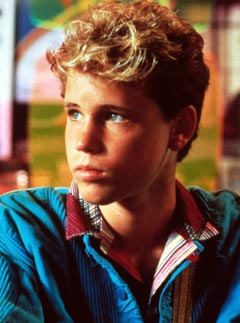
When I was a teenager I had a HUGE crush on Corey Haim. 

In 1986 the movie The Lost Boys was released.  It was one of a flurry of Corey Haim/Cory Feldman cinematic team ups that came out in the 80’s.  The best one of if you ask me.  Though, I suppose, Dream a Little Dream comes in a close second.  The Lost Boys had all the big names of the time:  The two Cory’s, Kiefer Sutherland, Jason Patric, Jami Gertz.  Beautiful people, dressed fashionably (for the time—don’t laugh), and gyrating to one of the best soundtracks of all time.  But at the center of it all, for me, was Corey Haim.


So, picture it.  It’s the 80’s and you live in one of the most conservative pockets in the region.  You’re surrounded by the small town mentality of “traditional” values, where deviation from the time honored norm resulted in bullying and harassment and even violence.  You know you’re gay; you have no interest in girls and panic regularly in the locker room before and after phy ed.  You watch a movie and become enamored by one of the lead actors.  What do you do? 

You get creative and you get sneaky. 

It wasn’t long after The Lost Boys came out that I was able to talk my dad into buying the family a VCR.  Shortly after that the VCR migrated from the family room to my bedroom where I connected it to my little 12” black and white TV.  Somehow I got my hands on a copy of The Lost Boys and voila!  My crush was in my bedroom.  To this day I’m not sure how I didn’t wear out that video tape. 
 

Let me pause for a moment and make an important point.  My crush on Corey Haim wasn’t just teenage lust provoking the typical reaction from a teenage boy.  Even back then I was more relationship oriented than “sex” oriented.  I would rather connect with a person than hook up with a person.  I just don’t want you going away with the wrong idea. 

So, I had “my Corey” on the huge 12” black and white television.  But there was more to feed my crush.

If you were like me, growing up in the 80’s from the safety of a closet, you may have had a sister.  Somewhere in that sister’s bedroom would be a collection.  Sometimes this collection would be proudly displayed.  Sometimes it would be tucked away for safe keeping.  Sometimes this collection would be inconveniently gutted and plastered all of the walls.  I’m talking about magazines.  But not just any magazines.  I’m talking about THE magazines filled with beautiful teenage boys, occasionally flashing some skin, smiling boldly.  In that smile was an unspoken message:  “So what if you’re gay.  I’m here for you.  Let’s talk about how hot I am.”


Occasionally one or two of these magazines would come to visit me in my bedroom.  They would bring New Kids on the Block with them along with Johnny Depp, Jonathan Brandis, Ralph Macchio, and Jay R. Ferguson of the dreamy eyes who I recently blogged about. 

You see, we didn’t have YouTube to watch clips of our crushes dorking around or sending greetings to their fans.  We didn’t have Instagram or twitter.  Time spent with our crushes was planned out, two dimensional, and required considerable imagination.  And if you were like me, isolated and afraid that the real you would be discovered, a certain amount of calculating resourcefulness was also required. 

So, I had a crush on Corey Haim (for obvious reasons) and in order to feed that crush I obsessed over a movie on a little black and white TV and snuck teen magazines from my sister’s bedroom.  There.  That’s my confession.  I’ll give you a moment to stop laughing before I continue.

Got it out of your system yet?

And now a disclaimer:  The tone of my thoughts from here on might sound judgmental.  I think it could be easy to relegate them to the “Hey, you kids, get off my lawn!” category.  I hope you don’t do that because my goal isn’t to be preachy here.  I just have a thought and, honestly, I’m curious what all of you have to say about it.

I admit that my opinion might be formed by a sense of nostalgia but I almost wonder if, at least where the idea of crushing and fanboying and fangirling is concerned, things were better before the internet.  I know that might be strange to hear.  It’s strange for me to say.  And it’s definitely not in keeping with the opinion I’ve shared in previous blog entries in which I celebrate the freedom LGBT people find through technology.  But bear with me and let me explain.

I think that there’s something to be said about mystery.  Mystery fuels the imagination.  Mystery fills in the blanks when reality fails or answers are evasive.  Mystery drives us to discovery, channeling us through a labyrinth of experience that helps develop identity and character. 

On the opposite end of this spectrum is everything that comes with internet:  Constantly flowing information, more than we can possibly consume and, sometimes, more than we want to know.  I had to laugh recently when singer/songwriter Sia made an appearance on James Corden’s “Carpool Karaoke” sketch.  Sia talked about wanting to maintain a sense of privacy in an era where stars have no problem tweeting out pictures of themselves from the dentist.  Just this past week Kim Kardashian West tweeted a picture that left absolutely nothing to the imagination.  A few months ago a photographer managed to “sneak” a picture of Justin Bieber sans clothes, finally showing obsessed fans around the world a side of the Biebster they’ve been wanting to see for years. 

I’m not saying these things are bad.  They just are.  I don’t think it’s possible to ascribe them a value apart from a subjective appraisal and those, I think, I pretty much useless in our culture today. 

I just wonder where the mystery is anymore when anything and everything you could possibly know is instantly available literally in the palm of your hand.  Music doesn’t dance around a topic anymore—it comes right out and says it.  Anyone with an internet connection, regardless of age, can watch total strangers have sex.  Heck, according to certain studies (which, admittedly, are problematic in their methodology), teenagers are having sex younger and younger, leaving absolutely no room for mystery and wonder. 

Do you know what I mean?

I think where I’m going with this can be summed up in this thought:  Everything we receive comes with a cost.   I think there is no better example of this than the internet.  Information flows, educating people, connecting people, creating community, liberating not just LGBT people but people who struggle with abuse, addiction, racism, sexism, and so on.  But when the information gate is opened we can’t pick and choose what information flows lest we make judgments about what information is “acceptable” and what information is “dangerous.” 

I’m not a luddite.  I’m not only fond of technology but I’ve grown quite dependent upon it.  Even if we could rewind time and figure out how to keep the “good things” technology does and eliminate the “bad things” that technology brings with it, I wouldn’t want to.  I wouldn’t want to meddle with that history any more than I would want to meddle with the history of my life and take “missed opportunities” to come out.  Time is.  History is.  We are at this moment in time, with all its good and with all its challenge.  The question isn’t “What should we have done differently?” but rather “What can we do now?”

I don’t know if you agree with me.  Maybe it’s just an observation made by someone who likes to think about things like this.  Maybe it’s something similar to what people who came before me thought about “my time” just like you will think of people who come after “your time.”  It might just be the nature of the universe, to see these positives bring their negatives, leaving people with way too much time on their hands to ask these kinds of questions. 

Regardless of whether or not you agree with my thoughts on the internet destroying mystery and imagination when it comes to the development of sexual identity and the feeding of that curiosity (whether straight or LGBT), I hope we can agree on two things.  First, I hope that we can agree that talking about these things doesn’t hurt anything.  I hope we can agree that coming together and having conversations about things that we either see ourselves or things that others see and bring to our attention can only benefit everyone involved.  Conversation is always good as long as all parties are listening and engaging.

I also hope we can agree on something very important.

I hope we can agree that Corey Haim was so hot!


Wednesday, March 9, 2016

A Beginners Guide to Troy Comets

Today I’m going to take a break from the relatively more serious posts I’ve been doing lately.  The last month or so I’ve seen a huge spike in blog traffic which has generated some feedback.  This makes this whole blogging adventure very exciting for me because I honestly didn’t think the blog was going to go anywhere.  I mean, I’ve tried blogging before—even using my real name and sharing it with family and friends and colleagues.  But to be honest?  I’ve had more readers and support and reaction from you, dear reader, using my pseudonym, than I did when I used my real name and shared with people who actually know me.  Kind of makes you think, doesn’t it?

So, I thought I would pause today and share a few things you might like to know about me and my blog. 

·        Just to be clear, Troy Comets is a fictitious name.  If you haven’t had a chance to do it yet, you might want to quick go and read my first blog post here.  It gives you some important background on why I chose to write with a pseudonym (fake name).  The cliff notes version is this:  Because of my life situation, coming out has been next to impossible and became more complicated with each passing year.  Obviously that wasn’t my intention; even telling lies for what seem like very good reasons results in chaos that doesn’t just affect your life but the lives of people around you.  Adopting the name “Troy Comets” has allowed me to not only publish the kind of stories I would have wanted to read as a teenager/young adult if the world had been different but it’s given me the chance to start this blog and try to make a difference.
·        Because of my need for anonymity and my appeal to you, the reader, to respect that, I try very hard not to share too many details about my non-Troy Comets life.  I think I’ve let a few things slip between Twitter (@TroyComets) and a few remarks in some blog entries.  I do live in Minnesota and I have traveled a bit.  I have quite a bit of education behind me.  I’m not saying that to brag and I’m not going to go into detail.  I think, dear reader, if you stick around long enough you’ll probably be able to figure out what my areas of study were in graduate school.  I just want to remind you of our agreement:  I’ll be here for you, sharing my knowledge and experience and even being that hole in the virtual wall through which you can scream and yell and cry (which I’ve been for a few of you already and you don’t know what an honor it is to have that experience)—all I ask in return is that you don’t go peaking around the curtain.  I’m not naïve.  I know if someone wanted to know who Troy Comets really is they could find out in no time.  But I believe in the inherent good of people and know that my readers aren’t the kind of people to out someone who has explained why coming out isn’t an option right now.
·        Blogging is an interesting thing for me.  I sometimes find that I blog the way I speak.  The way I speak is considerably different from the way I write.  Here’s the difference.  A couple of weeks ago I wrote this blog post on “Community,” having been inspired by a YouTuber by the name of Travis Bryant (@TravisBryantNYC on Twitter).  This is what a lot of my non-fiction writing looks like.  It’s research and cohesive argument driving to an ultimate point.  When I speak publicly as part of my non-Troy Comets life I intentionally leave loopholes and gaps in my thoughts and arguments.  I’ve noticed this approach in my blogging now, too.  The reason for this is that when I speak and when I blog I’m trying very hard to engage people in conversation.  I’m not here to impress you, dear reader, with my knowledge and my experience and beat you over the head with sound, air tight arguments every time I post a blog entry.  There’s a place for that kind of written communication and, as a rule, it’s not here.  I prefer to think of my blog as a kitchen table at which we can gather.  I’ll bring my stories and my experiences and you bring yours and let’s just…talk.  So I leave gaps in my blog writing.  I don’t always flesh out concepts or drive home arguments as hard as I could because I don’t want to control what you think.  I’ll share a thought or an idea or an experience, talk a little about it, and leave it alone for YOU to turn over and interact with.  One of the critiques I give myself is “You should develop this idea more” or “Talk more about this.”  For example, my post Soundtrack could have had more detail, more meat to it.  But that wasn’t my goal.  I didn’t want to talk about myself, I wanted to use myself as an example to encourage you to think about yourself.  I hope that makes sense.  I also hope that it doesn’t come off as condescending.  I just want to have a conversation and that’s just not going to happen if I’m dominating my blog with fine-tuned rhetorical arguments and research discourses. 
·        My goal with the blog since the beginning was to put out two posts each week: Wednesday and Sundays.  The problem is that inspiration is a fickle partner in this adventure.  Though I don’t think I’ve dropped below two posts in any week, I know that I’ve gone beyond that.  Just know that my goal has been two posts each week.  The other factor that complicates things is I’m currently working on my second book.  I’m really pleased with its premise and progress.  It seems like the story is so desperate to be told that it’s writing itself.  But it is a time consuming process and, unlike These Are The Days, I’ve had to do a lot more research for the new book.  I’m still writing what I know and what I would have liked to read but fortunately I always need to know more.  So know that if I’m late on a post or I miss my quota, I’m probably consumed with the new book.  My goal is to get it out early summer. 
·        If you haven’t done it yet, you really need to follow me on Twitter (@TroyComets).  That way I can follow you, too.  Like I said, the whole point of much of this blog is to have conversations.  I can’t tell you how much I appreciate you taking time to read my thoughts but I also want to hear your thoughts.  I want to hear your story.  Following me on Twitter also gives you a chance to help me out with the blog.  Sometimes I throw ideas out there or request ideas/stories from my Twitter followers.  If everyone who reads my blog were to follow me on Twitter and engage in some way….I just got goosebumps over just thinking about the great conversations we can have and what we could learn from each other.  Since starting the blog at the end of January it’s had just over 800 views from all over the world.  That’s a HUGE kitchen table!  Let’s make use of it!


That’s it!  I want to close, though, by expressing my sincere gratitude for your support.  It means so much to me, dear reader, that of all the choices you could make and all the things you could do and all of the other blogs you could be reading, you are taking the time to read this one.  Thank you.  I hope I make it worth your while.  

Sunday, March 6, 2016

Taking Control

(This is part two of a blog series I’m working on.  You can read part one here.)

It was a warm autumn evening in 1986.  School had just started.  I was in 9th  grade.  In some schools this might mean a big change.  Maybe a new building with different teachers and even a new bunch of friends.  Not in my school.  Not in my small town.  It was the same building, same teachers, same people I had known pretty much all my life.  Nothing ever changed except the one stoplight in our town, the only one in our county.

Summer freedom had ended.  The days of relative calm and the corresponding lowering of my guard had been brought to a close for the next nine months.  The imprisonment of body and soul in an institution and a routine which choked out creativity, originality, and authentic personality had begun.  It was time to conform to the expectation of peers and to pretend I was normal like everyone else.  Just like everyone else pretended to be normal like everyone else. 

This return to routine also meant a return to other age appropriate expectations.  For me this was represented by a return to church activities, particularly confirmation instruction.  I didn’t mind it.  Church, like other things in my life, seemed to be wired backwards.  Fourteen year olds shouldn’t enjoy church any more than fourteen year old boys should have crushes on other fourteen year old boys.  But I did enjoy my church experience growing up due in large part to experiences like the one that brought me to crossing the paved parking lot outside the local movie theatre on that warm autumn evening in 1986. 

It was a Sunday.  I had gone to church, as was expected of confirmation students.  After worship I went to the church’s basement and sat down at the table in the kitchen for…Sunday School. 

Forget everything you know about stereotypical religious education and Sunday School in general.  There were five of us who were “the regulars” who gathered at this kitchen table weekly to learn from one of the most formative people who has ever come into my life.  She was “religious” but not “holier than thou” religious.  She was a nurse who was enormously compassionate and understanding, patient to a fault sometimes.  And the struggles her son, who had transitioned into early adulthood, gave her a realistic and pragmatic view on the topics that teenagers faced in the mid-1980’s.  Her son’s drug addiction inspired her to be open and authentic with the riskier topics of addiction and other themes that were considered too adult to be taught to a group of teenagers who were being prepared to transition into adulthood in the eyes of the church. 

My Sunday School teacher was cool.

I don’t remember how it came up but I know that by the end of the hour in that kitchen that morning the plan had been made.     We would meet back at the church at 6:00 and pile into the teacher’s station wagon.  One of the other student’s mom would join us.  We were heading to the movies.  And not just any movie.  We were heading to see “Stand By Me.”

Let me put things into perspective since I know that by today’s standards “Stand By Me” is pretty tame.  Kids smoking and swearing?  Kids being honest about the troubles in their lives?  Kids going to find a dead body?  It was an “R” rated movie at a time and in a place where teenagers just didn’t go to see “R” rated movies.  But we were going and our Sunday School teacher was taking us. 

There’s a scene about halfway through the movie where two of the four main characters of the film are talking privately.  Gordy is trying to convince Chris to join him in taking some of the “smart kid classes” when they go back to school in the fall.  “You’re smart enough.” awkward Gordy assures his friend.  “They won’t let me.” Chris, the tough guy/leader of the misfit gang, says quietly.  Gordy presses him to explain and Chris continues.  “It’s the way that people think of my family in this town.  It’s the way they think of me.  I’m just one of those low life Chambers kids.”
           
“That’s not true.” Gordy argues flatly.

“Oh, it is.” Chris declares fiercely.  “No one even asked me if I took the milk money that time.  I just got a three day vacation.”

“Did you take it?”

“Yeah, I took it!  You know I took it!  Teddy knew I took it.  Everyone knew it, I think.  But maybe I was sorry and I tried to give it back.”

“You tried to give it back?!”

Chris shrugs.  “Maybe.  Just maybe.  And maybe I took it to Old Lady Simons and told her and all the money was there.  But I still got a three day vacation because it never showed up.  And maybe the next week Old Lady Simons had this brand new skirt on when she came to school.”

“Yeah!  It was brown and had dots on it!”

“Yeah.  So let’s just say I stole the milk money but Old Lady Simons stole it back from me.”  Chris presses.  “Just suppose that I told the story.  Me.  Chris Chambers.  Kid brother to Eyeball Chambers.  You think that anyone would have believed it?  And do you think that bitch would have tried anything like that if one of those douchebags from up on The View would have taken the money?  Hell no!  But with me?  I’m sure she had her eye on that skirt for a long time.  Anyway, she saw her chance and she took it.  I was the stupid one for even trying to give it back.”

And then we, the audience, see just how talented of an actor River Phoenix was. 

Chris’ lip starts trembling and his voice becomes heady and he starts sniffing back tears.  “I just never thought…I never thought that a teacher….Oh, who gives a fuck anyway?  I just wish that I could go someplace where nobody knows me.”  And tough guy Chris cries.


At the time, my fourteen year old self could completely identify with Chris Chambers.  Not that I had ever stolen anything or been accused of stealing anything.  But in Chris’ desire to be someplace else, to escape the stigma attached to his name and the judgment from the people around him—my fourteen year old self heard his own voice in Chris’ desperate wish.  Rumors, gossip, judgment, and everyone thinking they knew absolutely everything about absolutely everybody—that I could identify with in a painful way from the confines of “my closet.”

It’s one of my all time favorite films, “Stand By Me,” and so I find myself watching it regularly.  As the years went by and I grew to both understand the world and these fictional representations of very real people in the world, I began to see this powerful scene differently.   This is more than a kid feeling trapped by the sins of his family and the judgment of his community.  This is a kid who’s beginning to take back control of his story.  It’s from this point onward that we hear more and more from the adult Gordy, who is narrating the story, that Chris, unlike Teddy and Vern, takes the heavy academic classes with Gordy while Teddy and Vern disappear into the crowd, having taken the more “traditional” classes for people of their “class.”  Chris graduates and becomes a lawyer, a “peace maker,” the adult Gordy calls him at one point. 

There is nothing more damaging to a person’s self-esteem and self-concept than to let other people tell their story.  It limits us.  It handicaps us.  It puts us into a box.  When people, even well-intentioned people, decide what our themes and motives are, what our story is, how we could and should interact and react to the world around us—when we allow other people to tell our story, we lose ourselves to their interpretations and expectations.  We even run the risk of believing what others think and believe is the truth about us.  

This works both ways, by the way.  It’s not always about adopting the “negative” interpretations of our identities that others try to apply to us.  “Positive” reputations can be just as damaging.  Think about how many musicians and actors have crashed and burned because they started to believe all the hype surrounding them.  It’s more difficult to step away from attempts at wrestling this kind of control away from ourselves because, frankly, who doesn’t like to hear about how awesome we are?  There’s a huge difference between acknowledging a compliment and adopting another’s view of who we are and how awesome they think we are.  Sometimes being told that you can do no wrong only to discover that you can is more damaging than being told you can do nothing right and then discovering that you actually can do many things right.

I don’t know what it is in people that makes them want to recast the people around them for their purposes.  It might just come down to convenience.  It makes things much easier when we think we have everything figured out and everyone does what we want and responds the way we wish. 

Today I struck YouTube gold.  I’ve been chewing on this post for a while and trying to come up with a really good example of someone taking control of their story, someone who is able to speak to the struggle and occasional pain a person experiences when they try to push back against the confines of the box in which they’ve been placed.  Today, not even an hour after it had been posted, this video caught my attention.  

I love Chris’ video for a number of reasons.  The first is the sincerity with which he speaks, particularly when he talks about his desire to share parts of himself and show the things in which he believes.  As the video unfolds we realize the Chris that begins the video is a Chris from a week ago who just couldn’t find the right words or work up enough courage to take control of his story.  I don’t want to interpret or reinterpret Chris’ words or motivation but, taken at face value, I think he presents a very genuine struggle with enduring questions and allusions to his possible identity.  I think that a lot of his care and hesitancy in telling his story here is that he wants to be honest about who he is and take possession of the narrative of his life but he also desperately doesn’t want to appear judgmental or hurt anyone in the process.  If I’m wrong or missing something, I’m hoping that Chris will let me know.  I have to say, though, that this is one of the best candid and uncontrived conversations I’ve ever heard on the topic. 

It’s amazing to me how YouTube has become a vehicle of empowerment which encourages people more and more to simply tell their story.  I think it’s like anything; when a person starts there’s a certain amount of finding your voice that takes place but eventually authenticity begins to show through.  We, the audience, learn more about you, the artist, and we begin to see your personality, your values, your passions, and even your fears.  You inspire us to be the best us we can be.  Through honest conversations like this one of Chris’, we become emboldened and brave.  We discover our own voice and then we use it to share our story. 

Here’s the thing.  I’ve blogged a little bit before about the struggles of being in the position that I’m in.  I will not deny it:  I am very jealous of LGBTQ youth and young adults today because of how “easy” you have it compared to those of us who came before you.  You tell your stories honestly.  You even own your fear and uncertainty.  Like my fourteen year old self seeing River Phoenix playing a character in a movie who wanted to escape to a place where he could be himself, I look at you and wish the same thing.  I end up going through the, “If onlies” at breakneck speed.  “If only I could have had those opportunities…”  “If only I could have had a family like that….”  “If only the internet had existed when I was that age…”  “If only I could have just had the courage to be honest.”

But the problem is that if any of those “if onlies” were true, my story wouldn’t be my story.  Many of the experiences I’ve had, like the experiences many of us have had, have been far from pleasant or ideal.  Things have not “been fair.”  But these downs—all of these negative experiences and painful struggles—have been MINE.  They help to define me and create my story just as much as all of the good things I so easily own and celebrate.  Without these experiences and the knowledge that has come with them I wouldn’t be in the position I’m in now, a position of hopefully helping others to be true to themselves.

So, yes, I sometimes watch YouTube videos with a wistful eye and wish that my life could have been something else.  We all do that.  It’s human nature.  But we can’t let that desire for a life that simply isn’t ours force us to abandon our own stories.  In the end this becomes just as destructive and damaging as letting someone else define us. 

There is absolutely no one in the world better suited to tell your story than you.  You’ve been there every step of the way.  You’re the only one who can truly speak to your motivations and your decisions.  You’re the only one who can detail your joys and sorrows.  You’re the only one who can competently identify the themes in your life because it is your life. 

And, believe me, people want to hear your story. 


Wednesday, March 2, 2016

Thoughts on "The Real O'Neals"

Tonight on ABC (American Broadcasting Company), a new sitcom premiered:  “The Real O’Neals.”  I don’t watch much television on the TV.  It’s the 21st century; I stream and do on-demand when I’m in the mood to watch something.  It just happened that I found myself in front of the TV tonight and caught the first episode of a show I only heard about two days ago online. 

But before I get into it and share my thoughts on the show, in the interest of full disclosure I need to point out how ironic it is that in 2016 I’m watching a show that stars one of my very first “movie star crushes” from 1990.  Yes, I’m talking about Jay R. Ferguson.  Here’s a blast from the past.


This is Jay Ferguson as Ponyboy Curtis in FOX TV’s 1990 series “The Outsiders.”  It was the eyes, man.  Look at those eyes.  My teenage self was mesmerized. 

Hold onto this fact for a bit.  I’ll be coming back to it.

So the set up for “The Real O’Neals” is this:  The ideal, normal Irish Catholic family struggles to realize the fact that there is no such thing as normal as family members confess a series of real life issues and struggles:

Jimmy (the older son) is anorexic.
Shannon (the daughter) is a thief.
Kenny (the younger son) is gay.
Mom and Dad are getting a divorce.

So, yeah, that pretty much undermines any sense of “normalcy” in the classic understanding of the good Catholic family. 

Let me be honest for a moment.  I caught the previews for the show two days ago.  They grabbed my attention.  I sat down tonight and watched the first two episodes.  My initial concern was that the show was going to define itself too narrowly as “that TV show about the gay kid.”  What frustrated me about the creation of a show that attempts to normalize the experiences of LGBTQ youth and the whole coming out process these kids go through and the journey their families inevitably take in their acceptance of the reality of the child’s identity—what frustrated me was that, in my mind, the target demographic wouldn’t be sitting down to watch the show.  LGBTQ youth find their normalizing figures and heroes online and not on the television.  Why?  Because this generation of LGBTQ youth look for honesty and connection.  They’re not going to be satisfied with an actor’s portrayal of a struggle that is very real for them.  They will see through a perfectly cultivated and manicured script that, by the end of the half an hour, will solve all of the character’s problems and everything will come up puppies and unicorns.  They see through the Hollywood tricks. When the struggle is real for you, watching it acted out by professionals with scripts that not only solve real problems LGBTQ kids face but solve them by making the LGBTQ characters witty and perfect—it isn’t entertaining.  It isn’t comforting.  It complicates things even more.  It presents yet another impossible ideal for them.  They would much rather log onto YouTube and listen to real stories from the trenches than sit down and watch a romanticized version of a life that doesn’t exist. 

So I worried that the show was going to do more harm than good.  It wasn’t going to reach what I felt was the target audience. And when it would get canceled its critics from the religious and political right would celebrate its demise as demonstrative of how “America isn’t interested in those values.”

And then I started laughing at Martha Plimpton’s comment about “pity pork” in the second episode and I found myself relaxing and rethinking my initial cynicism.  I found myself enjoying the writing more and more.  I started appreciating the individual performances of the brilliant cast.  And then my brain made a connection:  Comedy comes from pain. 

Now, I’m not necessarily talking about dark comedy and gut-wrenching pain.  I’m talking about the fact that as human beings we tend to use comedy to move us through painful times in our lives.  We tend to use humor to soften the edges of our agony and hurt so that our story becomes more bearable.  Imagine what it would be like if we weren’t able to laugh in those dark times. 

Let me give you a quick example that has absolutely nothing to do with “The Real O’Neals.”  My grandmother (the mother of my mother) died from cancer in 1993.  My mother, my at-the-time-very-pregnant-aunt, and my great aunt all went on a road trip to see the best cancer doctors in the area.  They were all in the room with my grandmother when the doctor shared the news that the cancer was terminal and there was nothing that they could do.  My aunt had to leave the room; she was so emotionally distraught.  My grandmother, a few minutes later, followed her out into the hall and said, “You’re ruining all the fun, you know.”  In that moment, my grandmother’s sense of humor broke into a very painful moment to remind my aunt that there was more to their time together than this horrible moment.  My aunt still laughs when she shares this story.

I think that’s what “The Real O’Neals” might be attempting to do.  This isn’t a how-to show.  It’s not like we’re going to tune in to Jay Ferguson, Martha Plimpton, and Noah Galvin to tell us how to navigate issues of marriage, religion, and identity like we would tune into Nicole Curtis on DIY to show us how to sand a window and mount it in the wall.  This is a comedy in the traditional sense:  It’s trying to communicate something through humor to address the pain and struggle many folks experience in their day to day lives. 

That’s when it kind of hit me.  Though I stand by my first reaction (that most LGBTQ kids aren’t going to be on the couch watching this show because it’s in their nature to want something real and not massaged like a sitcom), I realized where my negativity was actually coming from.

And this brings me back to my teenage crush on Jay Ferguson.

When I was a kid and was “forced” to sit and watch “The Outsiders” because my sister was obsessed with the show, I remember to this day the panoply of emotions that tore through me.  It wasn’t just a matter of watching this “hot guy” with killer eyes but it was the struggle of knowing that, in that place and in that time, that kind of attraction was not “normal.”  I would have killed to be able to sit on the couch, even in the silence of an inability to come out, and watch a family struggle to understand there is no such thing as normal even within the context of religion and identity.  Just watching it would have softened the edges of my agony and hurt.

Truth be told, I am still a little worried that “The O’Neals” may end up narrowly defining itself.  But I think I’ve come to a place of appreciation for the show—or at least the first two episodes.  What I think would be interesting is to see how many coming out stories follow the #TheRealONeals hashtag as the show moves forward.  How many LGBTQ youth might actually find the courage to turn to the adults in their lives and say, “Kenny?  Yeah.  That’s me.”  And hopefully the adults will be able to turn to their kids and, even in Martha Plimpton’s Eileen-way say, “I love this project.  I’ve known this project since it was a little project.” 


God knows too many of us should have had opportunities like that when we were growing up rather than suffering in silence.  So even if “The Real O’Neals” does end up narrowly defining itself, at least it’s here now, helping to bring attention to the struggles of LGBTQ youth and their families, and normalizing the struggle of telling their story.  

Tuesday, March 1, 2016

Community

Recently I took the opportunity to sit in on a YouNow session with the very talented and inspirational Travis Bryant.  If you don’t recognize his name, you can find him on Twitter @TravisBryantNYC and you can catch his videos on Youtube by searching for “Travis Bryant.”  Travis is a youtuber.  He’s part of a growing group of individuals who document parts of their lives and create entertaining and thought provoking videos for the world at large.  If you want to check Travis out, start with this video.

During the course of the live streaming conversation between Travis and roughly one hundred fans on YouNow, Travis started talking about trying to encourage a positive and supporting community for all of his fans to be at home in.  This resonated with me.  I quickly typed a question into the chat field.  “How much of your desire to create community comes from the fact that you didn’t really have a place to belong when you were younger?”  Travis saw the question (which is a bit of a miracle if you think about it because with one Travis and 100+ fans, you can imagine that the flow of conversation moves pretty fast).  He confirmed what I suspected: It definitely comes from not having a sense of belonging while growing up. 

Human beings are communal creatures.  We crave community.  We look for groups of people that meet our needs and help inform and affirm us as individuals.  It’s not just a social need that is being met when we connect with community; we learn from the community and, through our participation, the community is made stronger. 

Before I go any further I want to pause and define what it is that I mean by “community.”  Often times I think returning to the origin of words helps us understand the word the best; that is certainly the case with a word like “community,” which has somewhat lost some of its power in recent years as it has moved into the ever-broadening lexicon of “buzzwords.”

The entry at dictionary.com for “community” isn’t the best but it includes this discussion of the word’s origin:   

Latin communitatem" was merely a noun of quality ... meaning 'fellowship, community of relations or feelings.” 

I don’t like this discussion for two reasons.  First, as I’ve gotten older I’ve come to understand what my third grade teacher used to yell at us about when we did vocabulary words:  You can’t use the word you’re trying to define in the definition of your word.  Dictionary.com is basically telling us that the word community comes from a Latin word that means community.  Thanks, dictionary.com.

The second reason I don’t like this discussion is that it’s too truncated.  I wonder what those ellipses are replacing. 

The one thing that this explanation has going for it is that it describes what this “fellowship, community” is established around:  relations or feelings.  This is key.  Remember this.

As I said above, “community” has become a buzzword in many circles.  People are looking for a thing called community.  People are establishing something called community in new ways and in unexpected places.  We are beginning to understand that something called community is no longer bound geographically or involves a shared ownership/stake in a tangible thing (“community pool,” “community garden,” etc.).  This revolution in the consideration of community, what it is/how it looks/where it is found, is a direct result of the advancement of technology, specifically social media.  Remember this, too. 

So what is it about this thing called “community” that calls to us?  Why do we crave it?  What do we get out of it?  And, most importantly, what happens if we don’t have it?

In 1986 social Psychologists McMillan and Chavis published a theory in The Journal of Community Psychology .  The theory was called “Sense of Community” and McMillan defined it like this: 

“Sense of community is a feeling that members have of belonging, a feeling that members matter to one another and to the group, and a shared faith that members’ needs will be met through their commitment together.”

Please note that I don’t believe that McMillan’s use of the word “faith” here should be understood in a religious context.

In 2013, David Spinks explores the research McMillan and Chavis did and identifies four factors that contribute to a sense of community.  They are:
1.     Membership (including a process of gate keeping, creating trust and emotional safety, a sense of belonging, personal investment or having a stake in the community, and a rallying symbol like a jersey, gang colors, pink ribbon, etc.)
2.     Influence (influence of members over the community and community over members; members need to know they have a say that matters and the community means something to its members)
3.     Integration and Fulfillment of Needs (members feel rewarded/completed/fulfilled by their participation in the community)
4.     Shared Emotional Connection (this includes a shared/common history and sense of a future trajectory in and for the community; “This factor is believed to be the ‘definitive element for true community.”)

I would also like to suggest as part of the shared/common history of members within the community there is a transmission of values and ideals.  That is to say that the things that are important within the community, the mentality and traits that are valued by the community and the behaviors exhorted by the community, are handed down from generation to generation or sideways from existing members to new members.  Another way to think about this is that it’s through community that we send and receive elements of our culture.

But notice how most of these four elements connect in some way with that idea of a shared relationship or feeling?  There is a fellowship (companionship) centered on emotional elements.

So here’s the question with which we should struggle:  What happens if we lack that sense of community?  What happens if we are denied access to this thing that psychology tells us with greater and greater urgency is so important to not just our development but our ongoing mental well-being?

I know a number of families who have adopted children across ethnic lines.  On the surface it’s a beautiful thing but it does come with some struggles.  Part of the struggle comes when the identity question, complicated by the adoption, surfaces.  One of the families, who adopted two children from Korea, experienced significant struggles with one of the children.  Part of the problem was the community question; the family, though quite active, couldn’t seem to find a community that would meet the child’s needs.

That was an obvious example.  It’s obvious in that there are physical traits that enter into the equation when considering the community question.  It’s difficult to participate in and develop a connection with a community when you never completely feel accepted by the community because of physical traits that define you as different.  In an overwhelmingly White community with minimal multi-ethnic understanding or even tolerance, where do you find community when you are obviously not White?  You’re an outside out of the gate and connection with the community is going to be complicated. 

What if the example isn’t so obvious?  What if it’s not a question of appearance or physical characteristics?  What if it’s a question of an identity that is in development, an identity that is labeled as “deviant” by the communities a child is socialized in by a family that doesn’t know any better?

This is what happens with so many LGBTQ people.  I almost said “kids” but it’s not just kids.  Adults, too, who struggle with identity struggle in part because there is no community for them, no way to gain that sense of belonging, sense of normalcy, sense of “you’re okay, we’re in this together.”  In fact, many LGBTQ people receive the opposite from the communities they are naturally matriculated into—political organizations, churches, skill and development organizations.  This isn’t as bad as it used to be.  For example, the Boy Scouts no longer discriminates against LGBTQ people (at least policy wise) but remember that just because there is an absence of discrimination doesn’t mean there is actual acceptance. 

And that’s really the problem, isn’t it? 

Michael Friedman, PhD, wrote an article entitled “The Psychological Impact of LGBT Discrimination” in 2014.  In this article Dr. Friedman identifies a number of troubling statistics and phenomenon faced by LGBT people including:

·        As many as 50% of LGBT teens experience a negative reaction from parents when they come out.
·        30% of LGBT teens experience abuse
·        LGBT children make up 40% of all homeless youth due in large part to family rejection
·        LGBT adults who report rejection by their families are six times more likely to experience depression, three times more likely to use illegal drugs, and eight times more likely to attempt suicide than their “non-rejected” peers.
·        85% of LGBT children are verbally bullied in schools during the course of a school year.
·        40% of these report physical bullying
·        19% of these report being physically assaulted (Remember, too, there is a thing called reporting bias in which people aren’t always honest and forthcoming when it comes to reporting these things because they fear the potential for repercussion.)
·        30% of those LGBT students who experience bullying cite the bullying as a principle reason for missing school because they feel unsafe.
·        LGBT students who experience bullying are six times more at risk for depression and suicide than their straight peers.

How do you experience community when you are denied the experience of family?  How can you experience the element of trust and safety if the people who should love you are the people who abuse you because of something you can no more change than the color of your eyes?  How can you discover a sense of belonging when you are perpetually in transition?

And, again, it’s not just kids.  Adults experience this as well.  42% of LGBT adults experience workplace discrimination; according to Dr. Friedman, this is four times the rate of straight employees.  Those who have experienced workplace discrimination because of their sexual identity have higher levels of psychological stress and health related problems, less job satisfaction, and greater absenteeism. 

I hope you’re getting the idea.  So many experiences in the lives of LGBTQ people alienate and isolate LGBTQ individuals.  Just because a person might appear active and busy, involved in different organizations and appears to be socially engaged, it doesn’t necessarily mean that the individual’s need for community is being met.

Justin Worland (@justinworland), a writer for TIME Magazine, wrote a piece on March 18, 2015 entitled “Why Loneliness Might Be the Next Big Public Health Issue.”  Mr. Worland doesn’t speak directly to the LGBTQ issue in his piece but he does bring up some important points to consider.  These points are developed out of a study published by Brigham Young University, which, coincidentally, isn’t too likely to consider taking up a study about loneliness in LGBTQ populations.  If they were, I think they might find the opposite of this observation is true in LGBTQ circles:

Many social scientists say technology and housing trends are increasing the risk of loneliness. More Americans are living alone than ever before, and technology like texting and social media has made it easier to avoid forming substantive relationships in the flesh and blood. Yet research shows that relationships can improve health in a variety of ways, by helping us manage stress, improving the functioning of the immune system and giving meaning to people’s lives.

For a long time I’ve been skeptical of technology’s ability to host and house sustainable community.  It’s fleeting, it’s not tangible, there’s no sense of physicalness and the security that it can give or the emotional support that can be shared.  Emoji are cool but I have yet to see a study where an emoji can trigger the same emotional/psychological reaction as a hug can. 

And yet I think the one population among whom technology encourages a sense of connection and community is in LGBTQ circles.  Why?  Because it can be anonymous; honesty in the real world comes with a price whereas honesty online can be safe as long as you protect certain truths.  I mean, think about:  You are reading the blog of an author who won’t use his real identity to publish anything because of the real life consequences his coming out would cause.  Cyberspace may not be as stable as the real world (but, remember, stability is a subjective thing particularly when you remember the statistics Dr. Friedman cites with reference to LGBTQ youth) and emoji aren’t hugs, but in cyberspace stories can be shared, a common history discovered, and acceptance can be found.  At least in some measure.

This brings me back to Travis Bryant and many other youtubers out there.  I only discovered Travis about two months ago.  I haven’t met him in person.  I haven’t talked with him outside of the conversation I cited at the beginning of this post.  But I *do* see something special in him and people like him.  They are able to share their stories and create a community around themselves where others can share their stories by participating in the life of the community.  By taking just an hour of his time on a Sunday afternoon to sit in front of a camera and hang out with 100+ fans, Travis models behavior and acceptance that too many teens (and adults) are literally dying for.  In the two months since I first stumbled across Travis’ videos rarely has there been a week in which I haven’t thanked him for his willingness to share his story and be a role model for the LGBTQ community.  Not only does this model turn writer normalize an identity that on the surface may be gaining greater acceptance but he is willing to open up about his struggles and encourage a positivity that I would bet the majority of those 100+ fans who were in that virtual room on Sunday don’t experience in their day to day lives. 


That is community.