I need to tell you about my cousin, Joanna.
So I’m really good with people. It’s equal parts education and intuition, I
think. I spend a lot of time watching
people and I’ve spent a lot of time working with people. It doesn’t take me long to figure a person
out. It comes with my background and
training. People talk to me or I listen
to people and things just click into place, giving me an insight into the
person’s goals, interests, fears, and challenges.
For example. If you
tell me that you have a difficult time having a relationship because you
exhaust yourself and neglect yourself for the energy you invest in the
relationship, I can tell you that you haven’t had people to connect with in the
past and you’re so desperate not to repeat a pattern of broken connections that
you put everything into your
relationships. You are driven to
connection but by the time you’ve poured all you have to pour into a
relationship in order to secure that relationship you’ve burned yourself out. (This is just an example from a conversation
I recently had. It’s not a universal
truth.)
It’s easy for me, given some time, to figure people
out.
My cousin, Joanna? It
takes her absolutely no time to figure a person out. She is so good at intuiting people, their
motivations, their fears, their emotions, that it makes a lot of people
uneasy. She’s so good at this she’s
developed this shtick in which she “reads palms.” She’ll hold your hand, point at the different
lines, tell you the names of the lines and what they all mean, and then she’ll
completely ignore your hand and tell you everything about yourself. I’ve seen her do it hundreds of times and it’s
fascinating.
It’s not always received well. Once people know she does “this palm reading
thing” they’ll race up to her, holding out their hands. Once people see how accurate she is in her
observations, people’s hands start disappearing into their pockets. I have family members who actually stay on
the opposite side of any room Joanna’s in for fear that she’ll see their
secrets and truths in their eyes.
My cousin Joanna is unconventional. She’s a free spirit. She’s a seeker. She’s deeply spiritual but challenges a lot of
ideas about traditional religion. I’ve
learned a lot from her—about people, about myself, about faith and
spirituality.
I’ve held onto something Joanna taught me a few years
ago. It was such a brilliant way of
explaining and describing something I see in certain people and how these
people affect the world around them. She
taught me the concept of a lightworker.
One of the reasons I held onto this information the way I
have is that nearly every approach I take to explaining how people react to and
interact with the world around them is based in traditional Christianity. I use Christian terminology to explain, in
Christian terms, how God works through people to improve the word, specifically
in providing care for the least and the lowest.
This works great if it’s Christian people of faith I’m speaking with,
but as regular readers of my blog may have figured out by now, I have a
particular interest in reaching out to the people the Church has hurt in some
way. Who wants to hear about how God
works through people when the people who should be God’s hands and voice in the
world are the very people who have rejected you, called you names, and stripped
you of your humanity for simply not conforming to their expectations?
So I’ve held onto this idea of lightworkers. I’ve used the term before with people. The trick of it, for me, is that I’m
abandoning Christian terminology and concepts for the language and metaphor of
another religion…and that doesn’t make me feel comfortable either. My discomfort isn’t that I think Christianity
is right and the other religion is wrong.
My discomfort comes from the fact that I’m not a part of the faith
tradition that speaks of lightworkers. I
don’t want to be one of those people who picks over other religions,
philosophies, and cultures for “the good stuff” and then, in my arrogance and
ignorance, misrepresent the thing I’ve stolen.
I also never want to speak for a group or culture to which I don’t
belong.
But I find myself using this term more and more because I
think it accurately represents a phenomenon that can be seen in people
regardless of faith tradition. So as I
talk about lightworkers, I hope that I do so respectfully and accurately.
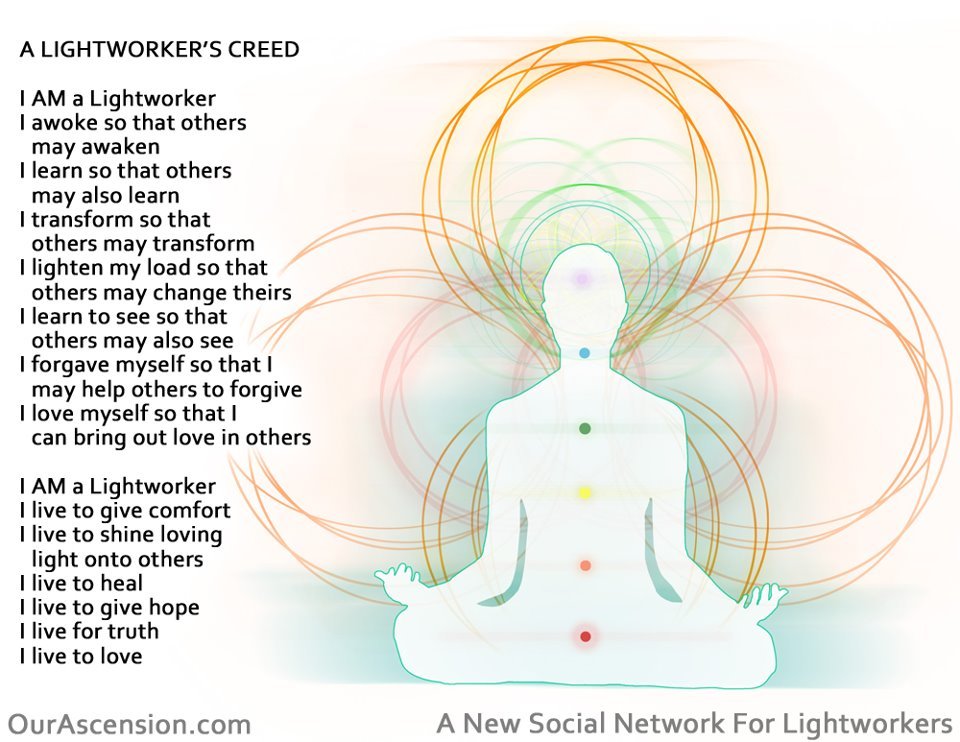
What exactly is a
lightworker? One resource suggests
the following:
Lightworkers are souls who carry
the strong inner desire to spread Light – knowledge, freedom and self-love – on
earth. They sense this as their mission. They are often attracted to
spirituality and to therapeutic work of some kind.
Because of their deeply felt
mission, lightworkers often feel different from other people. By experiencing
different kinds of obstacles on their way, life provokes them to find their own
unique path. Lightworkers are nearly always solitary individuals, not fitting
into fixed societal structures.
I think this description might be a bit conservative
compared to others I’ve seen in that the individual actually may not realize
how spiritual they are or recognize how their work (light) actually affects the
people around them. I do think it’s
universal that these individuals are “helpers” in some way. It may not be some sort of therapeutic or
healing job in which they work but somewhere along the way they engage in healing
activities to help people around them.
Healing in this case is more than just physical healing. They are motivated to see healing in the
world—healing within communities and healing within individuals.
That’s kind of the “ground floor” explanation of
lightworkers. From there the definition and
identification of traits becomes more and more spiritual. I don’t want to go any deeper into the
spiritual conversation for our purposes here mainly because I’m not qualified
to speak to the deeper spirituality.
What I want to focus on is the fact that these are people who, consciously
or subconsciously, reach out to the hurting people around them to ease their
pain and make the world a better place.
Think about everything you know about the imagery of
light. Light is used to connote healing,
knowledge, wisdom, life, and good. It
can convey grace or blessing from divine forces. The disappearing of light can reflect fear,
anxiety, cold, illness, and death. The
coming of light can convey understanding, growth, healing, and salvation from
difficulty. Light metaphors permeate our
literature (“…what light through yonder window breaks?”) our music, our movies,
and our religious expressions. It’s
universally known imagery within the whole of human experience even apart from
a religious context—and that’s why I’m drawn to the term.
To me a lightworker is an individual who has a knack for
understanding things differently, through compassionate eyes that see deeper
into the humanity of struggles most politicians and religious leaders choose to
over-simplify. With that unique
understanding comes the ability to connect with people to pass the light which
is within them along to others.
I believe lightworkers are able to make these connections
through common struggles and pains. I
think that’s why, within the context of the LGBTQ community and
relationships/friendships, it’s through the recognition of common struggles,
themes, and pains that create the bridge for the light to pass between the lightworker
to the person in need of healing. Why do
you think the “It Gets Better” campaign is so successful? People who watch these videos and hear these
stories are able to see themselves in the “expert’s” story.
Why am I even bringing this up? Over the past couple of weeks my blog has
focused on taking control of your own story along with some serious discussions
about homophobia, bullying, and suicide.
I’ve spent time taking my faith tradition to task for continuing to hold
onto ignorant and superstitious interpretations and institutionalized
prejudices. Why am I suddenly talking
about this concept of lightworkers?
Like all of you I’ve been watching the news. Brussels was just attacked; another city of
innocents drawn into a war of ideology and politics that the Western world
created but refuses to take responsibility for.
North
Carolina has legalized bigotry by passing a law that does not protect LGBTQ
people from discrimination. The
state of Georgia is on the verge of signing into law a bill that would give religious
officials in the state the option to refuse to perform same-sex marriage
ceremonies and for tax-funded groups to deny services to gay people. Donald Trump’s rise to power continues. The Senate GOP refuses to do its job by
calling for hearings to confirm Judge Merrick Garland to the Supreme
Court. Iran sanctions, Obama in Cuba….it
all just gets to be too much. The news
is so incredibly discouraging and that just the news. The talking heads on the 24/7 news networks
have no idea of the struggles of my life or yours, the pain that doesn’t hit
close to home but lives in our homes. It’s
easy to feel like the darkness is about to swallow us whole.
But one
of the things I’ve noticed more and more is this: The darker things seem to get, the more
people I would consider lightworkers I seem to notice. I guess it’s true: You can’t appreciate the
power of a candle until all of the lights have gone out.
I see a
lot of candles in the darkness.
They’re
all around us. They come to us from a
variety of places, usually unexpected places as the world continues to
change. They reach out to us, to
reassure us and bring us healing and hope, to remind us that we matter and have
value. The tell us it will get
better.
I think
the old saying still holds true. “The
world is going to hell in a handbasket.”
But that’s nothing new. Humanity has
been visiting pain and suffering onto itself since we learned to walk on two
legs and make fire. But more than that
and much more importantly than that: We
are able to do so much more good.
Sometimes I wonder how our public mood would change if 24/7 news
networks would start reporting light-related stories rather than the headlines
that have traditionally made them money—headlines of murder, terror, and fear.
So,
look around you. I guarantee that no
matter how dark it seems right now in your life and how overwhelmed you are by
the horrible stuff that is going on in the world and in your life, there are
lightworkers right there with you, ready to share their light. I also guarantee that everyone who is reading
this right now has enough light inside of themselves to reach out to the broken
world around them to make life a little better for the people around them as
well. You are both worthy of the gift of
hope that people will offer you and able to share that gift with others. I promise you.