Follow Me on Twitter!

Find me on twitter @TroyComets
Showing posts with label writing. Show all posts

Monday, April 4, 2016

Life Lessons from Dungeons and Dragons

Last Friday I wrote about the challenge I have in writing LGBT antagonists.  On the one hand I said that I like to write fiction with which the readers can identify.  It’s unfortunately extremely easy for LGBT readers to identify with LGBT characters whose stories show a struggle with the “traditional” mentality of the non-LGBT majority.  IN my writing the LGBT character/community is the hero going up against institutionalized ignorance and homophobia in families, religious communities, schools, and politics.

On the other hand I confess that there is a danger in always setting up a story with this formula.  Even though I still believe that this particular formula makes it easy for LGBT people to see themselves in the story and identify with the characters because they share a common struggle, I also have to acknowledge that the world isn’t as black and white as we sometimes make it out to be.  Not all non-LGBT people and institutions are bad guys (obviously) and not all LGBT people are heroes. 

I’ve been chewing on this idea since I posted that 500 word essay last week.  I’ve come to the conclusion that, though I’m obviously well intentioned, I’m feeding the beast that is one of our society’s most challenging problems:  Oversimplification leading to polarization.

In Harry Potter and the Order of the Phoenix, Harry is complaining to Sirius Black about the new teacher, Professor Umbridge.  He clearly believes Umbridge could be a Death Eater, the bad guys who support He-Who-Must-Not-Be-Named.  In response Sirius observes, “…the world isn’t split into good people and Death Eaters.  We’ve all got both light and dark inside us.  What matters is the part we choose to act on.  That’s who we really are.”  I think this also becomes part of the answer to the recurring question of, “If all the bad guys come from Slytherin, why not just kick them out?”  Because it’s not that simple. Look at Snape, one of the best literary characters of all time

What stings a little as I come to terms with this oversight on my part is this.  You would think that someone with a background in counseling and psychology, who is a fierce advocate for the appreciation of any individual’s story rather than summarily dismissing or categorizing the individual based on my limited understanding of their story—you would think I would know better.  You would think that I would be more aware of the “shades of gray” when it comes to individual morality and personality types.  To truly understand an individual’s motivation we need to hear their story and, after hearing their story, we will very rarely ever find that the individual does what they do because they describe themselves as “evil.”

Here’s a great example.  Last night the season six finale of The Walking Dead aired and it shocked fans.  I mean, Alfred Hitchcock once said, “Always let your audience suffer as long as possible.”  Well, The Walking Dead takes Mr. Hitchcock’s advice to the next level.  Last night we were introduced to the new antagonist, a guy by the name of Negan, and by the end of the episode all we know is that Negan has killed one of our heroes.  We don’t know who.  All we know is that we now hate Negan. 

After new episodes of The Walking Dead, there’s always a show in which actors, creators, and fans sit down and process what they’ve just seen.  It really is a massive group therapy session.  Last night was the creator of the show, a producer, and the guy who plays Negan along with someone who might be our dead character (because we won’t know who died until the new season airs later this year).  As the audience in the studio and at home was processing the loss of a character and their hatred of Negan, I think it was the creator of the show that said, “Look, if we would have started from day one with Negan instead of Rick (our main hero) and followed his story instead of Rick’s story, you would understand Negan’s motivations better and sympathize with Negan and think it’s Rick who’s the out of control psychopath.”  This assessment was spot-on.  The audience’s estimation of the “evilness” of Negan rests solely on the fact that we know Rick’s story and not Negan’s.  Negan’s not “evil.”  Negan is trying his best to establish order in chaos.  And it’s obviously working because no one has taken him out yet.  You see?

In our post 9/11/01 world it’s a difficult truth to accept because we have been so conditioned by politicians and the media to paint with a broad brush when we use the word “terrorist.”  However, this is another perfect example of the fact that people are not motivated by “evil.”  One person’s terrorist is another person’s freedom fighter.  Over Easter weekend there was a terrorist attack in Pakistan.  It’s easy to dismiss the perpetrators of the act as “evil” but it doesn’t solve the problem.  I’m not an apologist for heinous activity, but I do know that if we took the time to understand why people keep blowing themselves up in their effort to blow up as many other people as possible, we’d be further along to ending this so-called war on terror.  Certainly much further than using “advanced interrogation techniques.” 

And the thing is, when it comes to my writing, I’ve written stuff that is more nuanced when it comes to morality and ethics.  I’ve just never done it my LGBT young adult stuff.  I suppose that’s because, going back to my first assertion, I want to write things that readers can easily see themselves in.  I’ve said it before:  I try to write the kind of story that I really wish I could have read when I was growing up. 

So, setting aside real life for a while (which is what writing is all about for me), let me briefly explain how I normally develop characters.

It’s a process, character development, and it’s usually never done.  I joked a few weeks ago that in my current book the characters weren’t cooperating.  Sometimes it’s like, “You think you know me?  Well, just because you’re the one at the computer coming up with this crap doesn’t mean you know what I’m going to say and do.”  And it’s true!  Sometimes I’ll be clipping along in a story and BAM!  I’m completely sidelined by a comment or a reaction from a character.  When I start the story I obviously sketch out histories and goals and motivations; these end up being parameters for the character.  For example, in These are the Days, Caleb is extremely motivated to be honest about everything.  It’s one of the things he values the most.  So when it comes to dating Tyler, who hasn’t come out yet and is actually “in a relationship” with one of Caleb’s female friends, it causes Caleb a considerable amount of stress.  It would never be in Caleb’s character to turn a blind eye to something he thought was deceitful.  Honesty is a boundary Caleb won’t cross.  So, I set the boundaries but as I get to know the characters in the first and second and all the way through to the final drafts, they characters themselves fill in the space between the boundaries.  It’s how I work.

In planning those boundaries, I go back to something really simple.  It’s about the only thing I ever learned by heart from my attempts at playing Dungeons and Dragons.  Character alignment. 
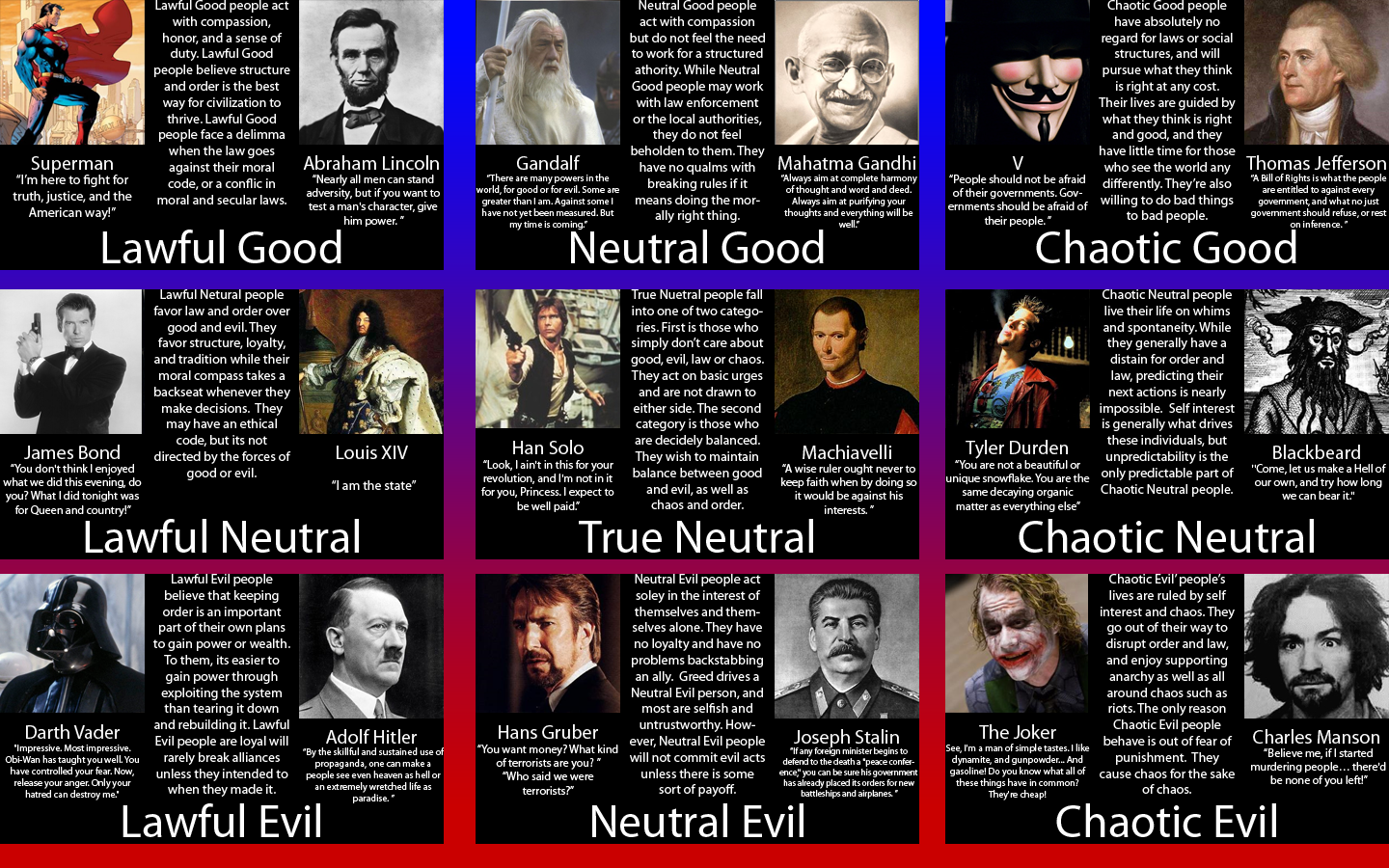

I like this image because it gives fictional examples as well as real life examples as it describes one of the nine basic alignments as seen through Dungeons and Dragons.  There are other ways of doing this, identifying character traits, beliefs, and motivations which ultimately lead to the character’s position on the “good vs. evil” spectrum.  You can even go so far as to tap into psychological theories like Bowen’s Family System’s Theory to understand the fictional people you’re creating or even the very real people in your life—not so that you can pigeon hole them but so that you know how to both approach them and protect yourself.  Basically, so you know to get along with them. 

I think the most important thing to remember, though, is that charts like this are objective.  Hitler wouldn’t describe himself as “evil.”  Gandhi wouldn’t describe himself as “good.”  These are external estimations applied to an individual.  Again, if you really want to understand a person’s morality, you need to talk to them and listen to their story. 

Here’s another way to look at it.  When you study ethics, you will learn that an individual who behaves in what appears to be the most unethical way may actually be a very ethical person.  Ethics is the branch of philosophy that involves systematizing, defending, and recommending concepts of right and wrong.  Going back to Hitler, most of the world would agree that he was immoral or even amoral, his actions unethical.  To Hitler, he had systematized and was obviously able to defend his beliefs and actions, thus creating them, in his mind and in the minds of his followers, as perfectly ethical.  It goes back to the same truth:  In order to understand a person, you have to hear their story.  We don’t do this anymore in our world.  It’s just easier to dismiss people with whom we disagree or who we need to be enemies as “evil.” 

And that brings me back to where I started.  Maybe by setting up my young adult fiction according to the simplified formula of “hero vs. anti-hero” I’m contributing to a mentality that is crippling our society.  It makes for nice, clean story telling that doesn’t drag out with loads of exposition to reveal internal dialogues and motives.  There’s a challenge here I need to explore more.  It’s something I’ve done in other writing but it is a more complex way of writing.

But maybe that’s the ultimate lesson in this.  Maybe I’m underestimating the intelligence of my readers. 

The bottom line is this:  It’s easy to say, particularly in our present election cycle, that this candidate or that party is the physical embodiment of evil.  I may not always agree with certain politicians, religious leaders, high profile actors, etc., but I don’t think any of them are “evil.”  I might think of them as uninformed and ignorant, their ideas and positions as aberrant and abhorrent, and their policies as regressive but I don’t think any of them are actually evil.  This means I have to take the time to understand them, why they say the things they say and why they do the things they do. 

I’m pretty sure I’m a better person for the effort.  

Share it forward!

Follow me on Twitter @TroyComets

Thursday, March 31, 2016

500 Word Friday: Gay Bad Guys?

I was just looking at some writing prompts.  I subscribe to a number of writing blogs on tumblr and a few of them occasionally list writing prompts.  I haven't ever really used a writing prompt; I find more than enough content to write about on a daily basis for the blog just by scanning social media.

When I saw this writing prompt, though, it made me stop and think.  The prompt?  “It’s perfectly fine to make your antagonist gay.”  In other words, bad guys can be gay, too.

At first I thought that this was a legitimate point.  Statistically speaking a segment of the world’s most villainous leaders have been LGBT.  Why wouldn’t I consider making a character who “kicks  puppies and steals candy from children and is the most despicable person on the face of the earth and is gay?”  Then I realized the sad truth.  When I write LGBT fiction I always make characters who happen to be gay and are heroes because the world vilifies LGBT people enough on its own.  For me, at least right now in my writing journey, I want to write characters with whom LGBT people identify  and that means characters struggling to come out or characters who are LGBT and being vilified by segments of the community in which they live.

Last night I was made aware of a member of the Minnesota State House of Representatives by the name of Glenn Gruenhagen.  I blogged about him last night. In his ignorance and in an attempt to sound informed, Mr. Gruenhagen has introduced legislation he claims is based on the Diagnostical and Statistical Manual in an attempt to legally label LGBT people as “mentally ill” and “in need of treatment.”  With people like this trying to continually and consistently victimize and vilify the LGBT community, why would I ever consider writing a character that is an antagonist when members of the LGBT community, particularly youth, know who the real villains  in the real world are.

That being said, I wonder if I’m not being disingenuous by rejecting the idea out of hand and making all of my antagonists non-LGBT.  I mean, I’m acutely aware of how segments of the LGBT community emphasize a false dichotomy.  It’s not always us (LGBT) against them (non-LGBT),  The world isn’t black and white.  I think we need to be careful about who we consistently define as antagonists.  After all, there are degrees of “bad.”

I don’t know.  As I finish my current book, I’ve already begun scribbling down ideas for the next one and pulling out some research and old short stories.  I might have to think more about this idea, though.

What do you think?  Does the world need to be introduced to some bad guys/gals who happen to be gay?

Share it forward!
Follow me on Twitter @TroyComets

Monday, March 28, 2016

The Hidden Truth Behind Me, Queen Elizabeth, Barack Obama, and the Aliens

We’re going to have some fun today.

So, I’ve been doing this blogging thing for about three months.  I started my Twitter account the same day I launched my blog.  I did these things because I wanted a way I could connect with readers and build an audience for my book.  But I’ve ended up being surprised at how the blog has really become a creature of in its own right. 

I’ve been kind of bummed lately, however, because my numbers on both my blog and my Twitter account seemed to have leveled off.  Last night I realized why.  Because Troy Comets isn’t a real person and I write pseudonymously, I don’t bring a natural audience and network to my blog and social media.  I don’t have friends and family and colleagues signing up, right out of the gate, to read my stuff or to share it.  What I’ve built on my blog and through Twitter was built in a vacuum.  Those of you who read my blog are people who found me on your own.  I think that means something.  My family would be….well, they would be shocked to read the stuff I share with you….but they would be obligated to read and share my stuff.  You guys aren’t.  But yet you do.  That means something to me.

As part of learning to do this blogging thing, I follow some different experts on social media.  One of those experts is Yann Girard (@girard_yann).  I won’t get into all of the reasons why I follow Yann, but recently I read an article he wrote on “Why No One Reads Your Stuff.”  In the article, Yann lists some do’s and don’ts…and some of the do’s are actually don’ts.  With absolutely no offense intended to Yann, who makes many valid points in his writing and shares numerous inspirational thoughts, I thought I would have some fun with some of his points.  So based off of the ideas Yann lists that work for him….

Idea Number One:  Post Pictures of Naked Women
Just to be clear, Yann states he’s never tried it but encourages readers to try it if they want.  The idea is that so many people include graphics, pics, etc., that you need something to stand out.  I hope Yann doesn’t mind that I subbed a guy for a woman, though. 


Idea Number Two:  Screw Everybody Else
The idea here is that it takes a lot of time and effort to read other people’s blogs.  Yann’s suggestion is to stop reading other people’s stuff and focus on making your own writing better, devoting that now “freed up time” to your own projects.  So, as soon as I’m done writing this post, I’ll be unfollowing Yann.  That will free up A LOT of time.  The guy’s writing is profuse!

Idea Number Three:  Insult People
You jerks!

Just kidding.  What Yann means here, I think, is to not be afraid to write things that show your knowledge and opinions.  Don’t worry about offending people.  Well, I think I got that down with my posts about Easter and my posts about lazy, ignorant Christians

Idea Number Four:  Don’t Add People
I think this is reverse psychology.  Yann clearly says “don’t do it” and then explains that he does do it for the obvious reason of creating an audience.  I’m not comfortable doing that.  I follow people who inspire me or have something to share with me to improve my life.  I don’t want to use people to generate an audience or balloon any artificial indicators of success.  I blogged a bit about that here.

Idea Number Five:  Screw Analytics
I feel like I already talked about this with idea number four.  Success for me isn’t knowing how many people are reading or even finishing the things I post.  Success for me is planting a seed and being okay with the fact that I’ll probably never know if that seed germinates and grows.

I write not to become famous.  I blog not to stroke my ego.  I do these things because they’re in me and I will explode from the pressure of my thoughts and stories if I don’t get them out.  It’s therapy.  It’s catharsis.  I’m just…either really selfish or really brilliant for dragging you along for the ride.

Idea Number Six:  Not More than Two Lines
Supposedly I need to learn to hook readers right away, in those first two lines.  I kind of see that.  But I also know that the best part of a good song doesn’t show up in the first ten seconds.  Hell, the best part of some larger, classical orchestrations doesn’t even show up in the first two movements.  So, this is what I propose:  I’ll write and share what I write.  You skim it/read it and if you find it helpful, hooray!  If you find it useless, stop reading it and move on.  Deal?

Idea Number Seven:  List Posts to Die For
Yann suggests here to arrange post listings, which are title to draw interest, in such a way that people can’t help but to keep clicking.  That’s why I titled this post what I did.  It got your attention, didn’t it?

Idea Number Eight:  Don’t Read
Since I’m supposed to be working on becoming a better writer I should be writing and not reading.  I’m not so sure about that.  Realize that I’m an academic with a buttload of graduate work under my belt.  I feel like if I’m going to write I want to be informed and I want to inform.  I’m not wasting my time or yours by just….writing.  Don’t get me wrong; I’ll share my opinions.  God knows I have enough of them.  But the world has enough people shooting off their ignorant nonsense without me adding to the choir of the ignorati. 

Idea Number Nine:  Reinvention
I’ll be honest.  I’m struggling with this one right now.  The idea here is that if you write every day you’ll eventually run out of things to say.  I’m not short on things to say but I’m afraid my blog is going to become too narrow in its focus and content.  It’s kind of why I’m doing this post today.  What do you think I should blog about?  Leave a comment.  I’m serious.  I want to know.

Idea Number Ten:  Write Bad Stuff
Hrm….

Post for March 28, 2016.  CHECK!

Well, that was easy.

Idea Number Eleven:  Writing Rules
First rule of writing club?  There are no rules for writing club.  And I think this is Yann’s point throughout his article and something I try to talk about on a regular basis.  I can tell you what works for me, today, in my writing, in my life, in whatever.  But I’m not going to make these hard and fast rules for anyone including myself.  Life has taught me in rather harsh ways that I need to be more pragmatic.  So, if there’s one piece of advice….okay, well, two pieces of advice I could offer you it’s this:
1.      Go with it.  Learn from what comes to you.  Make the best decision you possibly can with the information available to you and live into that decision knowing it was the best you could have done and that life will give you chances to change directions when you need to.
2.     Go and watch this music video.  It’s old but it’s still brilliant.

Thanks, Yann, for (hopefully) being okay with me doing this.  But, then again, if you’re following your own suggestions, like number two, you’re not going to read this anyway so I should be golden. 

And thank you, dear reader, for letting me be goofy on this Easter Monday morning.

Share it forward!

Follow me on Twitter @TroyComets

Sunday, March 20, 2016

The View from Here

I was a strange child.

Well, okay.  Maybe “strange” is a bit over the topic.  Let me try a few other words. 

Unique?  Peculiar?  Unusual? 

Getting closer.  But I think all of those words still miss the reality.  Not to mention they carry with them a bit of a stigma that needs to be unpacked.

How about…creative?  Pensive?  Imaginative? 

Hrm.  Those are good adjectives that described me as a child but they still aren’t quite capturing the reality I’m trying to describe. 

Maybe because there is no easy, clean-cut way to describe people.  Or, in this case, the result of what people become because of the coping mechanisms they end up using.

Let me explain.

Today I’m having one of those “stuck on the outside, looking in” sort of days.  It’s a phrase that basically means there’s something separating you from all of the activity you want to be a part of.  Think of it like walking down a city street and passing a huge window through which you see a party going on.  Fun looking people eating great food while laughing and dancing and celebrating life in one another’s presence. 

The reality, though, is that when I say this, like many other people, I mean, “I’m trapped on the inside, looking out.”  In other words, I’m stuck inside myself and the reality I experience, longing to be a part of the world I see around me.  This isn’t a new phenomenon for me.  A lot of LGBTQ people feel this way, especially when they are literally trapped inside of themselves for fear of revealing who they truly are. 

Some of you might recognize this experience.  Growing up, particularly in my teenage years, school was not a pleasant experience.  It wasn’t that the academic work was difficult; I would have had straight A’s if I would have decided that was what I wanted.  What made it difficult was watching the people around me and, in many cases, wanting to be involved in what they were doing but never daring to step up and be involved.  I was awkward and inept, like all teenagers, I suppose.  But the big thing that kept me from coming out of my shell was fear of simply coming out.  How would I dare try to hang out with one of the guys that simply radiated cool when it wasn’t his charisma that attracted me to him but how incredibly attractive he was?  Sandy brown hair, bright green eyes flecked with gold, not a zit in sight, and (don’t you dare laugh) a permed mullet that was so damn sexy back in the day.  Not to mention his sense of humor, his quick wit, his athletic body….

….you get the idea.

Like I said, some of you will recognize the experience.  And you’ll also recognize the fear that grips you in these situations because you’re so worried about being “too interested” in something he or she does or says.  What if I laugh too hard?  What if I ask the wrong question?  What if I just say the wrong thing and he figures out who I actually am and what I actually see when I look at him?

When those are your fears, when you live with the anxiety of being discovered and outed, it just becomes easier to withdraw and live inside yourself.  If you don’t interact you don’t risk interacting too much.   Sure, that means watching the world move on around you—people laughing, having fun, falling in love, having relationships—but it’s worth the occasional twinge of pain at being left behind if you can protect yourself.

Isn’t it?

I mean, look at it this way.  If the story I’m about to share would have happened today, it would have ended quite differently.  When I was in ninth grade I was the victim of what today would have been considered an assault.  Or worse.

It was in an art class.  “Back in the day” we were required to take a certain number of art classes, music classes, writing classes…the artsy classes that are only occasionally offered now as electives because there’s not enough time in the day to indoctrinate students on taking standardized tests.  These classes were mandatory in my school.  It was a large room that seemed to ramble on in every direction.  The main part of the classroom was near the door.  Large, wooden worktables with worn tabletops which had been nicked and painted and stained by generations of pubescent Picassos were our desks.  I don’t remember what the teacher was lecturing on that day or what we were actually working on but I do remember the sense of panic I experienced when one of my classmates took a wire used for slicing chunks of clay off of the larger blocks and, from behind me, wrapped it around my neck and pulled it tight.  I’m not sure how long he held the wire around my neck but I remember the laughter of his friends and the pain when he finally released the wire.  I don’t know where the teacher was when this happened; he never did find out about it.  Plenty of students on my side of the room saw what happened but no one ever said anything.  Probably because I never said anything.  I forced myself to laugh, as if I was in on the planning of the morning’s entertainment.  I knew that if I made an issue about it my complaint would just draw more attention and more attention was not what I wanted.

If this was the kind of thing my peers did when they only suspected I was gay, what would they do if they actually knew I was gay?  If I said the wrong thing, did the wrong thing, walked the wrong way, talked the wrong way, gave someone too much attention….It was just easier (and safer) to withdraw as much as possible within myself.

I think this is how my imagination and creativity blossomed. 

I began to write in junior high school, which for me began in seventh grade.  Puberty had arrived, bringing with it a number of realizations that couldn’t be unrealized.  This is when I started pulling back within myself.  But once there, apart from the world outside, I would create worlds and scenarios.  Sometimes I would even bring the people around me from the “real world” into my imagination; if I couldn’t hang out with them in the “real world,” I could hang out with them in my fictional world where I could be the cool one that they wanted to hang around and emulate. 

So I wrote stories starring mythical versions of myself and the people who were either too cool for me to talk to or the guys I was too attracted to that I avoided lest they look into my eyes and see my soul.  Looking back at the thought of writing those stories I have to admit I’m embarrassed—but not for reasons you would think.  I’m not embarrassed because of what I turned my fear and anxiety into and how I attempted to capture the personalities and characteristics of my classmates.  It was the writing that was cringe worthy. 

I think some of the best writing, some of the best fiction, has to come from something relatable and something real.  Learning to take my struggle and turn it into a narrative in which I learned to expose my thoughts and feelings to even fictional versions of the people around me was an important lesson for me to learn.  I still do it.  In These are the Days, I’ve inserted pieces of myself and people I know into the characters.  In the new story I’m working on I’ve taken it a step further and am actually using people I knew as the rough outline of the characters in the story—and it’s working really well.

Where am I going with all this?  Well, I have two points I need to make.

The first point goes back to where I began:  I’m having a “trapped on the outside, looking in” sort of day.  It’s been….an undisclosed number of years since my high school days but old habits die hard.  There are a many people whose own paths mine has connected with in some way, whose light I find refreshing and inspiring.  Being a connection oriented person I find myself aching to learn more about these people.  This is why I hate doing “meet and greets” at concerts; the twenty minutes or so I have with the artist or artists isn’t nearly enough for me to develop that connection—especially when I have to share the artist with other people with meet and greet tickets.  So, for example, when I try to interact with people through social media and my attempts fall flat, I feel like I’m looking in through that large window at fun people having a fun time and I have no idea how to get involved. 

Still happens. 

I think it will always happen. 

So I think it’s important to remember that I’m in control of how I respond to this feeling.  If I let myself be consumed by the sights that are holding my attention through that window, I’ll become rooted to the spot.  I’ll never find a way in and I’ll just make myself feel worse and worse.  But if I choose to change my perspective, to leave that spot and turn away from those tantalizing sights, I might someday find my way “into the party.”  Or…better yet….I might find something even better to be a part of.

Remember, though, that the grass is never greener on the other side. 

The second point is this:  You aren’t alone.  I know there are people reading this who can identify with my story.  I know there are people out there who are victims not only of the ignorance and prejudice of the people around them but who are also victims of their own coping strategies, the things they do to make it through life.  Things like disengaging from the world around you because you’re too afraid that the world around you won’t accept you.  It gets better.  It really does.  And the experiences you had or are having, experiences like mine, will give you something.  They’ll give you lessons to help you be a better person.  They’ll give you motivation to become a better person.  And they may stimulate your imagination and creativity to help you help others to stimulate their imaginations while telling them that there is absolutely nothing wrong with who they are.