Follow Me on Twitter!

Find me on twitter @TroyComets
Showing posts with label healing. Show all posts

Saturday, March 26, 2016

Easter and Ignorance

Okay.

I’ve debated long enough on this topic and I’ve decided to write about it.  I went back and forth on it not because I didn’t feel competent and comfortable writing on the topic.  If anything I’m too comfortable and competent to write on it.  I was hesitant because I try very hard not to focus on religion in my blogging because religion has hurt too many LGBTQ people, including myself,  and I don’t want to keep rubbing salt in the wounds. 

I also didn’t want to “tip my hand” and maybe show too much non-Troy Comets knowledge through my Troy Comets activity.  What I mean is this:  Troy Comets has never disclosed what he does off of the internet or what the person behind Troy Comets has actually studied.  I’ve hinted that if you look at my writing you can probably figure out what I’ve studied and how much time I’ve spent in those studies.  After reading this post you may have a more complete idea.  I’m not 100% certain that’s a good thing…but I’m 100% certain it’s not all a bad thing either.

But, here’s the thing.

1.     Trying to avoid talking about religion because of the pain it has caused us isn’t going to make that pain go away.  Maybe I’m wrong to avoid the topic the way I do.  Maybe I should acknowledge religion’s role in the oppression of the LGBTQ community more.  Maybe I should acknowledge our pain—my pain—more in my writing.  Maybe it could be more a part of the healing process than I’ve previously imagined it could be.  All I know is that I don’t want this blog to become “Troy Comets’ Ongoing Commentary about How Messed Up the Church Is.”  Though I know there’s MORE THAN ENOUGH to talk about there, there’s more for us, LGBTQ and non-LGBTQ people alike, to worry about and talk about.
2.     Sometimes I can’t turn off the things I know.  It would be nice.  Believe me.  Sometimes I can’t think of anything that would bring me more peace than to forget half the things I know.  But, as I write this, it’s Holy Saturday.  Tomorrow is Easter.  We’re ending Holy Week….and, as a Christian person of faith, religion is all around me right now and I can’t escape it.  Add to that the fact that I’ve wasted an hour and a half of my life today by watching Tyler Perry’s “The Passion Live” and I’m more than a little angry about how ignorant the Church is about its own heritage and its own story.

I just tweeted a comment that to understand the Passion of Jesus, the whole story that’s told between what is usually referred to as “The Triumphal Entry” (Palm Sunday) through the Last Supper, the trial and execution, and ends with the Resurrection—to understand any of this, a person needs to understand politics in first century Palestine.  Let me explain why.

The Jewish leaders get a bad rap in traditional Christianity.  As they’re portrayed in biblical interpretations throughout history they are the antagonists to our hero, Jesus.  They try to shut him down.  They want to argue with them.  They appear clueless and obstinate.  Nothing could be further from the truth.  The fact of the matter is that these were faithful men of God.  They were not only adhering to the interpretation of Hebrew Scriptures that had been handed down to them but they were also trying to protect their people. 

Judea, where the bulk of Jesus’ ministry takes place in the four biblical Gospels, was an occupied territory.  Since its fall in “Old Testament Times” it had changed ownership a number of times.  It was prime real estate.  You couldn’t travel anywhere in the region without moving through Israel and Judea.  At the time of Jesus, it’s Rome that holds the deed to Judea and Rome wasn’t known for its kind and gentle ways when it came to occupation.

Within living memory of most of the elders of the Jewish people at the time of Jesus there was at least one revolt that was stamped out tragically by Rome.  What the leaders understood was that there was going to be no uprising as long as Rome was a factor.  There would be no independence until God’s anointed appeared, the “messiah” or “Christ,” who would lead God’s chosen people back to their chosen status in the world.

So when Jesus, who overtly and tacitly claims to be this messiah, begins to amass a following, who challenges the status quo, who attracts people like Judas the Zealot to his cause—when the leadership begins to see this, it makes them worried.  They see the makings of another revolt and, remembering the last revolt and how Rome dealt with it, they begin planning ways to get Jesus out of the picture before it’s too late.  Why do you think one of the charges the Jewish leaders argue in front of their Roman rulers is, “He’s no friend of Caesar’s?”  He’s a traitor and you need to deal with him.

So, of course, he’s dealt with.  There’s a trial in which Pontius Pilate famously gives the people a choice between two prisoners—Jesus or Barabbas.  Never mind the fact that no such tradition even existed.  Our English Bibles tell us that Barabbas was a criminal/murderer.  The actual word in Greek which describes him is “zealot.”  Like Judas, Barabbas was a freedom fighter.  He was a patriot.  He probably would have been considered a “terrorist” by today’s standards.  Which would you choose if you were under occupation?  Someone who just a few days ago came to town with under the auspices of being the messiah who would kick Rome out but the most he could do was throw a tantrum in the Temple?  Or the guy with the proven track record of undermining the occupational forces?  The gospel author is making a point here—not giving us a history lesson. 

If you watched “The Passion Live” on FOX you might remember Tyler Perry’s explanation of what crucifixion was like and then what was done with the body.  According to Tyler Perry’s script, Jesus was buried in a tomb which was sealed with a boulder and guarded by Roman soldiers—all under Pilate’s orders.  Of course nothing like it happened.  The earliest Gospel we have is Mark.  Mark tells us that it was the day of preparation.  We already know it’s late in the afternoon so the pressure’s on under Jewish religious law to get things done before Sabbath begins.  Joseph of Arimathea, who is identified as a Jewish leader, comes to Pilate and asks for the body.  Pilate gives it to him and Joseph of Arimathea quickly buries Jesus in Joseph’s own tomb.  It really was a “hurry up and get it done” affair.  Sabbath was hours and minutes away.  This is why later in the story the women return on the first day of the week (Sunday) to do the burial rituals after Sabbath. 

What Tyler Perry’s scriptwriter and the majority of Christians fail to understand here is the process of developing what Christian theologians call “a high Christology.”  What this means is that years and years after the fact, followers of “The Way” (which is what this sect of Judaism was initially called) struggled to make the story of Jesus flow out of the story of God as recorded in the Hebrew Scriptures.  We see the beginnings of the development of this Christology in Mark, with its use of the terms “Christ” and “Son of God.”  Mark, remember, was written about 35 years after Jesus’ death.  But this Christology advances again by the time Matthew and Luke are written, roughly 20 years after Mark.  Matthew and Luke begin to answer questions that the earliest Christian community started asking.  Questions like “Where did Jesus come from?”  In reply, Matthew and Luke give detailed birth narratives.  They also address the arguments of skeptics.  “Maybe Jesus wasn’t really dead.”  This is why in Matthew one of the Roman soldiers impales Jesus’ through the side with the spear.  “Maybe someone stole Jesus’ body and created the whole resurrection story.”  Again, this is why Matthew has Pilate setting guards on the tomb. 

But Christians have done  exactly what Tyler Perry’s scriptwriters have done throughout history.  We don’t pay attention to what is written or ask why it’s written the way it is.  Instead, we harmonize the stories and stupidly recite them during the most holy times in our religious calendar.  Like Christmas.  All of a sudden we have Mary and Joseph having a child in a barn (because there’s a feed trough being used) and we simultaneously have angels (which, by the way, are messengers from God and not divine beings with wings.  The whole angelic cult is developed later.) and wise men from the East showing up all at the same time.  Never mind the fact that the wisemen (of an undesignated number, by the way.  Scripture never tells us three beyond three gifts which are symbolic in their own right) show up YEARS after Jesus’ birth.

This is what makes me so freaking angry about my fellow adherents to the Christian faith:  Too many people are comfortable in their ignorance, blindly accepting the watered down, dumbed down, Christian message that generations of preachers and pastors and priests have massaged to diminish its power and “teeth.”  Again, for an example, I turn to “The Passion Live” in which the song performed to capture the spirit of this “triumphal entry” into Jerusalem is “Love can Move Mountains” by Celine Dion.  The triumphal entry of Jesus into Jerusalem was not “lovey dovey, love conquers all” nonsense.  It was a protest.  It was desperation.  The crowd was shouting “Hosanna!”  Hoshi’ana!  “SAVE US!”  People were flocking to the person who was supposed to be their liberator crying out in pain and anguish! 

How many congregations capture that spirit in their annual Palm Sunday parades of palm waving and Sunday School children singing?

But this is the issue:  All of these biblically conservative Christians who, like the people they vilify in the gospel stories, may mean well.  But unlike the people they treat as antagonists in the Jesus story, they are completely oblivious to what it is they’re reading, where it came from, and how it’s been transmitted.

And it drives me nuts.

This brings me back to “The Passion Live” once again.  This feel good, for club members only, overly produced, poorly researched and written spectacular dumbed the story down still further and didn’t pause to consider the full implication of the music they chose to accentuate the story.

For example.  Trisha Yearwood as Mary singing “In the end only kindness matters.”  Really?  See, the biblical message claims that in the end it’s the love of God that matters.  Or Jencarlos Canela  as Jeuss singing “I won’t give up if you don’t give up.”  Really?  The commitment of Jesus Christ is dependent on my commitment?  Then we’re all screwed because, newsflash, human beings are fickle creatures incapable of commitment.  That’s why the biblical message highlights God’s commitment to humanity trumping humanity’s commitment to God.

What’s worse than picking songs with bad theology?  Picking songs that capture good theology and thinking that the people singing the song will embody the meaning of the song.  I’m referring to the song used by “The Passion Live” at the climax of the performance:  Unconditionally  

Come just as you are to me
Don't need apologies
Know that you are all worthy
I'll take your bad days with your good
Walk through this storm I would
I'll do it because I love you, I love you

This!  This is the message that so many people, so many people in so many subsets of our society, not just the LGBTQ community--but SO MANY PEOPLE need to hear.  It's the message of the story of God told through the pages of the Christian Bible.  It's the power behind the Hebrew word chessed and the Greek word agape.  It's unconditional love--it's love poured out without qualification, without prerequisite, without the receiver moving himself or herself to a place in which they might "fit in better" or "conform more appropriately" the beliefs and behaviors of any particularly community that holds power and domination.  It's a love that says, "You.  Just as you are.  You are special.  You are loved.  Just the way you are."

The Church will join Jencarlos Canela. It will sing this song, add it to its repertoire of “contemporary hymns” and then it will turn around and, as a rule, insist gay people should be straight, people in poverty should pull themselves up by the bootstraps, that women should be obedient to their husbands…..you get the idea.

Which makes me wonder how Katy Perry feels about the Church coopting her song.

Look, I get it.  The Church, like every other human institution whether religious or secular, is flawed.  It’s broken.  It’s far from perfect.  That’s what happens when human beings enter the picture and try to take something as powerful as a movement like civil rights or Christianity and make it a system.  It’s going to lose momentum, power, and even sight of its mission and purpose.  That doesn’t mean we can use that as an excuse.  That doesn’t mean we can ignore the damage we’ve done and continue to do.  That doesn’t mean we forgive our own blatant ignorance and hypocrisy when we sing songs like “Unconditionally” but turn around and tell people to “give up your sinful ways and be something you can’t possibly be and then God will love you.”

The reason I’m rethinking my approach to religion and the Church, at least for this post, is that it’s Easter in the Western Church.  It’s the season of resurrection, renewal, and hope.  Traditionally and historically it’s understood as a moment of profound change where God alters the rules and breaks down barriers that seem unbreakable.  It’s a season of forgiveness.  It’s a celebration of how far God is willing to go to demonstrate God’s love. 

For people reading this who are solidly inside the Church, maybe the barrier that God is breaking down is the barrier that keeps you from exploring and even challenging the theology that has been handed to you.

For people reading this who are outside of the Church because it is where you have been placed by people within the Church or where you have placed yourself for your own protection and self-preservation, maybe the renewal that God is offering you is the renewal of God’s promise of unconditional love—whether the institutional Church is willing to offer it to you or not.  If it’s one thing that has been made abundantly clear:  God does not need the participation or approval of faith institutions to love God’s children. 


For people reading this for whom faith is not a part of your life, I hope I haven’t offended or bored you.  Thank you for giving me the space to share these thoughts.

As always, feel free to share these thoughts forward.

Follow me on Twitter @TroyComets 

Friday, March 25, 2016

Stranger in My Own Skin

American Idol jumped the shark a number of seasons ago.  It’s not surprising; what goes up must come down.  This is their final season.  For fifteen years this show has entertained us, made us angry, made us wonder why in the world certain people were invited to be judges (Kara Dioguardi?  Nicki MInaj?)

I wasn’t planning on watching this season.  I haven’t been able to enjoy the show since they stopped invited big industry names to be mentors and forcing contestants to perform a variety of different genres and styles.  I like my music to sound unique; I like to connect with an artist.  What I’ve heard from the past few seasons was a contest to identify the next manufacturer of the same mass produced sound that dominates the music industry in the United States.  It didn’t help that the weekly rotation of successful artists was replaced by an industry producer skilled at looking for “that marketable sound.”

But I have been watching the final season.  My family has fond memories of watching the show when it was in its prime and I was hoping to recapture some of those warm fuzzies we experienced years ago.  I’m glad that I have been watching because there have been a couple of legitimate artists this season who are able to and insist on doing their own thing despite what the judges and producers advise them to do. 

I think the real reason I’ve been glad to be a part of the audience the past couple of weeks is because of the realism a couple of the artists have demonstrated in telling their stories.  Of particular interest to me has been the introduction of the subject of mental health through Dalton Rapattoni, the blue eyed, platinum haired, eye-liner wearing artist who won his “golden ticket” to Hollywood by contemporizing “The Phantom of the Opera” in his audition.


It started last week, with episode 19.  In the package leading up to Dalton’s performance, we heard the beginning of a conversation Dalton has with us about having difficulties “being comfortable in my own skin.”  In the package we’re introduced to Dalton’s mother, Kiva, who talks about Dalton as a child, how he experienced severe highs and lows.  Dalton continues to talk about how, when he would feel emotions, they would be 1000 times as powerful as how he saw other people experiencing them.  He began talking about a really bad breakdown he was having in the driveway when his mother’s voice comes back in and says, “He was screaming and crying and saying ‘I just want to die.’” 

Dalton shares with us that at age nine he was diagnosed with Bipolar Disorder.  He explains that even though he began receiving treatment he still struggled with the severe emotions he felt and the fact that he had no way to express them.  Finally, through the gift of guitar lessons from his grandmother, Dalton discovered music, which he says “changed my life. “

Dalton then went on to perform a song I’ve never liked:  “The Sound of Silence.”  Yeah.  He changed my mind about that song. 

Fast forward seven days.

Last night Dalton made it into the top four, which I think ended up being a gift to America.  if he hadn’t made it, we never would have heard more of his story, see him relate to Sia, who was the big star working with the contestants and who also struggles with Bipolar Disorder, or heard the killer performance he gave.  Dalton covered Sia’s “Bird Set Free.”  He barely made it through; the power of the lyrics were overwhelming and, knowing Dalton’s story, I found myself hearing the song in a completely different way.

And then, of course, came the judge’s feedback.  Jennifer Lopez started by saying, “You know….everybody is cheering for your bravery.  It’s what we all want to do.  We all want to let go.  We all want to feel good in our own skin.  We all want a moment where we can release and we can just be ourselves and find ourselves.”

I don’t think Jennifer Lopez was done talking before I had taken to Twitter to offer my gratitude to Dalton for that bravery, for his courage to be honest about his story and talk about these painful memories and ongoing struggles in front of a population that refuses to engage in a legitimate conversation about mental health care.  And I’m not just talking about things like awareness of things like Bipolar Disorder or Depression or Anxiety (which I’ve written about before as this is the primary issue I struggle with).  I’m talking about how Dalton began this conversation two weeks ago with his statement about struggling to be “comfortable in my own skin” and having the conversation continue with Jennifer Lopez speaking for many of by saying, “We all want to feel good in our own skin.”

I’ve never felt comfortable in my own skin and I imagine for a significant number of you who are reading this it’s the same.  For us, who are LGBTQ (and I’m not including Dalton into that population because I have no idea how he identifies and that’s really not the point here)—but for those of us who are LGBTQ and struggle to make peace within ourselves and with the people around us because of an identity we can’t change, we really don’t feel comfortable in our own skin.  Either by a series of choices we make or by a limiting of choices that are provided to us, we end up wearing a skin that is not our own.  It’s a skin that the people around us—in our homes, in our schools, in our churches, in our places of employment—it’s a skin that everyone else accepts.  It’s also a skin that slowly suffocates those of us who wear it. 

Again, I’m not talking about Dalton here.  I’m using his story and his struggle as a starting point for a similar story and struggle too many LGBTQ people struggle with because, as a society, we are still a long ways away from accepting people for who they are and how they are made.  We have absolutely no idea, as a whole, how to support people in their challenges as the discovery who they are and how to overcome the things inside of themselves that threaten to consume them:  Loneliness, depression, isolation, confusion, anger, fear….

And why wouldn’t LGBTQ people be suffocating in a skin that isn’t theirs when we have politicians passing laws that strip LGBTQ people of their humanity?  How many teens and young adults in North Carolina are resolving today to not be themselves after the North Carolina legislature not only passes a law excluding LGBTQ people from discriminatory practices but forbids local governments from passing ordinances that would protect LGBTQ people?  Think about it:  Now not only do LGBTQ youth in North Carolina have to worry about whether their family and friends will accept or reject them but there is nothing in place to protect them from systematic rejection of society based on who they are

Look, I know the LGBTQ issue wasn’t even on Dalton’s radar when he started sharing his story last week.  But this is what happens when we start sharing stories.  We discover we’re more alike than different.  Many of us fight the same demons.  The demons might come from different places, come in different shapes, and have different levels of power over each of us as individuals, but when it gets down to it, Jennifer Lopez hits the nail on the head:  “We all want to feel good in our own skin.”

And this is why I’m so grateful to Dalton Rapattoni for having the courage to share his story in such an honest and powerful way.  Each time someone can share their struggle in a way that it touches something inside so many others and draws attention to a common thread that runs through the lives of so many people, the conversation about that thread gets easier.  It’s what history tells us.  Look at suffrage.  Look at civil rights.  Look at marriage equality.  The more we hear stories and grow to understand the pain behind those stories, the more we identify with the people telling the stories because we can see ourselves in their story

I definitely see myself in Dalton’s story.  The details are different.  It’s not Bipolar that I struggle with.  Music is not how I express myself (for which the American public should be eternally grateful).  But I know exactly what he means about not being comfortable in my own skin.  And thanks to Dalton’s willingness to share part of his story about this feeling of being an alien in your own body, I feel a bit more comfortable sharing part of my story about the same feeling. 

We need to come to a place where we’re comfortable sharing our stories, especially the painful ones, dear reader.  It’s the only way things are ever going to change.  

Post Script

I'm adding this comment about an hour after publishing the original post.  I was conflicted:  Should I add this comment and link to this post or should I do another one?  In the end I decided to add it.

If you want to see someone who's learned to be comfortable in her skin, I suggest you check out Jordan Gray (@TallDarkFriend), who is a contestant on The Voice UK this season.  This is another inspirational story with a POWERFUL performance

.

Thursday, March 24, 2016

Lightworkers and Making It Through

I need to tell you about my cousin, Joanna. 

So I’m really good with people.  It’s equal parts education and intuition, I think.  I spend a lot of time watching people and I’ve spent a lot of time working with people.  It doesn’t take me long to figure a person out.  It comes with my background and training.  People talk to me or I listen to people and things just click into place, giving me an insight into the person’s goals, interests, fears, and challenges. 

For example.  If you tell me that you have a difficult time having a relationship because you exhaust yourself and neglect yourself for the energy you invest in the relationship, I can tell you that you haven’t had people to connect with in the past and you’re so desperate not to repeat a pattern of broken connections that you put everything into your relationships.  You are driven to connection but by the time you’ve poured all you have to pour into a relationship in order to secure that relationship you’ve burned yourself out.  (This is just an example from a conversation I recently had.  It’s not a universal truth.)

It’s easy for me, given some time, to figure people out. 

My cousin, Joanna?  It takes her absolutely no time to figure a person out.  She is so good at intuiting people, their motivations, their fears, their emotions, that it makes a lot of people uneasy.  She’s so good at this she’s developed this shtick in which she “reads palms.”  She’ll hold your hand, point at the different lines, tell you the names of the lines and what they all mean, and then she’ll completely ignore your hand and tell you everything about yourself.  I’ve seen her do it hundreds of times and it’s fascinating. 

It’s not always received well.  Once people know she does “this palm reading thing” they’ll race up to her, holding out their hands.  Once people see how accurate she is in her observations, people’s hands start disappearing into their pockets.  I have family members who actually stay on the opposite side of any room Joanna’s in for fear that she’ll see their secrets and truths in their eyes.

My cousin Joanna is unconventional.  She’s a free spirit.  She’s a seeker.  She’s deeply spiritual but challenges a lot of ideas about traditional religion.  I’ve learned a lot from her—about people, about myself, about faith and spirituality. 

I’ve held onto something Joanna taught me a few years ago.  It was such a brilliant way of explaining and describing something I see in certain people and how these people affect the world around them.  She taught me the concept of a lightworker.

One of the reasons I held onto this information the way I have is that nearly every approach I take to explaining how people react to and interact with the world around them is based in traditional Christianity.  I use Christian terminology to explain, in Christian terms, how God works through people to improve the word, specifically in providing care for the least and the lowest.  This works great if it’s Christian people of faith I’m speaking with, but as regular readers of my blog may have figured out by now, I have a particular interest in reaching out to the people the Church has hurt in some way.  Who wants to hear about how God works through people when the people who should be God’s hands and voice in the world are the very people who have rejected you, called you names, and stripped you of your humanity for simply not conforming to their expectations?

So I’ve held onto this idea of lightworkers.  I’ve used the term before with people.  The trick of it, for me, is that I’m abandoning Christian terminology and concepts for the language and metaphor of another religion…and that doesn’t make me feel comfortable either.  My discomfort isn’t that I think Christianity is right and the other religion is wrong.  My discomfort comes from the fact that I’m not a part of the faith tradition that speaks of lightworkers.  I don’t want to be one of those people who picks over other religions, philosophies, and cultures for “the good stuff” and then, in my arrogance and ignorance, misrepresent the thing I’ve stolen.  I also never want to speak for a group or culture to which I don’t belong.

But I find myself using this term more and more because I think it accurately represents a phenomenon that can be seen in people regardless of faith tradition.  So as I talk about lightworkers, I hope that I do so respectfully and accurately.

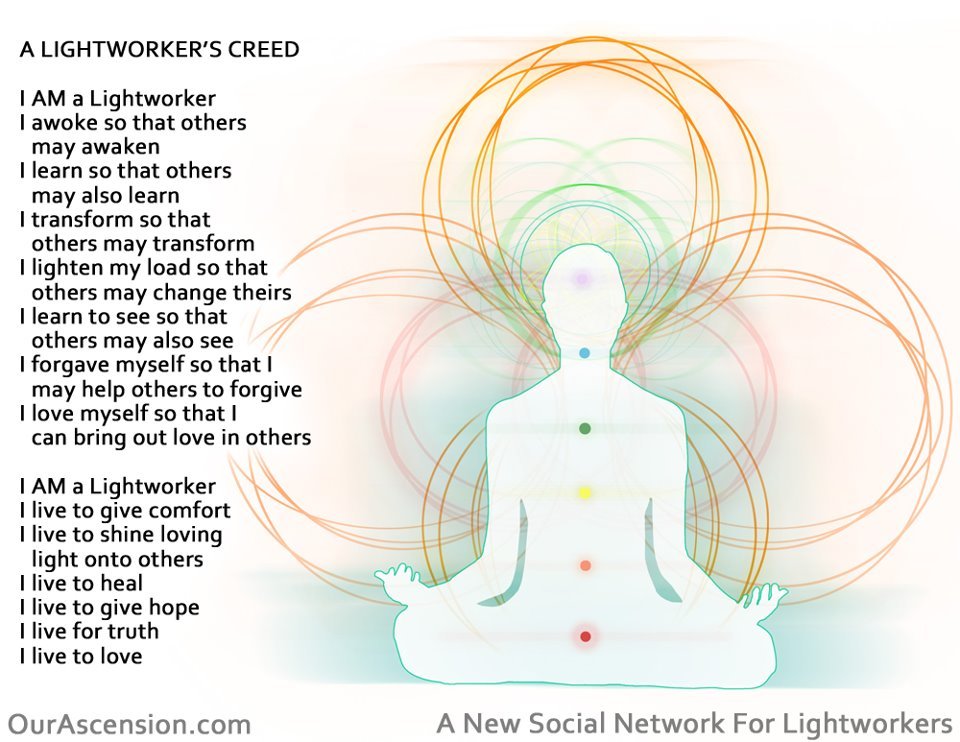
What exactly is a lightworker?  One resource suggests the following:

Lightworkers are souls who carry the strong inner desire to spread Light – knowledge, freedom and self-love – on earth. They sense this as their mission. They are often attracted to spirituality and to therapeutic work of some kind.

Because of their deeply felt mission, lightworkers often feel different from other people. By experiencing different kinds of obstacles on their way, life provokes them to find their own unique path. Lightworkers are nearly always solitary individuals, not fitting into fixed societal structures.

I think this description might be a bit conservative compared to others I’ve seen in that the individual actually may not realize how spiritual they are or recognize how their work (light) actually affects the people around them.  I do think it’s universal that these individuals are “helpers” in some way.  It may not be some sort of therapeutic or healing job in which they work but somewhere along the way they engage in healing activities to help people around them.  Healing in this case is more than just physical healing.  They are motivated to see healing in the world—healing within communities and healing within individuals. 

That’s kind of the “ground floor” explanation of lightworkers.  From there the definition and identification of traits becomes more and more spiritual.  I don’t want to go any deeper into the spiritual conversation for our purposes here mainly because I’m not qualified to speak to the deeper spirituality.  What I want to focus on is the fact that these are people who, consciously or subconsciously, reach out to the hurting people around them to ease their pain and make the world a better place.

Think about everything you know about the imagery of light.  Light is used to connote healing, knowledge, wisdom, life, and good.  It can convey grace or blessing from divine forces.  The disappearing of light can reflect fear, anxiety, cold, illness, and death.  The coming of light can convey understanding, growth, healing, and salvation from difficulty.  Light metaphors permeate our literature (“…what light through yonder window breaks?”) our music, our movies, and our religious expressions.  It’s universally known imagery within the whole of human experience even apart from a religious context—and that’s why I’m drawn to the term.

To me a lightworker is an individual who has a knack for understanding things differently, through compassionate eyes that see deeper into the humanity of struggles most politicians and religious leaders choose to over-simplify.  With that unique understanding comes the ability to connect with people to pass the light which is within them along to others. 

I believe lightworkers are able to make these connections through common struggles and pains.  I think that’s why, within the context of the LGBTQ community and relationships/friendships, it’s through the recognition of common struggles, themes, and pains that create the bridge for the light to pass between the lightworker to the person in need of healing.  Why do you think the “It Gets Better” campaign is so successful?  People who watch these videos and hear these stories are able to see themselves in the “expert’s” story. 

Why am I even bringing this up?  Over the past couple of weeks my blog has focused on taking control of your own story along with some serious discussions about homophobia, bullying, and suicide.  I’ve spent time taking my faith tradition to task for continuing to hold onto ignorant and superstitious interpretations and institutionalized prejudices.  Why am I suddenly talking about this concept of lightworkers?

Like all of you I’ve been watching the news.  Brussels was just attacked; another city of innocents drawn into a war of ideology and politics that the Western world created but refuses to take responsibility for.  North Carolina has legalized bigotry by passing a law that does not protect LGBTQ people from discrimination.  The state of Georgia is on the verge of signing into law a bill that would give religious officials in the state the option to refuse to perform same-sex marriage ceremonies and for tax-funded groups to deny services to gay people.  Donald Trump’s rise to power continues.  The Senate GOP refuses to do its job by calling for hearings to confirm Judge Merrick Garland to the Supreme Court.  Iran sanctions, Obama in Cuba….it all just gets to be too much.  The news is so incredibly discouraging and that just the news.  The talking heads on the 24/7 news networks have no idea of the struggles of my life or yours, the pain that doesn’t hit close to home but lives in our homes.  It’s easy to feel like the darkness is about to swallow us whole.

But one of the things I’ve noticed more and more is this:  The darker things seem to get, the more people I would consider lightworkers I seem to notice.  I guess it’s true: You can’t appreciate the power of a candle until all of the lights have gone out. 

I see a lot of candles in the darkness.

They’re all around us.  They come to us from a variety of places, usually unexpected places as the world continues to change.  They reach out to us, to reassure us and bring us healing and hope, to remind us that we matter and have value.  The tell us it will get better. 

I think the old saying still holds true.  “The world is going to hell in a handbasket.”  But that’s nothing new.  Humanity has been visiting pain and suffering onto itself since we learned to walk on two legs and make fire.  But more than that and much more importantly than that:  We are able to do so much more good.  Sometimes I wonder how our public mood would change if 24/7 news networks would start reporting light-related stories rather than the headlines that have traditionally made them money—headlines of murder, terror, and fear.


So, look around you.  I guarantee that no matter how dark it seems right now in your life and how overwhelmed you are by the horrible stuff that is going on in the world and in your life, there are lightworkers right there with you, ready to share their light.  I also guarantee that everyone who is reading this right now has enough light inside of themselves to reach out to the broken world around them to make life a little better for the people around them as well.  You are both worthy of the gift of hope that people will offer you and able to share that gift with others.  I promise you.