Follow Me on Twitter!

Find me on twitter @TroyComets
Showing posts with label LGBTQ. Show all posts

Sunday, April 10, 2016

Do LGBT YouTubers Have a Special Responsibility?

Before I begin I want to make a few things clear.

1.     I’m not picking a fight or manufacturing drama.  I’m simply sharing my opinion on this topic.
2.     I am not speaking for Jack Merridew (@OfficialJackM) nor am I trying to put words in his mouth.  I’m simply writing my impressions.  Jack can speak (and clearly has spoken) for himself. 
3.     I am not attacking DaveyWavey (@TheDaveyWavey).  Again, just writing my impressions.   
4.     And I am certainly not speaking ill of Gayety (@gayety), who help to raise so much awareness of the LGBT community. 

A couple of weeks ago I wrote about role models and how some people you absolutely don’t agree with are actually very good role models because of the way they connect with ages and cultures others can’t connect with.  In that post I talked a little about Jack Merridew and a video he had recently shared on gay sex-ed.  Though it wasn’t the kind of video I would be comfortable making, I applauded it for its frankness and honesty and providing necessary information to young LGBT people who may not get the same reliable information elsewhere. 


This morning the online news resource, Gayety, shared an article/video produced by YouTuber DaveyWavey.  It was Davey Wavey’s explanation on how to safely have gay sex.



I’ll be honest.  My initial reaction was, “Jack just did this and did a better job of it.”  But the more I thought about it the more I realized that that really wasn’t the problem I was having with DaveyWavey’s video.  It wasn’t about who did what first.  Here’s where I was struggling. 

I’ve been watching Jack’s videos for a while.  The more I watch them the more I appreciate the ongoing narrative behind them.  Jack speaks candidly.  He is open and honest about things.  Heck, this week he shared a video in which he was completely upfront about losing his virginity as well as his views on sex.  In listening to this narrative you actually get the picture of someone who is almost shy, very humble, but very much wanting to get good information out to people who need it.  Jack seems to recognize what it takes to be an effective communicator for his growing audience.  He’s meeting an important need in the LGBT community.  He’s a role model.  I know for a fact from interacting with folks through social media people look up to Jack.

I’ve followed DaveyWavey for a while.  At first I thought I was missing something.  I know his reputation and how famous he’s become but, to be honest, something just wasn’t clicking for me.  I think I figured it out this morning.  To me, when I watch DaveyWavey, the narrative I see is the narrative of someone pushing an envelope for the sake of pushing the envelope and not so much about improving the LGBT community and, by extension, the world.  I’m not so sure how helpful that is right now.

Let me explain.

Over the past few videos on DaveyWavey’s YouTube channel, not only have we seen the “do it for the chuckles” comedic videos about “bro jobs” and “It’s only gay if our balls touch” and watched him interview people while have battery operated sex toys attached to their penises but we’ve also seen DaveyWavey talk a straight guy into having sex with him and another straight guy into douching.  I worry that pushing the envelope for entertainment purposes when it comes to LGBT themes might actually work against the LGBT community.

Right now we are seeing a frenzied movement of hate bills being passed in conservative leaning states and being introduced in many moderate states.  The momentum behind these bills is that there is a “perversion” about LGBT people and to “give in” to their demands for equal protection and rights will only lead to corruption of young people or even sexual assault in our public restrooms.  We can sit here and provide all the facts we want.  We can point out to these political and religious leaders that in fact there have been more Republican politicians arrested for lewdness in public restrooms than transgender people and that states who have adopted laws providing for equal protection have had none of the incidents that the supporters of these hate bills claim are coming.  None of that matters.   Reality doesn’t matter.  Facts do not matter.  In situations like this what matters is who controls the narrative. 

And as we all know conservative politicians and religious leaders are very good at controlling the narrative.  Why?  Because when you disregard facts and ignore the existence of nuance, it’s simple to cram your message onto a bumper sticker.  Once you’ve stripped reality out of the equation and have a catchy slogan, it’s easy to get that slogan repeated by the masses.  When it’s repeated enough times, it becomes “truth.”

When members of the LGBT community push the envelope solely for entertainment purposes or to dance on the edge of daring so as to increase their audience, I think they do the greater community a disservice.  DaveyWavey’s content is a good example of this.  Apart from the innuendo and explicit videos, there are these two recent additions that you know anti-LGBT people can pull out and say, “Look, sexuality is a choice!  Look how this gay YouTube star has influenced these straight guys into gay sexual activity.”

It’s not a conspiracy theory.  I know enough about people to know this kind of thing happens.

And when we have people like Minnesota nutcase and member of the state legislature Glenn Gruenhagen taking control of the narrative by pretending to understand mental illness and the American Psychiatric Association’s Diagnostic and Statistical Manual, I think we need to be very careful about how we portray ourselves. 

This morning I commented on Twitter about Gayety’s article.  I said that Jack Merridew was able to cover the “how to” of gay sex more effectively and less provocatively.  I don’t think I chose the right word there.  In fact, if you read my post on role models you’ll probably remember me talking about Jack being provocative and me being okay with that.

The word “provocative” picked up a sexual connotation in the seventeenth century.  The word actually comes from a Latin word that means “to call forth.”  Think of it as elicit, draw forth, bring out, or evoke.  The idea was to call forth conversation. 

Jack’s videos always call forth conversation.  Again, some of the content might be a little more risqué than some might think is necessary, but that’s the beauty of what Jack does.  That daring dance Jack does earns him respect for being honest and open.  After all, how many of us would be able to sit there and make a video about how we lost our virginity or even talking about struggles with body image?

It seems the only struggle with body image DaveyWavey has ever dealt with is whether he should wear a shirt or not.

And I’m not saying that all LGBT YouTubers need to do the same thing.  I think a plurality of voices is necessary because not no one can be all things to all people.  The LGBT community is made up of a wide variety of people with a wider variety of experiences and backgrounds.  We need all of these voices to speak to our community. 

I just don’t think we need to do things, say things, produce things that others intent on the destruction of our community can use against us.  That might mean that YouTubers in our community are going to be held to a higher standard.  Should that be surprising?  Our community has always been held to a higher standard.  Most minority groups are.  But I think the celebrities of our community, the ones who have developed a name for themselves from within the community and out into the greater world, have a responsibility to attend to how what they do and say might impact the community. 

I’m not trying to pick on DaveyWavey or impart sainthood on Jack Merridew.  I’ve seen far worse than what DaveyWavey has put out and I’ve seen better than what Jack has put out—all from members of the community.  But those “better” and “worse” evaluative terms?  Those are mine and I completely recognize they are my opinion. 


Once again:  I am grateful for the diversity of voices within the celebrity circles of the LGBT community.  I just think that right now, with the political climate the way it is, we need to be fighting good fights to improve the community and secure our rights and not just be doing things to increase our own individual notoriety and publicity.  

Share it forward!
Follow me on Twitter @TroyComets

Wednesday, March 30, 2016

The Anti-LGBT Bill of Glenn Gruenhagen

On March 30, 2016, Raw Story ran this article on a MN State Representative by the name of Glenn Gruenhagen.  Mr. Gruenhagen has introduced a piece of legislation into the MN House of Representatives to identify LGBT people as “mentally ill” and “in need of treatment.”  The basis of his argument?  The Diagnostic and Statistical Manual Fifth Edition (DSM-V).

The DSM-V is the guidebook produced by the American Psychiatric Association (APA) as a tool to help identify mental health issues and deviations.  I will admit that I’m not well versed on the DSM-V; it was in the process of final approval and publication when I made career changes.  But I know the DSM-IV and I know how to use the Manual in general.  I also know that Mr. Gruenhagen’s interpretation of this admittedly problematic diagnostic criteria for an identity disorder is neither in keeping with the science nor the ethics behind the DSM-V.

I’m not going to get into the ins and the outs of the actual diagnostic criteria for Gender Dysphoria because sometimes nitpicking psychological terms completely misses the point.  Besides, it’s not like Mr. Gruenhagen has released the actual reference or any literature in support of his position so that the academic community can respond to specific misinterpretations and misrepresentations.   I guarantee it’s not a licensed psychologist or psychiatrist that brought this to his attention. 

The American public in general often misunderstands what the DSM actually is.  We’re so accustomed to going to our doctors, laying out our symptoms, and having the doctor run through the rolodex in his mind or his little pocket book or an app to help identify our symptoms.  Psychology is different.  We look at the symptoms but we also consider how those symptoms may or may not affect one’s quality of life or day to day functioning.  We also consider environmental influences which could trigger symptoms.

The whole point to the DSM is to give a framework for treatment and not diagnosis.  When you look at a list of diagnostic criteria in the DSM, it may list five or seven areas of behavior that are negatively influenced because a disruption or disturbance in development or the environment or coping with the environment.  Depending on the diagnostic category, to appropriately apply the diagnosis the patient/client must meet a certain number of the criteria listed.  In short, it’s like a “check all that apply” list of maladaptive behaviors and/or maladaptive coping.  If the patient/client falls short, the diagnosis doesn’t apply.  The trick is, when doing this, is to look at the right criteria for the right problem.  For example, “depression” is a diagnosis of its own but it’s also a symptom in a variety of other diagnoses. 

But again the idea with the DSM isn’t to find the right label or labels for the patient/client.  The insurance companies like these labels because a lot of insurance companies will look in their Big Books of Money Saving Policies and say, “Oh.  Depression.  We’ll pay for six visits to a therapist for treatment because, on average, it takes six therapeutic sessions to treat depression.”  Which is a bunch of hogwash.  But that’s our healthcare system.

Once the provider has determined what the struggle is, however, an approach to treatment can begin. 

One of the MANY things Mr. Gruenhagen fails to realize in his hate-bill is that “disorder” is not “disease.”  A disorder is not an illness.  A disorder is what it says it is:  Not order.  Something is out of whack, either in the person’s thought processes, coping strategies, acceptance of reality, or environmental.  Yes, environmental.  A person can be diagnosed as 995.82 (Adult psychological abuse by nonspouse or nonpartner, Suspected, Subsequent encounter).  The damage caused by the abuse will need to be dealt with, but the disorder is caused externally, environmentally.  The disruption in the normal ordered thinking/feeling/behaving pattern is DISordered because of the environment.

When the DSM-V was being developed, I remember quite a bit of discussion among my peers about the gender and sexuality criteria and the diagnostic labels.  It’s problematic.  Our understanding is constantly changing.  Science, particularly our understanding of human psychology, is developing almost as quickly as computer technology.  The moment you buy a computer it’s outdated.  The moment the DSM-V was finally approved by the APA and printed it was outdated in a lot of respects.  Mr. Gruenhagen is treating the DSM-V like he treats his Bible—it says it, black and white, so that must be what it means now and forever.  And just like his approach to the Bible, Mr. Gruenhagen is too ignorant and too lazy to actually educate himself on what it is he’s reading.  (I’d be willing to have a conversation about Mr. Gruenhagen’s theology another time.)

I think a lot of psychiatrists and psychologists would agree with me when I say:  With Gender Identity Disorder, there is a disruption in the order of thinking/feeling/behaving but most of that disruption is aggravated by factors outside the person’s internal struggle for identification.  Namely:  Fear of judgment, fear of rejection, fear of politicians who want to label them abnormal and force them into behavioral conditioning camps where, perhaps, they can “pray the trans away.”  It doesn’t work that way.

I’ve posted recently two entries on my blog listing specific statistics identified by scientists describing mental health and the LGBT community.  The crux of the problem is not an internal one.  It is external.  It’s about how individuals and systems around the LGBT individual complicate coping and development.  (You can read these posts here and here.)

So, fine, if Mr. Gruenhagen wants to draw attention to the disordering of LGBT people, I hope he’s ready to pass legislation to ease that disordering.  Equal protection, equal access, anti-discrimination….basically all the things Mr. Gruenhagen has stood against in his tenure in the Minnesota House of Representatives.  Since his first key vote on January 27, 2011, Mr. Gruenhagen has voted:

  • To prohibit same sex marriage  [SF1308]
  • Increase requirements for Abortion Providers [SF1921]
  • Voted against an authorization for same sex marriage [HF1054]
  • Voted against requiring schools to establish antibullying policies (HF826]
  • Voted against approving the MN HHS Biennium Budget [HF1233]
  • Voted against the MN Health Insurance Exchange [HF5]
  • Voted against expanding Medicaid [HF9]
  • Voted against increasing equal pay and establishing workplace protections foe employees [HF2536]


It’s quite clear that, despite how he’s trying to portray himself with this anti-LGBT bill, he’s not interested in mental health care, health care, or services and policies that would change the environment and people’s perceptions in order to mitigate the symptomology which is disrupting the order of LGBT people’s lives. 

Mr. Gruehagen’s agenda is clear and it’s one of barbaric, religiously superstitious regression.  I mean, this is the guy who stood on the floor of the MN House and advocated that in order to end bullying we need to start beating our children. 

Honestly, though, we shouldn’t be surprised by Mr. Gruenhagen’s inability to understand how to interpret and apply the DSM-V.  He’s an insurance agent.  His professional reading is limited to an understanding of black and white.  I’m not disrespecting insurance agents; I have a number who I consider close friends.  But that is how their brains are wired.  Psychology is never black and white.  I hope he figures this out sooner rather than later.  Not that I care how badly he’s embarrassing himself; he’s making his bed and he can lie it.  My concern is how backwards he is making the State of Minnesota look by continuing to fight these old battles on which not only the citizens have spoken but science made its determination nearly fifty years ago.  And my BIGGEST concern is the continuing damage he is doing to LGBT individuals by prolonging a way of thinking that has been demonstrated to be grievously harmful to LGBT people time and time again. 

Or, I suppose, Mr. Gruenhagen’s bill might have absolutely nothing to do with actually helping people.  This might just be the Trump approach to politics:  Say whatever, do whatever, and soak up the attention.  After all, it’s clear from his anti-LGBT bill and his voting record he’s not about healing and wholeness.  To know what he’s really about, you can check out his entire voting record here. 

Share it forward!

Follow me on Twitter @TroyComets

Tuesday, March 29, 2016

The Fosters and Faith

Have you watched The Fosters?

It is a family oriented show for modern families which debuted on what was ABCFamily in 2013.  It’s now one of the flagship series for Freeform, the latest incarnation of what started as the Family Channel back in cable’s hayday.

I remember the buzz about it.  I hadn’t looked into it too much.  But because I knew a lot of people connected with the foster system I thought I would check it out.  So, picture it:  The premiere episode.  We meet a lesbian couple—a white cop and a biracial educator from a charter school—Brandon, the biological son of the cop, who, by the way, is still working with her ex-husband, the father of her child, on the police force, and the couple’s two adopted Latino children. Jesus and Mariana.  Then we meet Callie, a child they literally rescue from the absurdity of a foster system that has grown so large and so underfunded.  Eventually we meet Callie’s brother, Jude, who falls in love with one of his athletic classmates at the charter school and begins to identify as gay. 

Like I said:  A family oriented show for modern families. 

It was a dynamic premise for a forty something minute TV series.  There was always something going on relationship-wise with the kids, parenting-wise for Steff and Lena (the couple who have taken responsibility for this brood), and identity-wise for everyone.  The show has dealt with topics such as racism, addiction, sexuality, faithfulness, healthy boundaries, mental health, cancer, and…religion.

This poor family has dealt with more in three years than many families deal with in eighteen. 

And that’s where I’ve kind of settled on the show this season.  It just seemed that everything the writing team was throwing at the family was just too much.  Not unbelievable because everyone watching could identify with the struggles and challenges.  It was just becoming overwhelming.  I began to be afraid that either the writers had committed characters to storylines that were becoming weights around the neck of the show or…worse, they were trying to be too many things to too many people and failing everyone in the process.  This is why TV shows have “bibles” that set boundaries on characters and possibilities. 

To me, this season has felt less like a family oriented show for modern families and more like a telenovela of the Mexican variety:  Entertaining but way over the top in storyline and dramatic presentation.   

But then they aired the season finale last night and I remembered why I was first drawn to this show.

So after a season of melodramatic storylines, a painful episode featuring the culmination of a story arc about a Romeo and Juliet musical written by writers who had apparently never read Romeo and Juliet, and a few plotlines that seemed to go on and on like this current election cycle, driving us to a point where we really don’t care about Callie and Brandon and their poor boundaries….we’re punched in the gut with the reality of the foster care system:  Kids being placed in homes that are unqualified to take care of kids and in which the kids end up dead. 

This affects Jude profoundly because right before we learn that Jack, the foster kid who we’ve gotten to know this season, was murdered by the same foster father who had abused Callie and Jude, we see Jack kissing Jude.  Jack later confides in Callie that he felt it was a mistake because he’s not attracted to Jude because he, Jack, is straight.  Jack never has the chance to confess this to Jude. 

So the episode opens with a funeral/prayer service/informal gathering on the beach where Jude is delivering a sermon/eulogy.  This caught my interest right away because it was actually thoughtfully done and the words Jude was using to commend Jack to God’s care were words I’ve heard too many times in real funeral services.  This polished eulogy was coming from someone who has never really struggled with religion in the show’s run.  Jude has never explored it, questioned it, struggled with it.  But his sermon was spot on theologically.  In real life, if Jude was an actual person, one could clearly see that he was taking this seriously and had committed a great deal of thought and research to his reflection. 

So, as a student of religion and theology as well as psychology, I’m turning this scene over and over in my head for the rest of the episode.  I’m wondering where it came from and where it could be going because it was so unpredictable in a show that has become too predictable this season.

Fast forward to the last ten minutes of the show or so.  So, yeah, if you haven’t seen the episode and don’t want to know anymore, maybe you should stop reading now.  This is your warning.

Through the episode we see Jude talking with one of his female classmates and friends.  At one point we hear Jude expressing that maybe he’s not into guys.  Which, of course, the friend picks up on right away since she’s been crushing on Jude for about two seasons now.  But toward the end of the show we see Callie confronting Jude on his interest in the female friend.  Callie is confused because Jude has identified as gay pretty much since they came to this foster home which ended up adopting them.  Jude’s response?

“Maybe I’m not supposed to be gay.  I’ve loved two guys and God has taken them both away.”

I don’t know how other people heard that line but this is how I heard that line.  “I loved a guy named Connor and he moved away and our relationship ended.  I was falling in love with a guy named Jack and he was murdered.  I’m going to interpret this as a sign.  Maybe God is trying to tell me I need to get back on the straight path.”

I write about this a lot.  We story the events in our lives in an attempt to make sense of the things that we can’t explain.  When it comes to tragedy, as a rule, people will cite providential intervention as the reason things happen.  They will interpret that intervention as meaning this or that.  It’s how the individual copes.  I know that.

But here’s what I also know.  My theology informs me that God does not cause horrible things to happen.  God doesn’t need to.  Human beings do that well enough on our own.  God didn’t kill Jack in The Fosters.  The broken system operated by human beings killed Jack.  God certainly doesn’t punish people; that’s superstitious bullshit that should have died out with witch trials.  And God does not take people away from us or tear people away tragically to give us a message.   (I'm mentioning this in the middle of this review of The Fosters because I can't seem to stop reminding people of these important truths--especially a community and a subset of a community who tend to be victimized by such backward Christian nonsense.)

All of a sudden my interest in The Fosters has returned.  What sucks is that it’s from one of the most realistic characters that we don’t get to see too much of because of all the “kids” on the show the actor who portrays Jude is a kid and child labor laws impact his storylines.  But this is what The Fosters needed, I think.  A step away from the over-the-top-never-going-to-end drama of Callie and Brandon, or Jesus and his search for identity which, with a new actor, focused in a direction the character has never looked before (namely his birth father), or Mariana and all her teenage girl drama. 

Once again the show comes back to Jude. 

I don’t know where the writers are going to go with this but it’s pretty clear that in the time that passed between the horrible episode featuring Romeo and Juliet: The Musical and Jack’s tragic death and the season finale with the appearance of Preacher Jude, someone has obviously influenced Jude’s thinking on sexuality and God.  I really hope this is explored more next season because these are very real issues younger folks in the LGBTQ community struggle with.  I think that’s where they’re going considering the kiss Jude shares with his female classmate and the weird smile he has on his face afterwards. 

What do you think? 


Share it forward!

Follow me on Twitter @TroyComets

Monday, March 28, 2016

Boy George, Troye Sivan, and Me

I spend a lot of time puttering around on the internet.  Every morning I get up and start googling random crap and cruising through YouTube subscriptions and trendings.  It inevitably happens.  At some point a search for one specific thing will lead me to something completely different and it will be that something completely different that will unexpectedly educate and inspire me.


Today I ended up on this video on YouTube.  It’s an interview from 1984 between Johnny Carson and Boy George. 

History lesson time.  Before James Corden rode around in a car singing with superstars and Stephen Colbert lampooned newsmakers with mock earnestness, there was an old white guy who sat behind a desk and did some interviews and cracked some jokes.  In the interest of full disclosure I wasn’t a fan.  But a lot of folks tuned in because, really, he was the only game in town until folks like Joan Rivers and Arsenio Hall brought life and variety to the late night talk show arena.  But Carson was kind of the godfather of it all. 

So, picture it.  1984.  The AIDS crisis is evolving.  Ronald Reagan is president and neither he nor his First Lady, Nancy, will acknowledge the crisis because they don’t even want to be associated with the dirty word “homosexual.”  That doesn’t stop religious leaders and conservative politicians from making hay on the suffering of others by demonizing the victims of the disease while declaring “God’s judgment” on “sinful and deviant lifestyles.”

In the midst of this ignorant morass of silence and blame and fear comes…Boy George.


That picture is a screen capture of Boy George from the Johnny Carson interview.  It was the second time he had appeared on Carson’s show but the first time with Carson.  The first time he had appeared the iconic Joan Rivers was hosting.  This is a fact that Boy George jokes about in the interview with Carson by commenting, “The last time I was here you were in drag.”  Carson quickly distanced himself from the joke, clarifying that it had been Joan Rivers and not Carson with whom he had appeared.  If I’m right, this is a picture of Boy George and Joan Rivers from that first appearance. 


So, back to the video of Carson, the old White guy with his sense of humor that seems to ignore other people’s senses of humor, and Boy George sitting on the opposite side of the desk in all of his Boy George glory.  In 1984.  Amidst fear and ignorance.  And remembering that the culture of the UK is usually about 20 years ahead of culture in the US.  So, for Boy George, the smallest things he said or did at home were met with raised brows and anxiety here in the United States. 

Carson introduced Boy George, who comes in and makes the joke about Carson being in drag that Carson finds so repugnant, and then the interview begins.  It’s clear where Carson wants to go with the interview. 

Not long before this appearance Boy George attended the Grammies and made a joke about wondering when they music industry would see a real queen dressed as a drag queen.  Carson brings up the controversy his comment caused and Boy George brushes it aside, pointing out that in the UK you can say things like that and people laugh but in the US it’s basically a big scandal.  This brings up a conversation about “all of the stupid questions” Boy George had been answering since his arrival in LA from LA radio personalities. 

“What are some of the dumb questions they ask so I know which ones to avoid.  I mean, the first one has got to be,” and Johnny Carson makes sweeping gestures with his hands.  “Why do you dress like that?”

You can hear Boy George’s eyes rolling in his answer.  “I’ve answered that one so many times I’m going to avoid that one.”

“Okay, so what are the other questions?”

“Well, basic things like ‘How long does it take to do my makeup?’ you know and just boring things about my childhood.  Which was just the same as anybody else’s really.  Pretty dull.  Pretty boring.  So, Father Christmas, you know, and grazed knees, that kind of stuff.” 

“Yeah, but you can’t blame them, can you, Boy George, for asking those kinds of questions.  Because you are rather controversial.  It is something new that—“

“But after like three years of seeing me you would think people would be a bit used to me by now, you know.  I mean, in a country that has Liberace, I am hardly revolutionary, am I?

And the audience cheers.  But see the difference between Boy George and Liberace is that Liberace’s glam was still masculine.  He still wore tuxes and suits while performing.  So what if they were covered it glitter and sequence?

Johnny Carson continues.  “I’m trying not to be square you see.  I come from the middle of the United States.  State called Nebraska, which is right out in the middle of the country.  Rather conservative.  Now if I was your dad and you came home one day and I didn’t know it and I walked in and saw you as a young man—I guess you were about fifteen or sixteen when you started actually….wearing the make up and the costumes—I wouldn’t know how to react myself.  I think I would be adult enough myself to try to handle it but—“

“What do you got to handle?”

“Well, the effect that you walk in and you see your son dressing with makeup on.  The average person….”

“Okay, well, you’re going to have Halloween in a couple of weeks, you know.  What’s the difference between somebody dressing up for Halloween?  It’s only because people think it’s serious that they get frightened.  They look at me and they say, ‘Well, it’s not a Halloween party.’  So you have to have a reason to dress up.  There is nothing wrong with being different.  Why do you have to have an excuse to enjoy yourself?  You know there are people out there taking drugs, killing each other, fighting.  And like I just don’t see that you have to wait once a year, Christmas or Halloween, to enjoy yourself.  I think it’s a load of rubbish.  I think there is nothing wrong with dressing up and enjoying yourself if you want.”

“I think you’re right.  I think what you said before though…people are probably uncomfortable though with some things they don’t quite understand or something that’s different from them and they get uptight about it.”

I’ll leave the transcript there because it speaks to the points I want to make. [Go and watch the video, though.  It’s fascinating. ]

In 1984, when Boy George was being interviewed by Johnny Carson, I was in the sixth grade.  I remember my class’s Halloween party.  We still dressed up “back in the day” and spent the afternoon munching candy and watching movies.  One of my classmates dressed up as Boy George.  I knew it was a Boy George costume because she had obviously done the makeup and hair thing but she had written “Boy George” on her t-shirt.  My teacher, who was about the age of Johnny Carson, had a conniption.  He ranted about the costume being inappropriate and offensive.  And it was a female classmate dressed up as Boy George.

Of course this was the same teacher who demanded a male student remove his earring.

This was the mentality of the time.  It’s gotten better, to be sure, but we still have such a long way to go.  Someone I follow on social media just tweeted today that if people fought as hard for the poor as they fight against equal rights and protections, poverty would be history. 

But Johnny Carson, in this interview, actually makes a point.  He pointed out that people are uncomfortable with things they don’t understand or things that are different from them.  And make no mistake about it—Johnny Carson and Boy George and a significant segment of the audience knew that this conversation had nothing to do with make-up and clothes.  This was about identifying as something other than straight (on Boy George’s side) and the fear of validating something that not even the president would even speak about (on Johnny Carson’s side). 

I don’t know what the conversation was like in the UK or other parts of the world, but in the United States, at this time, coming out wasn’t an option for many artists and actors.  For example, George Michael at this same time was making it big with Wham!.  And speculation was just as bad.  If I had a dime for every time I heard a story about the members of New Kids on the Block having their stomach pumped to find gallons of bodily fluids, I could have retired at age 20.  I even remember watching some awards show with my folks one time and hearing my mother comment about how masculine Grace Slick from Jefferson Starship was trying to be while performing “We Built This City.” 

More and more I find myself stopping in my tracks to take stock of how far we’ve come, not just in the LGBTQ community but as a society.  Sharing our stories, when we can and how much we can and in whatever overt or veiled language we can, changes things.  It started somewhere.  It didn’t begin with Boy George on Johnny Carson and it’s certainly not going to end with marriage equality or the overturning of North Carolina’s disgusting law.  We all play our parts, when we can, how we can.  We show our faces with courage.  We move in small circles for our own safety.  We speak from behind the curtain of the internet to protect the people who love us. 

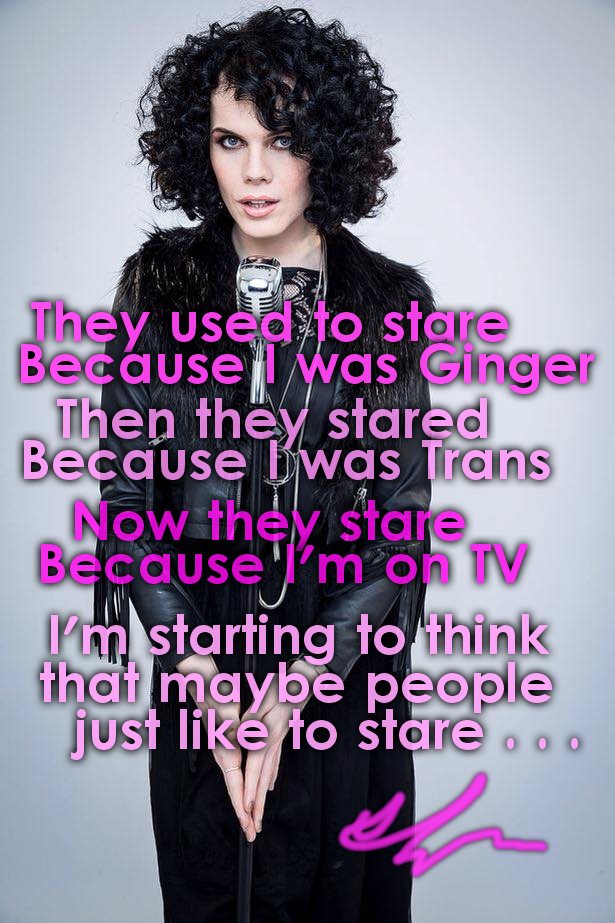
I’ve written before about Troye Sivan.  Last week Troye Sivan tweeted, “I am forever indebted and so so so grateful for the LGBTQ+ people who have come before me.”   This hit me for a variety of reasons but the truth of it is so poignant.  Troye Sivan, global recording superstar, gay, out at 20, changing the world.  But not just him.  Jordan Gray (@TallDarkFriend), trans contestant on The Voice UK, sharing her powerful story.  Noah Galvin on TV—a gay man playing a gay teen on The Real O’Neals.  YouTuber stars from all over the world, out and proud and sharing their stories, continuing the fight for equality so that the next generation of LGBTQ people won’t have to struggle so hard.

Just as Troye Sivan, still fighting with his beautiful spirit and his powerful words (“Without losing a piece of me, how do I get to heaven?”), doesn’t have to fight as hard as Boy George did. 


But here’s the flip side of Troye Sivan’s grateful statement.  My response:  “The ones who came before are grateful to the ones who come after; you’re still changing the world & us.”

You see, this is the reality in which I live.  The world has yet to open for me.  The light of peace and acceptance (of the world toward me and me toward the world, for that matter) hasn’t reached the dark recesses of my “closet.”  But I celebrate these rewards that have been hard won and the ability of those who can live in that light.  I am thrilled when I see Troye Sivan changing the world with his music.  I am thrilled when I read about Cole Ledford’s “Fifty States of Gay” project.  I am thrilled when I see someone like Jordan Gray on a national/international platform like The Voice, not only sharing her gift and her story, but doing it with Boy George himself watching and tearing up for each of her performances.

And all of these and more give me hope that maybe the world will change enough for me and this light will break open my prison door.  You see, in a place where teachers flipped out over girls dressing like Boy George and students assaulting other students just because they might be gay all with the blessing and support of a Church that loves Jesus but not enough to actually listen to the things Jesus says—for people who lived in these places, people like me, then and now, people like Boy George and Troye Sivan mean nothing.  They could be from a completely different world, somewhere over the rainbow (if you’ll pardon the expression). 

But from within my closet, I hear their words coming to me from that magical place of hope.  They inspire me, the one who came before who, from the shadows, fought and still fights,   It’s a cycle, I suppose.  An enormous wheel.  Where does what one generation give to the next begin and end? 

I hear their words and they tell me of a time I will be able to be me without causing the people I love and who love me a pain they don’t deserve for something not in their control anymore than the pain I’ve suffered for things outside of my control.  I’ve lived as a victim of the world’s ignorance for this long.  With these glimpses of hope, I can wait.  I will not victimize others to escape my lot. 

So I keep watch.  I listen.  I write and I speak what I can, when I can, how I can.  And I hope I make a difference.  Probably not as big of a difference as Boy George, Troye Sivan, or Jordan Gray.  But hopefully a difference, if only to one person.  Because that one person still has the potential to change the world.

Addendum:  About 30 minutes after posting this entry I found the interview of Boy George with Joan Rivers.  An astounding difference.  Night and day.  Whereas Carson backs away from Boy George, Joan Rivers sings his praises, calling him "cute and sexy."  


Share it forward!

Follow me on Twitter @TroyComets

Saturday, March 26, 2016

Easter and Ignorance

Okay.

I’ve debated long enough on this topic and I’ve decided to write about it.  I went back and forth on it not because I didn’t feel competent and comfortable writing on the topic.  If anything I’m too comfortable and competent to write on it.  I was hesitant because I try very hard not to focus on religion in my blogging because religion has hurt too many LGBTQ people, including myself,  and I don’t want to keep rubbing salt in the wounds. 

I also didn’t want to “tip my hand” and maybe show too much non-Troy Comets knowledge through my Troy Comets activity.  What I mean is this:  Troy Comets has never disclosed what he does off of the internet or what the person behind Troy Comets has actually studied.  I’ve hinted that if you look at my writing you can probably figure out what I’ve studied and how much time I’ve spent in those studies.  After reading this post you may have a more complete idea.  I’m not 100% certain that’s a good thing…but I’m 100% certain it’s not all a bad thing either.

But, here’s the thing.

1.     Trying to avoid talking about religion because of the pain it has caused us isn’t going to make that pain go away.  Maybe I’m wrong to avoid the topic the way I do.  Maybe I should acknowledge religion’s role in the oppression of the LGBTQ community more.  Maybe I should acknowledge our pain—my pain—more in my writing.  Maybe it could be more a part of the healing process than I’ve previously imagined it could be.  All I know is that I don’t want this blog to become “Troy Comets’ Ongoing Commentary about How Messed Up the Church Is.”  Though I know there’s MORE THAN ENOUGH to talk about there, there’s more for us, LGBTQ and non-LGBTQ people alike, to worry about and talk about.
2.     Sometimes I can’t turn off the things I know.  It would be nice.  Believe me.  Sometimes I can’t think of anything that would bring me more peace than to forget half the things I know.  But, as I write this, it’s Holy Saturday.  Tomorrow is Easter.  We’re ending Holy Week….and, as a Christian person of faith, religion is all around me right now and I can’t escape it.  Add to that the fact that I’ve wasted an hour and a half of my life today by watching Tyler Perry’s “The Passion Live” and I’m more than a little angry about how ignorant the Church is about its own heritage and its own story.

I just tweeted a comment that to understand the Passion of Jesus, the whole story that’s told between what is usually referred to as “The Triumphal Entry” (Palm Sunday) through the Last Supper, the trial and execution, and ends with the Resurrection—to understand any of this, a person needs to understand politics in first century Palestine.  Let me explain why.

The Jewish leaders get a bad rap in traditional Christianity.  As they’re portrayed in biblical interpretations throughout history they are the antagonists to our hero, Jesus.  They try to shut him down.  They want to argue with them.  They appear clueless and obstinate.  Nothing could be further from the truth.  The fact of the matter is that these were faithful men of God.  They were not only adhering to the interpretation of Hebrew Scriptures that had been handed down to them but they were also trying to protect their people. 

Judea, where the bulk of Jesus’ ministry takes place in the four biblical Gospels, was an occupied territory.  Since its fall in “Old Testament Times” it had changed ownership a number of times.  It was prime real estate.  You couldn’t travel anywhere in the region without moving through Israel and Judea.  At the time of Jesus, it’s Rome that holds the deed to Judea and Rome wasn’t known for its kind and gentle ways when it came to occupation.

Within living memory of most of the elders of the Jewish people at the time of Jesus there was at least one revolt that was stamped out tragically by Rome.  What the leaders understood was that there was going to be no uprising as long as Rome was a factor.  There would be no independence until God’s anointed appeared, the “messiah” or “Christ,” who would lead God’s chosen people back to their chosen status in the world.

So when Jesus, who overtly and tacitly claims to be this messiah, begins to amass a following, who challenges the status quo, who attracts people like Judas the Zealot to his cause—when the leadership begins to see this, it makes them worried.  They see the makings of another revolt and, remembering the last revolt and how Rome dealt with it, they begin planning ways to get Jesus out of the picture before it’s too late.  Why do you think one of the charges the Jewish leaders argue in front of their Roman rulers is, “He’s no friend of Caesar’s?”  He’s a traitor and you need to deal with him.

So, of course, he’s dealt with.  There’s a trial in which Pontius Pilate famously gives the people a choice between two prisoners—Jesus or Barabbas.  Never mind the fact that no such tradition even existed.  Our English Bibles tell us that Barabbas was a criminal/murderer.  The actual word in Greek which describes him is “zealot.”  Like Judas, Barabbas was a freedom fighter.  He was a patriot.  He probably would have been considered a “terrorist” by today’s standards.  Which would you choose if you were under occupation?  Someone who just a few days ago came to town with under the auspices of being the messiah who would kick Rome out but the most he could do was throw a tantrum in the Temple?  Or the guy with the proven track record of undermining the occupational forces?  The gospel author is making a point here—not giving us a history lesson. 

If you watched “The Passion Live” on FOX you might remember Tyler Perry’s explanation of what crucifixion was like and then what was done with the body.  According to Tyler Perry’s script, Jesus was buried in a tomb which was sealed with a boulder and guarded by Roman soldiers—all under Pilate’s orders.  Of course nothing like it happened.  The earliest Gospel we have is Mark.  Mark tells us that it was the day of preparation.  We already know it’s late in the afternoon so the pressure’s on under Jewish religious law to get things done before Sabbath begins.  Joseph of Arimathea, who is identified as a Jewish leader, comes to Pilate and asks for the body.  Pilate gives it to him and Joseph of Arimathea quickly buries Jesus in Joseph’s own tomb.  It really was a “hurry up and get it done” affair.  Sabbath was hours and minutes away.  This is why later in the story the women return on the first day of the week (Sunday) to do the burial rituals after Sabbath. 

What Tyler Perry’s scriptwriter and the majority of Christians fail to understand here is the process of developing what Christian theologians call “a high Christology.”  What this means is that years and years after the fact, followers of “The Way” (which is what this sect of Judaism was initially called) struggled to make the story of Jesus flow out of the story of God as recorded in the Hebrew Scriptures.  We see the beginnings of the development of this Christology in Mark, with its use of the terms “Christ” and “Son of God.”  Mark, remember, was written about 35 years after Jesus’ death.  But this Christology advances again by the time Matthew and Luke are written, roughly 20 years after Mark.  Matthew and Luke begin to answer questions that the earliest Christian community started asking.  Questions like “Where did Jesus come from?”  In reply, Matthew and Luke give detailed birth narratives.  They also address the arguments of skeptics.  “Maybe Jesus wasn’t really dead.”  This is why in Matthew one of the Roman soldiers impales Jesus’ through the side with the spear.  “Maybe someone stole Jesus’ body and created the whole resurrection story.”  Again, this is why Matthew has Pilate setting guards on the tomb. 

But Christians have done  exactly what Tyler Perry’s scriptwriters have done throughout history.  We don’t pay attention to what is written or ask why it’s written the way it is.  Instead, we harmonize the stories and stupidly recite them during the most holy times in our religious calendar.  Like Christmas.  All of a sudden we have Mary and Joseph having a child in a barn (because there’s a feed trough being used) and we simultaneously have angels (which, by the way, are messengers from God and not divine beings with wings.  The whole angelic cult is developed later.) and wise men from the East showing up all at the same time.  Never mind the fact that the wisemen (of an undesignated number, by the way.  Scripture never tells us three beyond three gifts which are symbolic in their own right) show up YEARS after Jesus’ birth.

This is what makes me so freaking angry about my fellow adherents to the Christian faith:  Too many people are comfortable in their ignorance, blindly accepting the watered down, dumbed down, Christian message that generations of preachers and pastors and priests have massaged to diminish its power and “teeth.”  Again, for an example, I turn to “The Passion Live” in which the song performed to capture the spirit of this “triumphal entry” into Jerusalem is “Love can Move Mountains” by Celine Dion.  The triumphal entry of Jesus into Jerusalem was not “lovey dovey, love conquers all” nonsense.  It was a protest.  It was desperation.  The crowd was shouting “Hosanna!”  Hoshi’ana!  “SAVE US!”  People were flocking to the person who was supposed to be their liberator crying out in pain and anguish! 

How many congregations capture that spirit in their annual Palm Sunday parades of palm waving and Sunday School children singing?

But this is the issue:  All of these biblically conservative Christians who, like the people they vilify in the gospel stories, may mean well.  But unlike the people they treat as antagonists in the Jesus story, they are completely oblivious to what it is they’re reading, where it came from, and how it’s been transmitted.

And it drives me nuts.

This brings me back to “The Passion Live” once again.  This feel good, for club members only, overly produced, poorly researched and written spectacular dumbed the story down still further and didn’t pause to consider the full implication of the music they chose to accentuate the story.

For example.  Trisha Yearwood as Mary singing “In the end only kindness matters.”  Really?  See, the biblical message claims that in the end it’s the love of God that matters.  Or Jencarlos Canela  as Jeuss singing “I won’t give up if you don’t give up.”  Really?  The commitment of Jesus Christ is dependent on my commitment?  Then we’re all screwed because, newsflash, human beings are fickle creatures incapable of commitment.  That’s why the biblical message highlights God’s commitment to humanity trumping humanity’s commitment to God.

What’s worse than picking songs with bad theology?  Picking songs that capture good theology and thinking that the people singing the song will embody the meaning of the song.  I’m referring to the song used by “The Passion Live” at the climax of the performance:  Unconditionally  

Come just as you are to me
Don't need apologies
Know that you are all worthy
I'll take your bad days with your good
Walk through this storm I would
I'll do it because I love you, I love you

This!  This is the message that so many people, so many people in so many subsets of our society, not just the LGBTQ community--but SO MANY PEOPLE need to hear.  It's the message of the story of God told through the pages of the Christian Bible.  It's the power behind the Hebrew word chessed and the Greek word agape.  It's unconditional love--it's love poured out without qualification, without prerequisite, without the receiver moving himself or herself to a place in which they might "fit in better" or "conform more appropriately" the beliefs and behaviors of any particularly community that holds power and domination.  It's a love that says, "You.  Just as you are.  You are special.  You are loved.  Just the way you are."

The Church will join Jencarlos Canela. It will sing this song, add it to its repertoire of “contemporary hymns” and then it will turn around and, as a rule, insist gay people should be straight, people in poverty should pull themselves up by the bootstraps, that women should be obedient to their husbands…..you get the idea.

Which makes me wonder how Katy Perry feels about the Church coopting her song.

Look, I get it.  The Church, like every other human institution whether religious or secular, is flawed.  It’s broken.  It’s far from perfect.  That’s what happens when human beings enter the picture and try to take something as powerful as a movement like civil rights or Christianity and make it a system.  It’s going to lose momentum, power, and even sight of its mission and purpose.  That doesn’t mean we can use that as an excuse.  That doesn’t mean we can ignore the damage we’ve done and continue to do.  That doesn’t mean we forgive our own blatant ignorance and hypocrisy when we sing songs like “Unconditionally” but turn around and tell people to “give up your sinful ways and be something you can’t possibly be and then God will love you.”

The reason I’m rethinking my approach to religion and the Church, at least for this post, is that it’s Easter in the Western Church.  It’s the season of resurrection, renewal, and hope.  Traditionally and historically it’s understood as a moment of profound change where God alters the rules and breaks down barriers that seem unbreakable.  It’s a season of forgiveness.  It’s a celebration of how far God is willing to go to demonstrate God’s love. 

For people reading this who are solidly inside the Church, maybe the barrier that God is breaking down is the barrier that keeps you from exploring and even challenging the theology that has been handed to you.

For people reading this who are outside of the Church because it is where you have been placed by people within the Church or where you have placed yourself for your own protection and self-preservation, maybe the renewal that God is offering you is the renewal of God’s promise of unconditional love—whether the institutional Church is willing to offer it to you or not.  If it’s one thing that has been made abundantly clear:  God does not need the participation or approval of faith institutions to love God’s children. 


For people reading this for whom faith is not a part of your life, I hope I haven’t offended or bored you.  Thank you for giving me the space to share these thoughts.

As always, feel free to share these thoughts forward.

Follow me on Twitter @TroyComets 

Dress Codes, North Carolina, and Subjective Opinion

I’ve gone back and forth on whether I should tackle this topic.  The initial event took place in August 2015 and, though there is plenty that can and should be discussed with regard to what happened and the thinking around it, it’s a bit of “yesterday’s news.”  But then I realized that if Froma Harrop (@FromaHarrop) could pick up the topic roughly seven months after it happened I probably could, too.  After all, I’m just a pseudonymous blogger; she’s a nationally syndicated journalist.  Besides, like so many other things, the story I’m about to relate intersects so easily with other stories we need to talk about.

Here’s what happened.

On Monday, August 17, 2015, The New York Daily News ran a piece discussing the disciplinary action Woodford County High School in Versailles, KY, took when a student arrived on the second day of school wearing a shirt that exposed her collarbone.  The headline of the article read: “Kentucky high school students, parents fight strict dress code that requires girls to cover collarbone.”  The protest to the school’s dress code began where all protests begin these days:  On social media.  The Facebook following for the movement began identifying the policy as sexist.  Students from Woodford County High began speaking to the issue including Maggie Sunseri, who produced a documentary entitled Shame: A Documentary on School Dress Code and posted it on YouTube. 


I can’t speak to the sexist aspect of the enforcement of Woodford County High School’s dress code.  I did review the dress code, having found it online, and discovered that the same expectations are laid on male and female students alike.  I don’t doubt the feasibility that one gender is held to a higher standard than others; that seems to be the rule of thumb in our society.  Look at our presidential election.  Bernie Sanders and all the other “old boys” can go from event to event wearing the same suit and tie without comment.  If Hillary Clinton didn’t change outfits between events A and B, there would inevitably be commentary about her appearance.  I’m not saying that this is what happened in this case; I have no idea.  I’m simply saying that this is the prevailing attitude and approach in our society.  I can imagine that this is how things happened in Versailles, KY. 

And this is what bothered me about Froma Harrop’s column on the topic.  Where I feel hesitant to address the sexist approach taken by the school in response to the student’s adherence to the universal dress code identified in the Woodford County High School’s student handbook, Ms Harrop had no hesitation.  Ms Harrop announced that “dress codes are the opposite of sexist.”

Ms Harrop may have a point in certain circumstances.  Perhaps in schools and institutions where there is an actual uniform dress code (school uniforms, military uniforms, etc.) and both genders are expected to wear the exact same clothing.  However, dress codes have always been skewed toward sexism.  I remember a story my mother shared in which she had to kneel in high school to have the length of her skirt measured in order to determine whether or not she was abiding by the dress code.  Talk about demeaning.  What application of dress code enforcement sees boys having to assume such a degrading posture? 

“Yeah, but, Troy Comets,” I hear some of you saying.  “That was sixty years ago or so.” 

That’s true.  But in doing research for this post I discovered that this sort of thing still happens.  An Edmonson County High School student (again in Kentucky) was forced to kneel in front of the male principal and have her dress measured just this past January.  

Dress codes and the enforcement of dress codes are fraught with sexism.  The whole idea of a dress code is to establish morality and appropriateness in those the dress code is designed for.  The Woodford County High School Student Handbook makes this claim right off the bat when it says:  “All students are expected to adhere to common practices of modesty, cleanliness, and neatness, and to dress in such a manner as to contribute to the academic atmosphere.”  [Emphasis mine.] 

Who defines modesty?  I have yet to discover a definition of modesty and an application of modesty that isn’t subjective in nature.  What is modest for this age bracket in community A could be deemed risqué and immodest in Community B. 

To understand what Woodford High School may mean by using the word “modesty,” it’s helpful to consider the demographics of Woodford County, Kentucky.  This is what I discovered:

·        Politically, Woodford, KY, is solidly Republican in its leanings.  In the last presidential election, 60% of the population voted for Romey versus 40% voting for Obama.
·        Religiously, nearly 40% of the population is Evangelical Protestant (the largest religious subset in the county).  According to data from 2010 the Evangelical Protestant community grew by nearly three thousand people since the year 2000.  Mainline Protestantism dropped and the Roman Catholic community grew ever so slightly.  This data informs us that the majority of religious adherents in Woodford County (nearly 10,000 individuals in a community of 23,208 people are of a so-called conservative Christian variety. 
·        From the same census data we learn the racial makeup of the county was 92.08% White, 5.41% Black or African American, 0.13% Native American, 0.31% Asian, 0.01% Pacific Islander, 1.13% from other races, and 0.93% from two or more races. 2.99% of the population were Hispanic or Latino of any race.

What this helps me understand is that, at least on the surface, Woodford County High School’s dress code isn’t sexist.  It’s subjective, born out of a culture and community that is conservative politically and religiously.  Their definition of “modesty” is going to reflect these conservative values. 

And this is the problem.  This is precisely why we need movement on a larger scale to establish rules, guidelines, and most importantly protections from outdated and outmoded notions of modesty and propriety that are often times completely divorced from reality.  There are zero studies that support Woodford High School’s statement regarding their dress code that these “common practices of modesty, cleanliness, and neatness” or even “dressing in such a manner as to contribute to the academic atmosphere” exists.  There are no conclusive data on these claims. 

Do you know what verifiable data does indicate?  The Woodford County High School student body is 65% proficient in English (which is amazing considering the demographic makeup of the student body), 49% efficient in Algebra, and only 38% are considered college ready.  Either the school board is right in their assumption regarding dress code, in which case the school is barely hanging on with these percentages all thanks to “modesty, cleanliness, and neatness” or the school district as a whole needs to evaluate its priorities and focus less on female collar bones and more on teaching Math and English.

This is precisely what North Carolina has failed to do.  Imagine Woodford County, Kentucky, on a larger, statewide scale, in which a section of the population, with its strict adherence to conservative political, social and religious principles, are able to force its definition of morality onto the entire population.  Not only this, but this section of the population then determines how it will enforce these principles and who will receive protections from these principles.  Just like Woodford County High School’s dress code and dress codes everywhere, girls are going to be targeted and held to a different standard than boys.  In North Carolina, LGBTQ people are going to be targeted, held to a different standard than non-LGBTQ people, and there is going to be no protection from the consequences of the intolerance they will face. 

Again, I can hear some of you objecting, “Yeah, but, Troy Comets, shouldn’t the community be able to decide what is appropriate or not for their own community?  Shouldn’t they be able to apply their political and religious beliefs as they see fit?” 

Do you know who else makes this argument?  Extremist Muslims and the so-called Islamic State.  Guess where the population of Woodford County, Kentucky, comes down on Islam and the “war on terror.”  Here’s a hint:  Trump won the GOP caucus in Woodford County with Ted Cruz a very tight second.  The rhetoric of these two (“Ban all Muslims” and “Carpet bomb their families”) is all you need to know.

Here’s the deal, folks.  There is more to our judgments about modesty and appropriateness than just our declarations and determinations.  You can sit behind accolades and achievements and declare that the application of a dress code is the opposite of sexism.  You can use this event and events like this one to further the advocacy of your belief that dress codes preserve female dignity.  But don’t think for a moment that your position on the issue is born out of anything but your experiences, prejudices, and opinions.  

The Woodford County High School school board can cite whatever support it wants for its subjective view of modesty but in the end it’s just an opinion and in the end the application of that opinion is going to be biased and prejudicial. 

North Carolina politicians can attempt to justify its decision to legally exclude a segment of its population from rights and protections but in the end it’s their prejudiced opinion that brought this heinous law to fruition. 

Make your rules, set your guidelines, establish your boundaries—but don’t be surprised when someone comes around and calls you on your baseless opinion and presents verifiable facts that contradict your beliefs.  Try owning your opinion and acknowledging that your views on modesty, propriety, and decency are subjective and, at the end of the day, just your opinion.

And that, dear reader, is my opinion.

Follow me on Twitter @TroyComets


Friday, March 25, 2016

Stranger in My Own Skin

American Idol jumped the shark a number of seasons ago.  It’s not surprising; what goes up must come down.  This is their final season.  For fifteen years this show has entertained us, made us angry, made us wonder why in the world certain people were invited to be judges (Kara Dioguardi?  Nicki MInaj?)

I wasn’t planning on watching this season.  I haven’t been able to enjoy the show since they stopped invited big industry names to be mentors and forcing contestants to perform a variety of different genres and styles.  I like my music to sound unique; I like to connect with an artist.  What I’ve heard from the past few seasons was a contest to identify the next manufacturer of the same mass produced sound that dominates the music industry in the United States.  It didn’t help that the weekly rotation of successful artists was replaced by an industry producer skilled at looking for “that marketable sound.”

But I have been watching the final season.  My family has fond memories of watching the show when it was in its prime and I was hoping to recapture some of those warm fuzzies we experienced years ago.  I’m glad that I have been watching because there have been a couple of legitimate artists this season who are able to and insist on doing their own thing despite what the judges and producers advise them to do. 

I think the real reason I’ve been glad to be a part of the audience the past couple of weeks is because of the realism a couple of the artists have demonstrated in telling their stories.  Of particular interest to me has been the introduction of the subject of mental health through Dalton Rapattoni, the blue eyed, platinum haired, eye-liner wearing artist who won his “golden ticket” to Hollywood by contemporizing “The Phantom of the Opera” in his audition.


It started last week, with episode 19.  In the package leading up to Dalton’s performance, we heard the beginning of a conversation Dalton has with us about having difficulties “being comfortable in my own skin.”  In the package we’re introduced to Dalton’s mother, Kiva, who talks about Dalton as a child, how he experienced severe highs and lows.  Dalton continues to talk about how, when he would feel emotions, they would be 1000 times as powerful as how he saw other people experiencing them.  He began talking about a really bad breakdown he was having in the driveway when his mother’s voice comes back in and says, “He was screaming and crying and saying ‘I just want to die.’” 

Dalton shares with us that at age nine he was diagnosed with Bipolar Disorder.  He explains that even though he began receiving treatment he still struggled with the severe emotions he felt and the fact that he had no way to express them.  Finally, through the gift of guitar lessons from his grandmother, Dalton discovered music, which he says “changed my life. “

Dalton then went on to perform a song I’ve never liked:  “The Sound of Silence.”  Yeah.  He changed my mind about that song. 

Fast forward seven days.

Last night Dalton made it into the top four, which I think ended up being a gift to America.  if he hadn’t made it, we never would have heard more of his story, see him relate to Sia, who was the big star working with the contestants and who also struggles with Bipolar Disorder, or heard the killer performance he gave.  Dalton covered Sia’s “Bird Set Free.”  He barely made it through; the power of the lyrics were overwhelming and, knowing Dalton’s story, I found myself hearing the song in a completely different way.

And then, of course, came the judge’s feedback.  Jennifer Lopez started by saying, “You know….everybody is cheering for your bravery.  It’s what we all want to do.  We all want to let go.  We all want to feel good in our own skin.  We all want a moment where we can release and we can just be ourselves and find ourselves.”

I don’t think Jennifer Lopez was done talking before I had taken to Twitter to offer my gratitude to Dalton for that bravery, for his courage to be honest about his story and talk about these painful memories and ongoing struggles in front of a population that refuses to engage in a legitimate conversation about mental health care.  And I’m not just talking about things like awareness of things like Bipolar Disorder or Depression or Anxiety (which I’ve written about before as this is the primary issue I struggle with).  I’m talking about how Dalton began this conversation two weeks ago with his statement about struggling to be “comfortable in my own skin” and having the conversation continue with Jennifer Lopez speaking for many of by saying, “We all want to feel good in our own skin.”

I’ve never felt comfortable in my own skin and I imagine for a significant number of you who are reading this it’s the same.  For us, who are LGBTQ (and I’m not including Dalton into that population because I have no idea how he identifies and that’s really not the point here)—but for those of us who are LGBTQ and struggle to make peace within ourselves and with the people around us because of an identity we can’t change, we really don’t feel comfortable in our own skin.  Either by a series of choices we make or by a limiting of choices that are provided to us, we end up wearing a skin that is not our own.  It’s a skin that the people around us—in our homes, in our schools, in our churches, in our places of employment—it’s a skin that everyone else accepts.  It’s also a skin that slowly suffocates those of us who wear it. 

Again, I’m not talking about Dalton here.  I’m using his story and his struggle as a starting point for a similar story and struggle too many LGBTQ people struggle with because, as a society, we are still a long ways away from accepting people for who they are and how they are made.  We have absolutely no idea, as a whole, how to support people in their challenges as the discovery who they are and how to overcome the things inside of themselves that threaten to consume them:  Loneliness, depression, isolation, confusion, anger, fear….

And why wouldn’t LGBTQ people be suffocating in a skin that isn’t theirs when we have politicians passing laws that strip LGBTQ people of their humanity?  How many teens and young adults in North Carolina are resolving today to not be themselves after the North Carolina legislature not only passes a law excluding LGBTQ people from discriminatory practices but forbids local governments from passing ordinances that would protect LGBTQ people?  Think about it:  Now not only do LGBTQ youth in North Carolina have to worry about whether their family and friends will accept or reject them but there is nothing in place to protect them from systematic rejection of society based on who they are. 

Look, I know the LGBTQ issue wasn’t even on Dalton’s radar when he started sharing his story last week.  But this is what happens when we start sharing stories.  We discover we’re more alike than different.  Many of us fight the same demons.  The demons might come from different places, come in different shapes, and have different levels of power over each of us as individuals, but when it gets down to it, Jennifer Lopez hits the nail on the head:  “We all want to feel good in our own skin.”

And this is why I’m so grateful to Dalton Rapattoni for having the courage to share his story in such an honest and powerful way.  Each time someone can share their struggle in a way that it touches something inside so many others and draws attention to a common thread that runs through the lives of so many people, the conversation about that thread gets easier.  It’s what history tells us.  Look at suffrage.  Look at civil rights.  Look at marriage equality.  The more we hear stories and grow to understand the pain behind those stories, the more we identify with the people telling the stories because we can see ourselves in their story. 

I definitely see myself in Dalton’s story.  The details are different.  It’s not Bipolar that I struggle with.  Music is not how I express myself (for which the American public should be eternally grateful).  But I know exactly what he means about not being comfortable in my own skin.  And thanks to Dalton’s willingness to share part of his story about this feeling of being an alien in your own body, I feel a bit more comfortable sharing part of my story about the same feeling. 

We need to come to a place where we’re comfortable sharing our stories, especially the painful ones, dear reader.  It’s the only way things are ever going to change.  

Post Script

I'm adding this comment about an hour after publishing the original post.  I was conflicted:  Should I add this comment and link to this post or should I do another one?  In the end I decided to add it.

If you want to see someone who's learned to be comfortable in her skin, I suggest you check out Jordan Gray (@TallDarkFriend), who is a contestant on The Voice UK this season.  This is another inspirational story with a POWERFUL performance

.