Follow Me on Twitter!

Find me on twitter @TroyComets
Showing posts with label Harry Potter. Show all posts

Monday, April 4, 2016

Life Lessons from Dungeons and Dragons

Last Friday I wrote about the challenge I have in writing LGBT antagonists.  On the one hand I said that I like to write fiction with which the readers can identify.  It’s unfortunately extremely easy for LGBT readers to identify with LGBT characters whose stories show a struggle with the “traditional” mentality of the non-LGBT majority.  IN my writing the LGBT character/community is the hero going up against institutionalized ignorance and homophobia in families, religious communities, schools, and politics.

On the other hand I confess that there is a danger in always setting up a story with this formula.  Even though I still believe that this particular formula makes it easy for LGBT people to see themselves in the story and identify with the characters because they share a common struggle, I also have to acknowledge that the world isn’t as black and white as we sometimes make it out to be.  Not all non-LGBT people and institutions are bad guys (obviously) and not all LGBT people are heroes. 

I’ve been chewing on this idea since I posted that 500 word essay last week.  I’ve come to the conclusion that, though I’m obviously well intentioned, I’m feeding the beast that is one of our society’s most challenging problems:  Oversimplification leading to polarization.

In Harry Potter and the Order of the Phoenix, Harry is complaining to Sirius Black about the new teacher, Professor Umbridge.  He clearly believes Umbridge could be a Death Eater, the bad guys who support He-Who-Must-Not-Be-Named.  In response Sirius observes, “…the world isn’t split into good people and Death Eaters.  We’ve all got both light and dark inside us.  What matters is the part we choose to act on.  That’s who we really are.”  I think this also becomes part of the answer to the recurring question of, “If all the bad guys come from Slytherin, why not just kick them out?”  Because it’s not that simple. Look at Snape, one of the best literary characters of all time

What stings a little as I come to terms with this oversight on my part is this.  You would think that someone with a background in counseling and psychology, who is a fierce advocate for the appreciation of any individual’s story rather than summarily dismissing or categorizing the individual based on my limited understanding of their story—you would think I would know better.  You would think that I would be more aware of the “shades of gray” when it comes to individual morality and personality types.  To truly understand an individual’s motivation we need to hear their story and, after hearing their story, we will very rarely ever find that the individual does what they do because they describe themselves as “evil.”

Here’s a great example.  Last night the season six finale of The Walking Dead aired and it shocked fans.  I mean, Alfred Hitchcock once said, “Always let your audience suffer as long as possible.”  Well, The Walking Dead takes Mr. Hitchcock’s advice to the next level.  Last night we were introduced to the new antagonist, a guy by the name of Negan, and by the end of the episode all we know is that Negan has killed one of our heroes.  We don’t know who.  All we know is that we now hate Negan. 

After new episodes of The Walking Dead, there’s always a show in which actors, creators, and fans sit down and process what they’ve just seen.  It really is a massive group therapy session.  Last night was the creator of the show, a producer, and the guy who plays Negan along with someone who might be our dead character (because we won’t know who died until the new season airs later this year).  As the audience in the studio and at home was processing the loss of a character and their hatred of Negan, I think it was the creator of the show that said, “Look, if we would have started from day one with Negan instead of Rick (our main hero) and followed his story instead of Rick’s story, you would understand Negan’s motivations better and sympathize with Negan and think it’s Rick who’s the out of control psychopath.”  This assessment was spot-on.  The audience’s estimation of the “evilness” of Negan rests solely on the fact that we know Rick’s story and not Negan’s.  Negan’s not “evil.”  Negan is trying his best to establish order in chaos.  And it’s obviously working because no one has taken him out yet.  You see?

In our post 9/11/01 world it’s a difficult truth to accept because we have been so conditioned by politicians and the media to paint with a broad brush when we use the word “terrorist.”  However, this is another perfect example of the fact that people are not motivated by “evil.”  One person’s terrorist is another person’s freedom fighter.  Over Easter weekend there was a terrorist attack in Pakistan.  It’s easy to dismiss the perpetrators of the act as “evil” but it doesn’t solve the problem.  I’m not an apologist for heinous activity, but I do know that if we took the time to understand why people keep blowing themselves up in their effort to blow up as many other people as possible, we’d be further along to ending this so-called war on terror.  Certainly much further than using “advanced interrogation techniques.” 

And the thing is, when it comes to my writing, I’ve written stuff that is more nuanced when it comes to morality and ethics.  I’ve just never done it my LGBT young adult stuff.  I suppose that’s because, going back to my first assertion, I want to write things that readers can easily see themselves in.  I’ve said it before:  I try to write the kind of story that I really wish I could have read when I was growing up. 

So, setting aside real life for a while (which is what writing is all about for me), let me briefly explain how I normally develop characters.

It’s a process, character development, and it’s usually never done.  I joked a few weeks ago that in my current book the characters weren’t cooperating.  Sometimes it’s like, “You think you know me?  Well, just because you’re the one at the computer coming up with this crap doesn’t mean you know what I’m going to say and do.”  And it’s true!  Sometimes I’ll be clipping along in a story and BAM!  I’m completely sidelined by a comment or a reaction from a character.  When I start the story I obviously sketch out histories and goals and motivations; these end up being parameters for the character.  For example, in These are the Days, Caleb is extremely motivated to be honest about everything.  It’s one of the things he values the most.  So when it comes to dating Tyler, who hasn’t come out yet and is actually “in a relationship” with one of Caleb’s female friends, it causes Caleb a considerable amount of stress.  It would never be in Caleb’s character to turn a blind eye to something he thought was deceitful.  Honesty is a boundary Caleb won’t cross.  So, I set the boundaries but as I get to know the characters in the first and second and all the way through to the final drafts, they characters themselves fill in the space between the boundaries.  It’s how I work.

In planning those boundaries, I go back to something really simple.  It’s about the only thing I ever learned by heart from my attempts at playing Dungeons and Dragons.  Character alignment. 
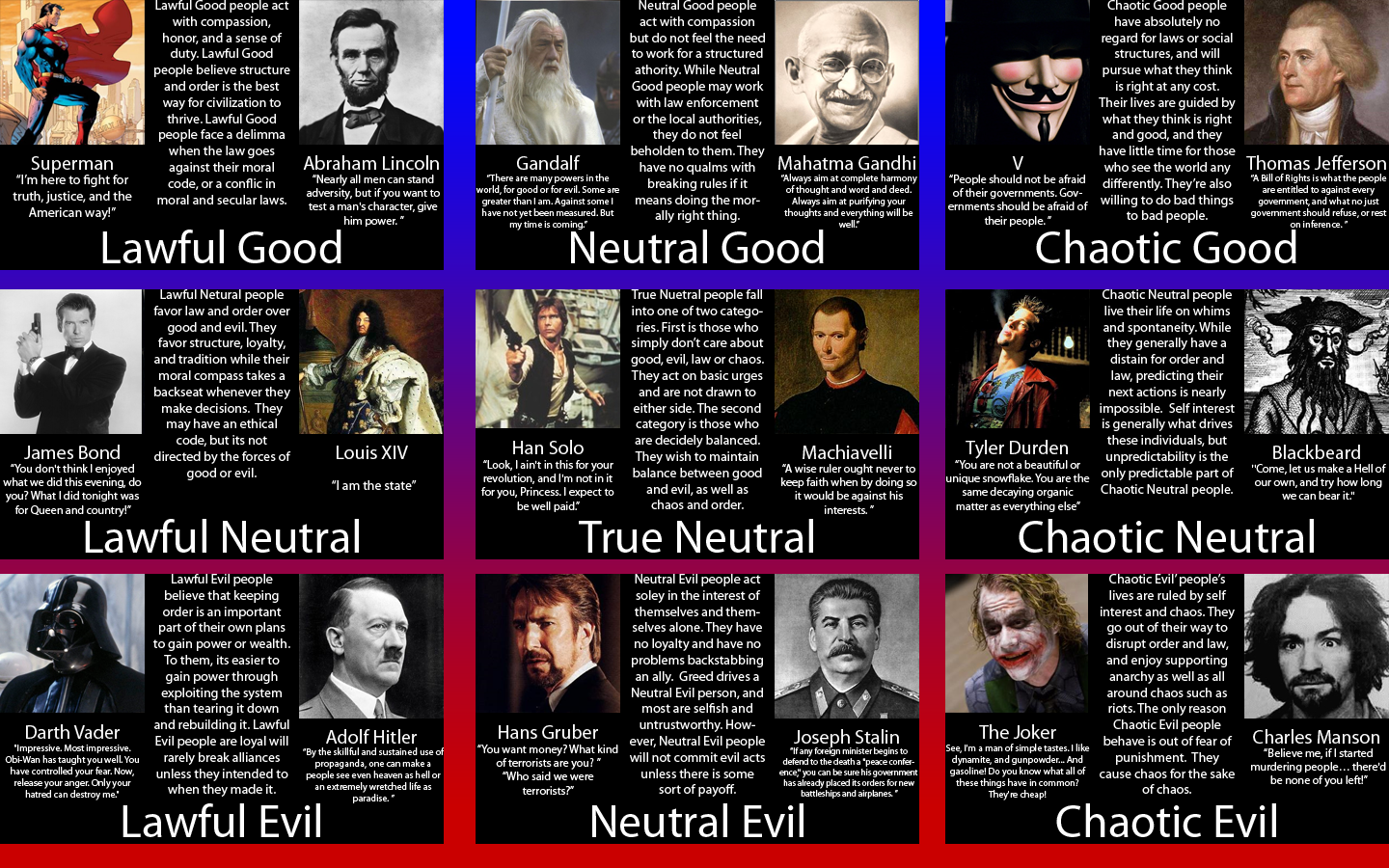

I like this image because it gives fictional examples as well as real life examples as it describes one of the nine basic alignments as seen through Dungeons and Dragons.  There are other ways of doing this, identifying character traits, beliefs, and motivations which ultimately lead to the character’s position on the “good vs. evil” spectrum.  You can even go so far as to tap into psychological theories like Bowen’s Family System’s Theory to understand the fictional people you’re creating or even the very real people in your life—not so that you can pigeon hole them but so that you know how to both approach them and protect yourself.  Basically, so you know to get along with them. 

I think the most important thing to remember, though, is that charts like this are objective.  Hitler wouldn’t describe himself as “evil.”  Gandhi wouldn’t describe himself as “good.”  These are external estimations applied to an individual.  Again, if you really want to understand a person’s morality, you need to talk to them and listen to their story. 

Here’s another way to look at it.  When you study ethics, you will learn that an individual who behaves in what appears to be the most unethical way may actually be a very ethical person.  Ethics is the branch of philosophy that involves systematizing, defending, and recommending concepts of right and wrong.  Going back to Hitler, most of the world would agree that he was immoral or even amoral, his actions unethical.  To Hitler, he had systematized and was obviously able to defend his beliefs and actions, thus creating them, in his mind and in the minds of his followers, as perfectly ethical.  It goes back to the same truth:  In order to understand a person, you have to hear their story.  We don’t do this anymore in our world.  It’s just easier to dismiss people with whom we disagree or who we need to be enemies as “evil.” 

And that brings me back to where I started.  Maybe by setting up my young adult fiction according to the simplified formula of “hero vs. anti-hero” I’m contributing to a mentality that is crippling our society.  It makes for nice, clean story telling that doesn’t drag out with loads of exposition to reveal internal dialogues and motives.  There’s a challenge here I need to explore more.  It’s something I’ve done in other writing but it is a more complex way of writing.

But maybe that’s the ultimate lesson in this.  Maybe I’m underestimating the intelligence of my readers. 

The bottom line is this:  It’s easy to say, particularly in our present election cycle, that this candidate or that party is the physical embodiment of evil.  I may not always agree with certain politicians, religious leaders, high profile actors, etc., but I don’t think any of them are “evil.”  I might think of them as uninformed and ignorant, their ideas and positions as aberrant and abhorrent, and their policies as regressive but I don’t think any of them are actually evil.  This means I have to take the time to understand them, why they say the things they say and why they do the things they do. 

I’m pretty sure I’m a better person for the effort.  

Share it forward!

Follow me on Twitter @TroyComets

Wednesday, March 16, 2016

Lessons Learned from Harry Potter

(This is part three of a blogging series.  Part One is herePart Two is here.  You don’t need to read the other two to make sense of this one but you’ll probably want to read them for your own benefit.)

I’m a huge fan of J.K. Rowling’s “Harry Potter” novels.  I know that they appeal to my inner child, who has always been fascinated with fantasy stories.  I also know that the adult in me enjoys the complexity and word plays that Rowling uses to craft her tale.  And, like everyone, there are characters in the world of Harry Potter that absolutely call to me, whose own story I find compelling in its own right.  These our favorites and each time we visit them in the pages of those seven books we grow closer to them, identify more with them, and love them more and more.

Who is my all-time favorite Harry Potter character?  I think my answer will surprise you.

Professor Severus Snape.

Now, I will admit that my choice might be affected slightly by the stellar performance of the late Alan Rickman, particularly in the last two movies in which, like the final book, we see at last who this character is and what made him be the character he was.  The theatrical influence of the films notwithstanding, however, Rowling created an epic character skillfully, an archetypical persona rarely seen in literature anymore. 

Before I continue I want to offer a short disclaimer.  I recognize that the books are called “Harry Potter and….” and not “Professor Snape and…”  What I mean by this is that the total complexity of the life of Severus Snape, as a supporting character, isn’t going to be fleshed out as fully as Harry’s or even the characters closest to the Harry-center.  Some of my observations could easily be made different if J.K. Rowling would have had the opportunity to introduce more of Snape’s history or internal dialogue.  But, like much in life, including those things in our own individual stories, this is what we are given and so we use our knowledge and experience to make sense of these things.

In a nutshell, this is what we know about Severus Snape.  His mother was a witch, his father was a muggle.  We assume at some point in his parents’ relationship there was affection but that had pretty much disappeared by the time we glimpse them through young Severus’ eyes.  As a boy he meets and develops a deep and abiding affection for Lilly Evans despite her sister, Petunia’s, best efforts to disrupt the friendship and keep Lilly for herself.  The two eventually are accepted to Hogwarts where you know their friendship had to have been tested beyond what we see in the pages of the book.  Goody-two-shoes Lilly Evans from brave Gryffindor friends with the slimy outsider from Slytherin?  As the two grow older they grow apart because they can’t escape the strength of their convictions.  Lilly eventually gives into the pursuits of James Potter and Severus finds himself in league with the Death-Eaters…all the while still pining in the privacy of his heart for Lilly.  When Severus learns that Voldermort was planning to kill the Potters, he seeks out Dumbledore.  Dumbledore intercedes but in so doing makes a deal with Snape.  I don’t know if Severus Snape ever understood his relationship with Dumbledore in these terms, but it seems clear to me that Snape becomes Dumbledore’s protégé. 

Of course by the time Harry comes along, all of Severus’ anger over James’ “theft” of Lilly’s affections are transferred to Harry, who resembles his father so much.  Except for the eyes, of course. 

Every decision Snape makes in his treatment of Harry is supposed to make the reader question Snape’s loyalty to Dumbledore, “the cause,” and even Harry himself.  It’s not until the end of the saga that we understand that the decisions Snape makes are actually in the best interest of Dumbledore, “the cause,” and even Harry himself. They were all decisions based on Snape’s own experience and understanding.  We occasionally hear Snape complaining to Dumbledore about Harry’s arrogance and lack of talent and ability, but we never hear Snape complain, through any of the books, about his own lot in life.  This is what makes Snape my favorite character.

Think about it.  Snape’s childhood sucked.  Snape’s only childhood friend not only turns away from him but falls into the arms of Snape’s worst childhood enemy.  This childhood friend turned romantic love is murdered by the guy who had lured Snape to a cause he thought was right and just.  As time unfolds Snape needs to learn to live with the consequences of his actions—not just Lilly’s death but all the pain he has caused.  He’s never allowed the recognition he deserves lest his entire cover be blown.  For seven years he is confronted by a student who reminds him not only of the chief tormentor of his childhood but also the only love he has ever experienced. 

And not once do we ever hear Snape complain.

Snape never launches into diatribes or soliloquys about the unfairness of life, how he tries and tries and never seems to succeed, how he’s somehow owed and yet always denied the things he believes he has earned.  The only time we hear Snape complain is one scene between himself and Dumbledore in which Snape is arguing with Dumbledore about having to do the things Dumbledore expects from him but we eventually discover that this has nothing to do with Snape’s role as a double agent or the teaching job he’s always wanted—it has to do with promising to be the one to kill Dumbledore when the time is right.

I don’t know about you but I am not so gracious when it comes to dealing with the frustrations life has to offer me.  I have often found myself reviewing the events of my life, the rises and more specifically the falls in my story, and I eventually find myself raging at the wind that blows ill in my direction and into my face.  “I’ve done everything right!  I’ve always done the best I know how to do for those I love and who love me!  I always try to be a good person, follow the rules!...”

“….why am I being punished?”

How many of us, if we don’t actually breathe life into those five words by speaking them, at least think them when we struggle with life’s challenges?

Why am I being punished?

It is in our human nature to ascribe motive to people in our lives.  Psychologist refer to it as “Attribution Theory.”  In a nutshell, if we do something bad it’s because of the circumstances that are foisted upon us.  If someone else does bad, or does bad toward us, it’s because they’re simply a bad person doing bad things from bad motivations.  You see the difference?  If do we bad, we scapegoat it out.  If others do bad, it’s because they’re rotten people. 

It’s how Harry and so many other characters become so dismissive of Severus Snape in the Harry Potter books.  Snape, in their eyes, is completely incapable of making a good decision while all of our heroes constantly struggle to do what is right.  Of course not one of these characters apart from Dumbledore actually takes the time to learn Snape’s story to understand why Snape does the things he does.  Only Dumbledore resists the temptation to dismiss Snape’s motivations as corrupt. 

This translates to the larger, intangible forces in life.  When it seems that there is no actual person behind our trouble and our misery, we ascribe this thing called “life” the same wicked motives we would ascribe someone who wronged us.  Life is unfair.  It is punishing us. 

This idea is sometimes translated into religious and spiritual teachings.  I can only speak within a Christian experience but this is just another ignorant and superstitious teaching perpetuated by the institutional church designed to keep the faithful in line.  God does not punish people.  People do enough punishing of people on their own without dragging God into it. 

We are driven to make sense of our lives, to interpret the good and especially the bad.  We do this by creating a narrative of our life, by telling our story.  We’re the main character, the hero, the protagonist.  We struggle and battle.  We win and celebrate.  We lose and wonder why.  We reach peaks and we fall into valleys.  If we can’t reason out logically the events that affect us, if we can’t access the thoughts and motives of the people whose own stories intersect ours, if it’s the amorphous, ambiguous, immeasurable thing we call “life,” we do what human beings have always done.  We ascribe it motive or place it within the purview of some divine force. 

Or maybe it just happens because life sucks.

Sometimes we get so focused on reasons and actors in the telling of our story that we forget that, even in the best stories, there are always “givens” that the reader has to accept to help the story move forward.  In life the biggest given is that life sometimes just sucks.  We aren’t being judged or punished.  We aren’t being tortured.  We are alive and if we are alive it means we have to accept the “givens” of this life. 

Life sometimes just sucks.

You see, sometimes getting caught in the narrative process, trying to divine the why’s and why not’s, we become stuck in the pain and misfortune.  The “suck” of life.  Here is the one thing I’ve learned about these “givens,” these things we accept that are without rules or rationale.  They are given to us to improve us.  Whether you want to call it luck or divine intervention or just the way it is, these tragedies, challenges, struggles come to everyone and how we deal with them will tell us how we move forward in our stories.  If we allow ourselves to be victimized by events outside of our control, to become trapped in wondering why we’re “being punished,” we miss the point. 

Maybe a better approach to these givens is not waste our time divining their origins but to remake them as characters.  They come into our lives as surely as love interests, friends, or workplace competitors.  They come to make us better.

What doesn’t kill us makes us stronger. 

Look at Snape.