Follow Me on Twitter!

Find me on twitter @TroyComets
Showing posts with label ethics. Show all posts

Tuesday, April 12, 2016

No Counseling for You!

I’ve written quite a bit about Minnesota nutcase and member of the State House of Representatives Glenn Gruenhagen.  Mr. Gruenhagen, who has opposed LGBT rights and equality since being elected in 2010, has recently introduced a bill which misuses and misinterprets the American Psychiatric Association’s (APA’s) Diagnostic and Statistical Manual (DSM-V) to draft a law referring to LGBT people as “mentally ill” and “in need of treatment.”

Today I read an article originally run in the Associated Press and picked up by LGBTQNation about a Tennessee bill giving counselors and therapeutic care givers the right to refuse service to LGBT individuals based on the provider’s religious beliefs.  The bill is on its way to the governor’s desk as we speak. 

You would think that the Republicans could be on the same page with their regressive tactics.  Are LGBT people “sick” and in need of “healing?”  Or should we just deny their humanity and hope they all succumb to depression and anxiety by refusing them treatment?

But, then again, logic isn’t really a character trait most people associate with fear mongering and Republican political tactics.

This is what I can tell you about this Tennessee bill that should encourage you.

First off, if you are a licensed professional counselor in the United States, you must abide by the American Counseling Association’s  (ACA’s) Code of Ethics.  This ethical code adopts that old medical mantra to do no harm.  This paper from 2012 summarizes this ethical mandate:

The ACA Code of Ethics clearly states that counselors encourage client growth and development in ways that foster the interest and welfare of clients, and that the primary responsibility of counselors is to respect the dignity and to promote the welfare of clients (ACA, 2005, p. 4). In fact, it is a fundamental assumption of the ACA Code of
Ethics, as well as other ethical codes within the mental health profession, to “avoid harm to clients . . .and to minimize or to remedy unavoidable or unanticipated harm” (p. 4). In other words, the needs of clients, not counselors, are the priority. Ethical codes and practice regulations exist to assure the welfare of clients, not accommodate the personal beliefs of providers. “Convictions of conscience” clauses imply that self-interest rather than devotion to client welfare can be the counselor’s priority.

The idea behind this, of course, is that simply refusing a client or patient based on an “ookiness” factor (the client is gay, the client is homeless and smells, the client drools when he talks, etc.) completely undermines the client’s dignity and more often than not compounds the very reason the client is seeking therapeutic services (addressing anxiety, identity, self-worth and self-concept, etc.). 

That being said, in order to appropriately treat a client or patient while understanding that a single individual cannot be all things to all people, the ACA Code of Ethics does provide a way out for providers who aren’t comfortable treating a client or patient for whatever reason.  Usually it’s invoked when the provider understands that the client’s needs lie outside of the provider’s capabilities.  In the scope of the current conversation it would amount to the provider doing the referral not because they find the LGBT client morally or religiously repugnant but rather because the provider does not feel competent to provide treatment.  The referral is always done respectfully, pointing to the fact that the current provider is not equipped to meet the client’s needs.  The responsibility, though, is for the current provider to facilitate the connection to the next, more qualified provider, so that the client is not left without care.

Leaving a client or patient without care, whether it’s a medical issue or a psychological issue, is not ethical no matter what your governing body is or what your professional organization’s code of ethics are.  “Do no harm” undergirds nearly all care giving vocations.

And, really, if you were an LGBT person, wouldn’t you want to be referred on to someone who’s more equipped to help you than to sit in an office with a closet homophobe who sees you as condemned because their interpretation of religious text declares you as “abomination?”  The point I’m driving at, however, is that the care provider has a professional responsibility to refer a client without any form of evaluative judgment on the client’s needs or condition that might affect the client’s well-being.

This Tennessee law defies this professional responsibility and gives homophobic individuals the power to do just that.  Imagine being the teenage child of a parent who has dragged you into counseling because you’re gay or lesbian.  You’ve (rightfully) dug in your heals and declared that this is who you are and there is no “cure” for it.  However your parent has brought you to the one therapist in town and, upon the initial consultation, the therapist pulls your parent into the room and says, “I can’t treat your child.  My religious convictions do not accept your child’s choice.” 

How many things can you count as wrong in that statement?  And yet you know it will happen because it does happen and has probably happened to you. 

We need to do better.

But here’s the thing.

For a party of “smaller government,” the Republicans have a habit of shoving their noses in where they don’t belong and then creating a bureaucracy to enforce their opinions.  As I’ve reminded you for the past few weeks it’s common for the Republicans to do this in an election year, to make something out of nothing in order to motivate their base.  There is no actual need for a law like this but what it does is gives the Republicans a talking point that can easily sidestep reason and abandon logic.  And, remember, this isn’t about the truth.  This is about creating truth by repeating a story often enough that people believe it’s truth. 

Though there isn’t an actual need for a law like this we can clearly see why the Republicans would endorse a law like this.  Or a law like the heinous bathroom laws.  Or any law that legalizes discrimination.  Such laws dehumanize people and, when it comes down to it, the Republicans work best when they have a group of people whose rights have been denied but continue to struggle for equality.  The Republicans have always and will always point to that struggle for equality and play on people’s fears with it.

The ACA’s Code of Ethics underscores the dignity and welfare of the individual.  This law and others like it, like one passed in Mississippi not too long ago, completely ignores and even reverses what years of professional research and observation have accomplished.  It’s another case of law makers, who don’t have a clue about what it is they’re actually talking about, pretending that they are doctors or teachers or scientists and know more than the entire profession they are trying to micromanage through the implementation of laws.  Laws, by the way, that are underwritten by special interest groups and financed by lobbyists.  It would be interesting to see what groups are backing this Tennessee law because, I guarantee, it’s not the ACA or any other credible professional organization. 

One last thing.  If you’re an LGBT teen in Tennessee or Mississippi or any of these other states in which politicians are literally playing games with people’s lives, including yours, and you’re not getting the help you need, please talk to someone safe.  I’ll leave contact info for The Trevor Project below.  I worry about all LGBT people facing such hateful resistance to common sense and decency, but I think LGBT teens are at a much higher risk and the world needs you.  Without you, how are we going to change the world?


866-488-7386

TrevorText -  Available on Thursdays and Fridays (4:00 p.m. - 8:00 p.m. ET / 1:00 p.m. - 5:00 p.m. PT). Text the word “Trevor” to 1-202-304-1200. Standard text messaging rates apply.


Monday, April 4, 2016

The Truth Behind Anti-LGBT Research

Last week I was introduced to MN State Representative Glenn Gruenhagen.  I immediately shared what I learned about Mr. Gruenhagen with all of you, paying particular attention to his anti-LGBT stance and his attempts at legalizing discrimination by pretending to care for the mental health of LGBT people through a misrepresentation of the Diagnostic and Statistical Manual (DSM). 

I have spent considerable time since researching Mr. Gruenhagen and his colleagues.  I’ve reviewed his website and have been in contact with a few media outlets who shared with me their experiences and findings with regard to Mr. Gruenhagen. 

Before I continue I want to point out the obvious.  I know the vast majority of my readers don’t live in Minnesota.  Heck, I know a lot of you don’t even live in the United States.  The reason why I’ve decided to devote attention to Mr. Gruenhagen’s attempts is because his tactics are universal.  Face it, a fear-monger only has one play:  Be afraid of those people.  The only thing that ever changes from fear-monger to fear-monger is who the those people are.   Mr. Gruenhagen has a few different those peoples to choose from; I’m simply going to focus on the LGBT community because of his recently introduced bill and the heinous actions of politicians in North Carolina.  This is becoming a theme again for this election cycle:  Be afraid of the gays because they’re going to corrupt you with their illness!

You would think that we could start moving past this considering recently court rulings but some people simply cannot abide progress or inevitable judgments that permit that progress. 

So according to Mr. Gruenhagen’s website, designed to get him elected every two years, there exist…

over 2500 studies in the social sciences that confirm the economic and social benefits of traditional marriage, for both men and women. Studies also confirm that children especially benefit in numerous ways when raised by a mom and dad.

It was a bibliography of these studies I had requested from Mr. Gruenhagen.  My request was ignored.  So, though I can’t speak directly to these individual studies, their methodologies and institutions of origin, I can speak to what I know and what I know is this:  Absolutely no legitimate institution of research or higher learning within the educated, academic psychological and psychiatric community within the United States (and perhaps the greater western world) would have published such a study within the past two decades for the simple reason that it defies the science behind identity and sexuality.  What this means is that, if these 2500+ studies Mr. Gruenhagen is talking about actually exist they were authored by pseudo-scientific organizations that are more religion than science, institutions like the Family Research Council.

The interesting thing about the Family Research Council, however, is that they actually don’t do any research.  If you review their list of so called experts you won’t find a single psychiatrist or psychologist in the bunch.  What you will find, however, is a bunch of marketing gurus and lawyers.  If you review their literature on topics like “marriage” and “sexuality,” you’ll find a few briefs that support their political position some policy publications promoting that position, and a number of op-eds advocating for that position.  There’s a gaping hole in the area of actually providing research that support their position and here’s why:

It doesn’t exist.

At least authentic, scientific research conducted morally, ethically, and appropriately away from underlying bias does exist.  It hasn’t existed since the 1970’s when the scientific community, namely the American Psychiatric Association (APA), removed homosexuality from the DSM in 1973.  In their determination the APA indicated that support for the traditional mentality that an LGBT sexuality was reflective of disorder, disturbance, or any similar pathology.  In short there is nothing to be addressed here; take your medieval ideas of prayer and healing elsewhere.  Science does not support it.

But as anyone with a Republican uncle knows after the topic of global climate change comes up at Thanksgiving Dinner, some people just can’t integrate actual science into their belief system.  Typically in such cases we see one of two reactions: 

1.     That’s just liberal nonsense trying to figure out how to run people’s lives and tax the bejesus out of them by using made up facts that happen to support the views of their campaign donors.
2.     But I read on the Family Research Council’s website and heard on Focus on the Family or saw on The Seven Hundred Club that that’s not even true.  It’s just part of the liberal gay agenda to let perverts near our children.

Reaction number one ignores scientific evidence.  Reaction number two counter scientific evidence with religious based pseudo-science. 

Why do you I say it’s religious based pseudo-science?  Look at the institutions that produce these so called studies.  How many of them are connected to current or former televangelists?  How many of them are connected to institutional denominations running ad campaigns in neighboring states to beat marriage equality? 

Here’s the other source for anti-LGBT propaganda:  Other scientific disciplines.   For example, two sociologists who have become champions of the conservative anti-LGBT campaign are Dr. Mark Regnerus, a sociologist from the University of Texas, Austin, and Father Donald Sullins, a Roman Catholic Priest and Sociology Professor at Catholic University of America in Washington, DC.

Just to be clear, let me offer simple definitions of the disciplines we’re discussing here.

Sociology is the study of social behavior or society, including its origins, development, organization, networks, and institutions. It is a social science that uses various methods of empirical investigation and critical analysis to develop a body of knowledge about social order, disorder, and change.

Psychology is the study of behavior and mind, embracing all aspects of human experience. It is an academic discipline and an applied science which seeks to understand individuals and groups by establishing general principles and researching specific cases.

Psychiatry is devoted to the diagnosis, prevention, study and treatment of mental disorders. These include various abnormalities that are affective, behavioral, cognitive and perceptual.

Do you see the difference here?  Whereas psychology and psychiatry focus on the inward processes of health and well-being and the behaviors that may stem from the internal, sociology focuses on the outward behaviors of society.  So when an individual looks at a sociology study that may seem to indicate that children in the home of two non-LGBT parents are more successful than children in the home of two LGBT parents, the factors that contribute to this success lie outside of the individual and within society itself.  We are no longer talking about mental health and identity.  We are now talking about the ability of an individual to matriculate into society without prejudice.  Contrary to the opinions of Dr. Regnerus and Father Sullins, there are far too many variables in such research to make conclusive arguments.  Which, of course, they should know since they are sociologists whose job is to remark on the behavior of society and not identify the development of individual identity and how to influence it. 

If sociology discovers that social behavior and society struggle with the integration of LGBT individuals with regard to respect and equality and even fundamental human rights, their discovery does not indicate something faulty or defective with the LGBT mind and/or development.  That is not their area of expertise.  If the psychiatric community, in 1973, determined there is nothing detrimental to the quality of life of an LGBT person when that LGBT person embraces their identity, a sociologist cannot come back, fifty years later, and declare that the whole field of psychiatry is wrong because our study of society shows society can’t deal with LGBT people.

It should be noted as well that these two scholars along with their work have been soundly criticized by their colleagues. 

So why am I sharing this with you?  I mean, it’s not like you’re ever going to have a conversation with that uncle at Thanksgiving Dinner and convince him that science is real and that there is a right way and a wrong way to do it.  Ours is not a society in which we have conversations that lead to change anymore.  Ours is a society in which we don’t have conversations, we no longer seek to learn as much as to teach, to be changed as much as to change. 

The first reason I share this with you is so that you know that when someone like Glenn Gruenhagen, an elected official of the State of Minnesota, stands up and tries to convince you of certain facts based on 2500+ studies that he’s apparently unwilling to share—you need to know where those facts came from and how they are interpreted.  People like Mr. Gruenhagen have anchored their arguments in a body of work but the body of work is as accurate and appropriate as the user’s manual from an old VHS player.  I could make a sound argument for forcing women into subservient roles, too, but it would mean taking the Bible out of context and relying on archaic research and cherry picked contemporary studies.  Not unlike Mr. Gruenhagen and his colleagues have done with LGBT equality. 

The second reason is more difficult than the first.  Armed with the knowledge that homophobes like Glenn Gruenhagen use bad science and no science to bolster their argument means that the people who fight for LGBT equality need to be equipped with actual facts and research for when they find themselves in a position to have legitimate conversation.  Google advocacy and support groups and learn truth to combat misinformation and ignorance.

The third reason is:  I don’t want you to feel bullied by law makers, teachers, or parents when they throw this pseudo-science at you while you struggle with your identify.  Do not let anyone ever tell you that because you identify as LGBT or question whether you identify as LGBT that you are somehow inferior or sick or that you need to change to integrate better with society.  You are a gift to this world—absolutely everything about you.  Don’t let others zero in on one thing that in the grand scheme of things is just one part of who you are and let them destroy you because of it. Again, the problem isn’t within you.  The problem is with how society might see you and that never going to change until society gets to know you.

Share it forward!

Follow me on Twitter @TroyComets


Life Lessons from Dungeons and Dragons

Last Friday I wrote about the challenge I have in writing LGBT antagonists.  On the one hand I said that I like to write fiction with which the readers can identify.  It’s unfortunately extremely easy for LGBT readers to identify with LGBT characters whose stories show a struggle with the “traditional” mentality of the non-LGBT majority.  IN my writing the LGBT character/community is the hero going up against institutionalized ignorance and homophobia in families, religious communities, schools, and politics.

On the other hand I confess that there is a danger in always setting up a story with this formula.  Even though I still believe that this particular formula makes it easy for LGBT people to see themselves in the story and identify with the characters because they share a common struggle, I also have to acknowledge that the world isn’t as black and white as we sometimes make it out to be.  Not all non-LGBT people and institutions are bad guys (obviously) and not all LGBT people are heroes. 

I’ve been chewing on this idea since I posted that 500 word essay last week.  I’ve come to the conclusion that, though I’m obviously well intentioned, I’m feeding the beast that is one of our society’s most challenging problems:  Oversimplification leading to polarization.

In Harry Potter and the Order of the Phoenix, Harry is complaining to Sirius Black about the new teacher, Professor Umbridge.  He clearly believes Umbridge could be a Death Eater, the bad guys who support He-Who-Must-Not-Be-Named.  In response Sirius observes, “…the world isn’t split into good people and Death Eaters.  We’ve all got both light and dark inside us.  What matters is the part we choose to act on.  That’s who we really are.”  I think this also becomes part of the answer to the recurring question of, “If all the bad guys come from Slytherin, why not just kick them out?”  Because it’s not that simple. Look at Snape, one of the best literary characters of all time. 

What stings a little as I come to terms with this oversight on my part is this.  You would think that someone with a background in counseling and psychology, who is a fierce advocate for the appreciation of any individual’s story rather than summarily dismissing or categorizing the individual based on my limited understanding of their story—you would think I would know better.  You would think that I would be more aware of the “shades of gray” when it comes to individual morality and personality types.  To truly understand an individual’s motivation we need to hear their story and, after hearing their story, we will very rarely ever find that the individual does what they do because they describe themselves as “evil.”

Here’s a great example.  Last night the season six finale of The Walking Dead aired and it shocked fans.  I mean, Alfred Hitchcock once said, “Always let your audience suffer as long as possible.”  Well, The Walking Dead takes Mr. Hitchcock’s advice to the next level.  Last night we were introduced to the new antagonist, a guy by the name of Negan, and by the end of the episode all we know is that Negan has killed one of our heroes.  We don’t know who.  All we know is that we now hate Negan. 

After new episodes of The Walking Dead, there’s always a show in which actors, creators, and fans sit down and process what they’ve just seen.  It really is a massive group therapy session.  Last night was the creator of the show, a producer, and the guy who plays Negan along with someone who might be our dead character (because we won’t know who died until the new season airs later this year).  As the audience in the studio and at home was processing the loss of a character and their hatred of Negan, I think it was the creator of the show that said, “Look, if we would have started from day one with Negan instead of Rick (our main hero) and followed his story instead of Rick’s story, you would understand Negan’s motivations better and sympathize with Negan and think it’s Rick who’s the out of control psychopath.”  This assessment was spot-on.  The audience’s estimation of the “evilness” of Negan rests solely on the fact that we know Rick’s story and not Negan’s.  Negan’s not “evil.”  Negan is trying his best to establish order in chaos.  And it’s obviously working because no one has taken him out yet.  You see?

In our post 9/11/01 world it’s a difficult truth to accept because we have been so conditioned by politicians and the media to paint with a broad brush when we use the word “terrorist.”  However, this is another perfect example of the fact that people are not motivated by “evil.”  One person’s terrorist is another person’s freedom fighter.  Over Easter weekend there was a terrorist attack in Pakistan.  It’s easy to dismiss the perpetrators of the act as “evil” but it doesn’t solve the problem.  I’m not an apologist for heinous activity, but I do know that if we took the time to understand why people keep blowing themselves up in their effort to blow up as many other people as possible, we’d be further along to ending this so-called war on terror.  Certainly much further than using “advanced interrogation techniques.” 

And the thing is, when it comes to my writing, I’ve written stuff that is more nuanced when it comes to morality and ethics.  I’ve just never done it my LGBT young adult stuff.  I suppose that’s because, going back to my first assertion, I want to write things that readers can easily see themselves in.  I’ve said it before:  I try to write the kind of story that I really wish I could have read when I was growing up. 

So, setting aside real life for a while (which is what writing is all about for me), let me briefly explain how I normally develop characters.

It’s a process, character development, and it’s usually never done.  I joked a few weeks ago that in my current book the characters weren’t cooperating.  Sometimes it’s like, “You think you know me?  Well, just because you’re the one at the computer coming up with this crap doesn’t mean you know what I’m going to say and do.”  And it’s true!  Sometimes I’ll be clipping along in a story and BAM!  I’m completely sidelined by a comment or a reaction from a character.  When I start the story I obviously sketch out histories and goals and motivations; these end up being parameters for the character.  For example, in These are the Days, Caleb is extremely motivated to be honest about everything.  It’s one of the things he values the most.  So when it comes to dating Tyler, who hasn’t come out yet and is actually “in a relationship” with one of Caleb’s female friends, it causes Caleb a considerable amount of stress.  It would never be in Caleb’s character to turn a blind eye to something he thought was deceitful.  Honesty is a boundary Caleb won’t cross.  So, I set the boundaries but as I get to know the characters in the first and second and all the way through to the final drafts, they characters themselves fill in the space between the boundaries.  It’s how I work.

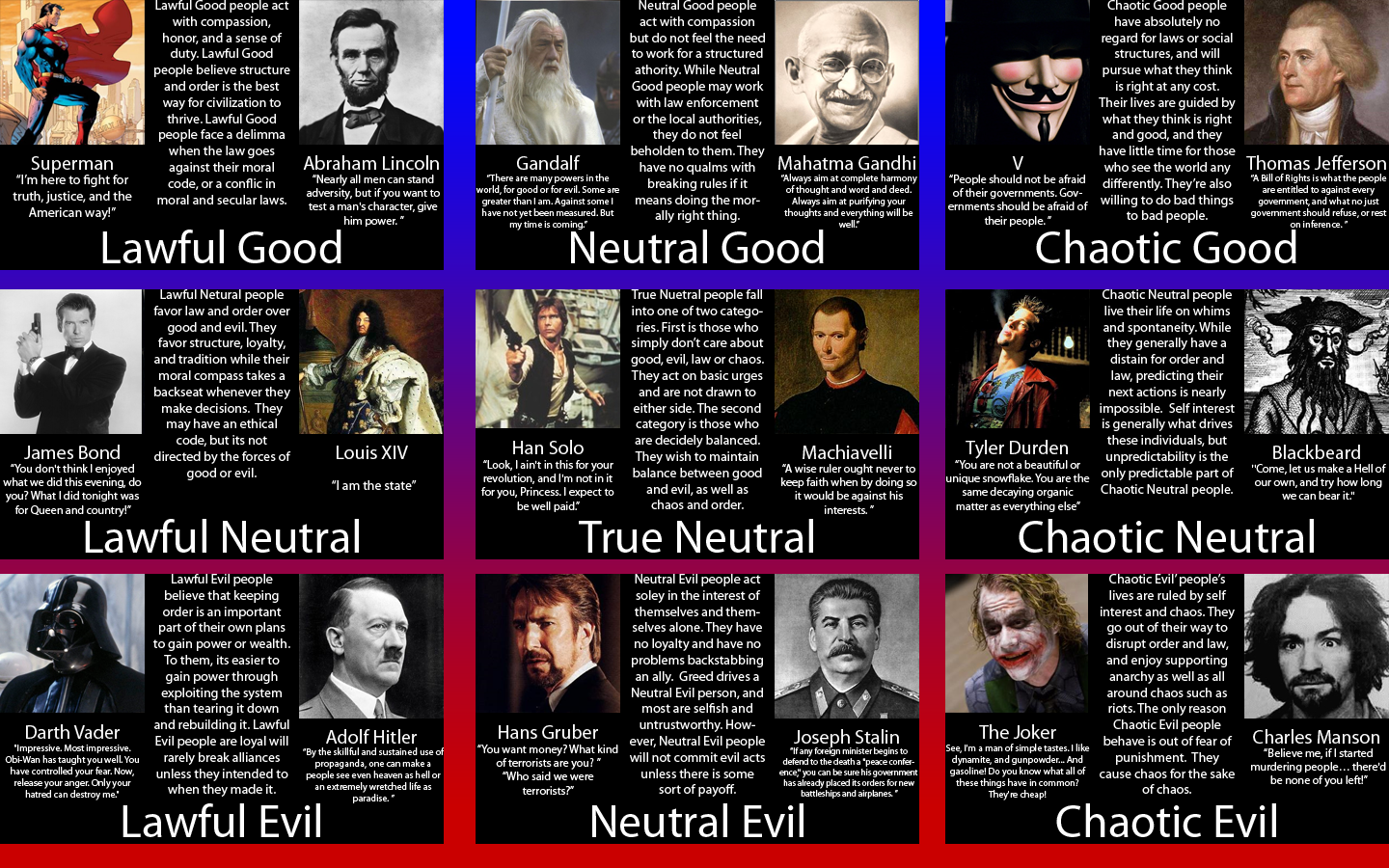
In planning those boundaries, I go back to something really simple.  It’s about the only thing I ever learned by heart from my attempts at playing Dungeons and Dragons.  Character alignment. 


I like this image because it gives fictional examples as well as real life examples as it describes one of the nine basic alignments as seen through Dungeons and Dragons.  There are other ways of doing this, identifying character traits, beliefs, and motivations which ultimately lead to the character’s position on the “good vs. evil” spectrum.  You can even go so far as to tap into psychological theories like Bowen’s Family System’s Theory to understand the fictional people you’re creating or even the very real people in your life—not so that you can pigeon hole them but so that you know how to both approach them and protect yourself.  Basically, so you know to get along with them. 

I think the most important thing to remember, though, is that charts like this are objective.  Hitler wouldn’t describe himself as “evil.”  Gandhi wouldn’t describe himself as “good.”  These are external estimations applied to an individual.  Again, if you really want to understand a person’s morality, you need to talk to them and listen to their story. 

Here’s another way to look at it.  When you study ethics, you will learn that an individual who behaves in what appears to be the most unethical way may actually be a very ethical person.  Ethics is the branch of philosophy that involves systematizing, defending, and recommending concepts of right and wrong.  Going back to Hitler, most of the world would agree that he was immoral or even amoral, his actions unethical.  To Hitler, he had systematized and was obviously able to defend his beliefs and actions, thus creating them, in his mind and in the minds of his followers, as perfectly ethical.  It goes back to the same truth:  In order to understand a person, you have to hear their story.  We don’t do this anymore in our world.  It’s just easier to dismiss people with whom we disagree or who we need to be enemies as “evil.” 

And that brings me back to where I started.  Maybe by setting up my young adult fiction according to the simplified formula of “hero vs. anti-hero” I’m contributing to a mentality that is crippling our society.  It makes for nice, clean story telling that doesn’t drag out with loads of exposition to reveal internal dialogues and motives.  There’s a challenge here I need to explore more.  It’s something I’ve done in other writing but it is a more complex way of writing.

But maybe that’s the ultimate lesson in this.  Maybe I’m underestimating the intelligence of my readers. 

The bottom line is this:  It’s easy to say, particularly in our present election cycle, that this candidate or that party is the physical embodiment of evil.  I may not always agree with certain politicians, religious leaders, high profile actors, etc., but I don’t think any of them are “evil.”  I might think of them as uninformed and ignorant, their ideas and positions as aberrant and abhorrent, and their policies as regressive but I don’t think any of them are actually evil.  This means I have to take the time to understand them, why they say the things they say and why they do the things they do. 

I’m pretty sure I’m a better person for the effort.  

Share it forward!

Follow me on Twitter @TroyComets